Free Fall Calculator
Calculate free fall time, impact velocity, and drop distance using standard gravitational acceleration.
Calculation Method (step by step)
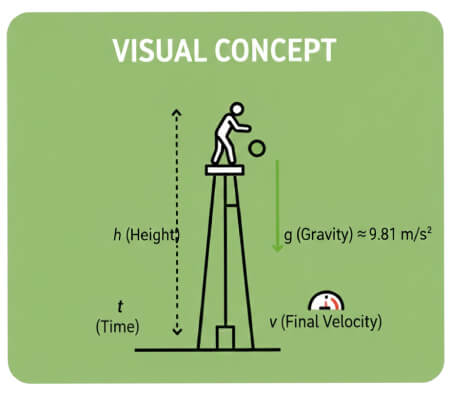
Assumptions: zero initial velocity, no air resistance. Kinematic equations used:
- h = ½ g t² — height / distance fallen
- v = g t — final velocity at impact
- t = √(2h / g) — time of fall
- h = v² / (2g) — height from velocity
- t = v / g — time from velocity
Acceleration due to gravity: g = 9.81 m/s²
Calculation Examples

How to Use the Free Fall Calculator
Select the parameter you want to find: fall duration \(t\), final impact velocity \(v\), or total displacement \(d\). Enter the known values into the remaining fields. For a standard drop from rest, set initial velocity \(v_0 = 0\).
Choose your unit system: metric (metres and seconds) or imperial (feet and seconds). The calculator applies the standard gravitational acceleration \(g = 9.80665\ \text{m/s}^2\) in metric mode and \(g \approx 32.174\ \text{ft/s}^2\) in imperial mode. Click Calculate and the result appears alongside the intermediate steps, which is useful for checking against manual working in physics coursework.
This tool models idealized free fall where air resistance is negligible. It is accurate for dense, compact objects over distances where drag effects are small relative to gravitational acceleration. For light or high-surface-area objects, or falls from very high altitude, terminal velocity effects become significant and are not captured by this model.
Mathematical Framework and Kinematic Equations
Free fall is uniformly accelerated rectilinear motion under a constant gravitational field. Starting from rest (\(v_0 = 0\)), three equations describe the motion completely:
\[\text{Displacement:} \quad d = \frac{1}{2}gt^2\]
\[\text{Final velocity from time:} \quad v = gt\]
\[\text{Final velocity from displacement:} \quad v = \sqrt{2gd}\]
These equations assume a uniform gravitational field and no aerodynamic drag, conditions that are satisfied in a vacuum and closely approximated for dense objects falling short distances in air. In a real atmosphere, drag force increases with the square of velocity. For a falling human, terminal velocity in a spread-eagle position is approximately 55 m/s (about 200 km/h); for a compact skydiver in a headfirst dive it can reach 90 m/s or more. These regimes require the full drag equation and are outside the scope of the kinematic model used here.
Useful Tips 💡
- Set initial velocity to zero for a true free fall scenario from rest; enter a non-zero value if the object is thrown downward.
- Keep units consistent across all input fields: mixing metres and feet within one calculation produces incorrect results.
📋Steps to Calculate
-
Select the unknown variable: fall time, impact velocity, or drop distance.
-
Enter the known values and set initial velocity to zero for a drop from rest.
-
Choose metric or imperial units and click Calculate.
Mistakes to Avoid ⚠️
- Confusing mass with weight: in a vacuum all objects fall at the same rate regardless of mass, because gravitational and inertial mass are equivalent.
- Applying these equations to objects with high surface-area-to-mass ratios such as paper or feathers, where air resistance dominates even over short distances.
- Using imprecise manual timing in experimental settings: a 0.1 s timing error at 3 s of fall introduces roughly a 6% error in calculated height.
- Applying these equations at speeds approaching a significant fraction of the speed of light or in non-uniform gravitational fields, where Newtonian mechanics is no longer valid.
Practical Applications📊
Estimate impact velocity and kinetic energy for structural safety and drop-test assessments.
Verify experimental free fall data against theoretical predictions in physics lab sessions.
Estimate the height of a structure or cliff from a measured drop time.