Work Calculator
Calculate work done in Joules using the force-displacement formula or the work-energy theorem.
Result
Calculation Examples

How to Use the Work Calculator
The calculator offers two methods depending on what values you have.
Method 1: Force and Displacement. Enter the force in Newtons, the displacement in metres, and the angle between the force vector and the direction of motion. Use this when a known constant force acts over a measured distance, such as pushing a crate across a floor or lifting a load with a crane.
Method 2: Work-Energy Theorem. Enter the object mass in kilograms and its initial and final velocities in metres per second. The calculator computes the net work as the change in kinetic energy. Use this when forces are variable or unknown but the velocity change is measurable, such as a braking car or a ball thrown against wind resistance.
All results are returned in Joules (J), the SI unit of energy. For both methods, use SI units throughout to avoid conversion errors.
The Work Formula in Physics: Understanding W = Fd cos theta
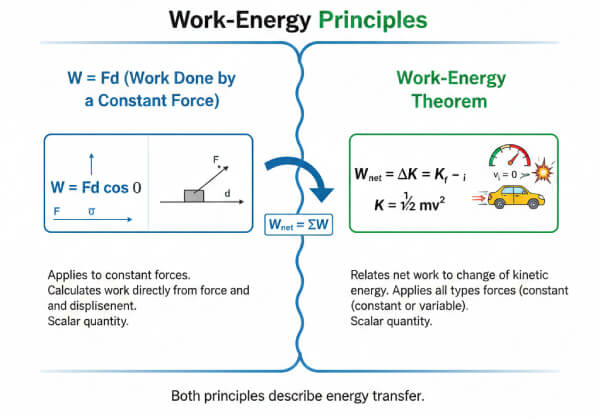
Work is done when a force causes displacement in its own direction. The standard formula is: \[W = F \cdot d \cdot \cos\theta\] where \(F\) is the force magnitude in Newtons, \(d\) is the displacement in metres, and \(\theta\) is the angle between the force vector and the displacement direction.
The cosine term is the critical factor. When force and displacement are parallel (\(\theta = 0°\)), \(\cos\theta = 1\) and all of the force contributes to work. When force is perpendicular to displacement (\(\theta = 90°\)), \(\cos\theta = 0\) and no work is done regardless of force magnitude: a shopping trolley pushed horizontally does zero work against gravity. When force opposes motion (\(\theta = 180°\)), work is negative, meaning the force removes energy from the system.
When multiple forces act simultaneously and the net effect is a velocity change, the work-energy theorem provides the total work directly: \[W_{net} = \Delta KE = \frac{1}{2}mv_f^2 - \frac{1}{2}mv_i^2\] A 1,000 kg car decelerating from 20 m/s to rest has \(W_{net} = \frac{1}{2}(1000)(0 - 400) = -200{,}000\ \text{J}\). The negative sign confirms that energy was removed from the system, in this case by braking friction.
Useful Tips 💡
- For work done by gravity on a falling object, the angle is 0° because gravity and displacement point in the same direction. For a rising object, use 180°.
- Positive work means energy is transferred into the object; negative work means energy is removed from it.
📋Steps to Calculate
-
Select the calculation method: Force and Displacement, or Work-Energy Theorem.
-
Enter force in Newtons, displacement in metres, and the angle in degrees; or enter mass and initial and final velocities.
-
Click Calculate to see the work done in Joules with the intermediate steps shown.
Mistakes to Avoid ⚠️
- Using mass instead of weight force in W = Fd: the force needed to lift a 10 kg object is 10 times 9.80665 N, not 10 N.
- Entering displacement in centimetres or feet while using force in Newtons, which produces a result in the wrong unit.
- Omitting the cosine correction when force and displacement are not parallel, which overestimates work by up to 100% at large angles.
- Forgetting to square the velocities when applying the work-energy theorem, which produces a result in the wrong unit and magnitude.
Practical Applications📊
Calculate the energy required to lift objects vertically, such as elevator loads or crane operations.
Find the work done by braking friction from a measured velocity change, without needing to know the friction force directly.
Apply the work formula to simple machines (ramps, pulleys, levers) to verify the principle of conservation of energy.