Potential Energy Calculator
Calculate gravitational potential energy in Joules using mass, height, and gravitational acceleration.
Calculation Examples

How to Use the Potential Energy Calculator
Enter the mass of the object in kilograms and the vertical height in metres above your chosen reference point. The reference point (zero level) is arbitrary but must stay consistent throughout the problem: the ground, a table surface, or the lowest point of the system are all valid choices.
The calculator pre-loads Earth's standard gravitational acceleration of \(g = 9.80665\ \text{m/s}^2\), but you can change this value for other bodies: the Moon (\(g \approx 1.62\ \text{m/s}^2\)), Mars (\(g \approx 3.71\ \text{m/s}^2\)), or any custom value for physics problems set on other planets. Click Calculate and the result appears in Joules, the SI unit of energy.
Understanding the Gravitational Potential Energy Formula
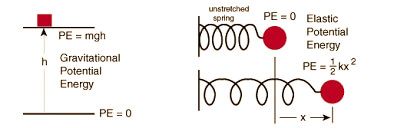
Gravitational potential energy (GPE) is the energy an object possesses by virtue of its position in a gravitational field. Near a planet's surface, where the gravitational field is approximately uniform, it is given by: \[E_p = m \cdot g \cdot h\] where \(m\) is mass in kilograms, \(g\) is gravitational acceleration in \(\text{m/s}^2\), and \(h\) is vertical height in metres above the reference level. The result is in Joules, since \(1\ \text{J} = 1\ \text{kg} \cdot \text{m}^2/\text{s}^2\).
The formula shows that GPE is directly proportional to all three variables: doubling the mass, doubling the height, or doubling \(g\) each doubles the stored energy. This linear relationship holds as long as the gravitational field is approximately uniform, which is an excellent approximation for heights small compared to the planet's radius. For Earth, this approximation remains valid to within 0.3% up to altitudes of about 10 km.
At very large distances from a planet, where the field is no longer uniform, the correct formula is the universal gravitational potential energy: \[U = -G\frac{m_1 m_2}{r}\] where \(G = 6.674 \times 10^{-11}\ \text{N}\cdot\text{m}^2/\text{kg}^2\) is the gravitational constant and \(r\) is the distance between centres of mass. The \(mgh\) formula is the linearized approximation of this expression near a surface.
Useful Tips 💡
- Define your reference level before measuring height and keep it fixed throughout the problem: changing reference points mid-calculation produces inconsistent results.
- Potential energy is a scalar quantity with no direction, so you do not need to worry about angle or orientation.
📋Steps to Calculate
-
Enter the object mass in kilograms.
-
Enter the vertical height in metres above your chosen reference level.
-
Adjust gravitational acceleration if needed (default is Earth standard at 9.80665 m/s squared).
-
Click Calculate to see the gravitational potential energy in Joules.
Mistakes to Avoid ⚠️
- Entering weight in Newtons instead of mass in kilograms: weight equals mass times g, and using weight as mass inflates the result by a factor of roughly 9.8.
- Mixing unit systems, for example entering height in feet while using the metric gravitational constant, which produces results off by a factor of about 3.28.
- Ignoring the reference level choice and assuming height is always measured from the ground, which produces errors in multi-step problems where the reference shifts.
- Applying the mgh formula to satellite orbits or interplanetary distances where the gravitational field is non-uniform and the universal formula is required instead.
Practical Applications📊
Calculate stored energy in hydroelectric dam reservoirs before conversion to electricity.
Analyze energy conservation in roller coaster design where GPE converts to kinetic energy.
Evaluate impact force and kinetic energy of falling objects in construction safety assessments.