Net Force Calculator
Find the magnitude and direction of the resultant force from any number of individual force vectors.
Resultant Force
Calculation Examples

How to Use the Net Force Calculator
Start by identifying all forces acting on the object, ideally by drawing a free body diagram (FBD) first. Enter the magnitude of each force in Newtons and its angle in degrees, measured counterclockwise from the positive x-axis: 0° points right, 90° points up, 180° points left, 270° points down.
Add as many force vectors as your problem requires. Once you click Calculate, the tool resolves each force into its horizontal and vertical components, sums them separately, and combines the totals using the Pythagorean theorem to produce the resultant magnitude and direction. The output includes the summed x-component, summed y-component, final net force in Newtons, and the resultant angle as a full 360° heading relative to the positive x-axis.
The Physics of Net Force: Equations and Definition
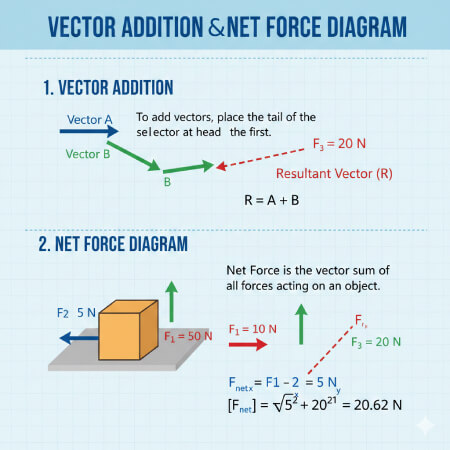
Net force is the single vector that represents the sum of all forces acting on a body simultaneously. By Newton's Second Law, \(\vec{F}_{net} = m\vec{a}\): if the net force is non-zero, the object accelerates in the direction of the resultant vector. If the net force is zero, the object is in equilibrium.
The calculation uses the vector component method in four steps:
1. Resolve each force into components: \(F_x = F\cos\theta\) and \(F_y = F\sin\theta\)
2. Sum all horizontal and vertical components separately: \(\sum F_x\) and \(\sum F_y\)
3. Find the resultant magnitude: \[F_{net} = \sqrt{(\sum F_x)^2 + (\sum F_y)^2}\]
4. Find the resultant direction: \[\theta = \arctan\!\left(\frac{\sum F_y}{\sum F_x}\right)\] using the four-quadrant arctangent (atan2) to get the correct heading.
Useful Tips 💡
- For forces pointing left use 180°, for forces pointing down use 270°, to stay consistent with the standard counterclockwise convention.
- Net force is a vector quantity: magnitude alone does not determine motion without knowing the direction.
📋Steps to Calculate
-
Draw a free body diagram to identify all forces acting on the object.
-
Enter the magnitude in Newtons and angle in degrees for each force vector.
-
Click Calculate to see the resultant magnitude, direction, and x/y components.
Mistakes to Avoid ⚠️
- Adding force magnitudes as scalars without resolving them into components first, which only works for collinear forces.
- Using the basic arctangent instead of the four-quadrant atan2 function, which places the resultant in the wrong quadrant for forces with negative components.
- Omitting friction or normal forces from the free body diagram before entering values.
- Mixing degrees and radians when manually checking trigonometric values against the calculator output.
Practical Applications📊
Determine acceleration in dynamics problems using \(a = F_{net} / m\) after finding the resultant force.
Structural engineering: verify that the net force at a bridge or building joint equals zero for static equilibrium.
Aerodynamics: sum lift, weight, thrust, and drag vectors to determine aircraft climb or descent performance.