Total Daily Energy Expenditure Calculator
Calculate your Total Daily Energy Expenditure (TDEE) - the total calories your body burns in 24 hours - using the Mifflin-St Jeor BMR equation multiplied by a Physical Activity Level (PAL) factor: TDEE = BMR x PAL. TDEE is your calorie maintenance level: the intake at which your weight remains stable, and the reference point for any weight management strategy.
Results will appear here
Calculation Examples

How to Use the TDEE Calculator
Enter your age, sex, weight, and height. Select your typical weekly activity level from the Physical Activity Level (PAL) options. The calculator first determines your Basal Metabolic Rate (BMR) using the Mifflin-St Jeor equation: Men: \(BMR = 10 \times \text{weight (kg)} + 6.25 \times \text{height (cm)} - 5 \times \text{age} + 5\); Women: \(BMR = 10 \times \text{weight (kg)} + 6.25 \times \text{height (cm)} - 5 \times \text{age} - 161\). This BMR is then multiplied by your PAL factor to produce your TDEE: \(TDEE = BMR \times \text{PAL}\).
If you know your body fat percentage, the Katch-McArdle method may be selected for a more accurate estimate in athletes: \(BMR = 370 + (21.6 \times \text{LBM kg})\), where LBM = body weight x (1 - body fat fraction).
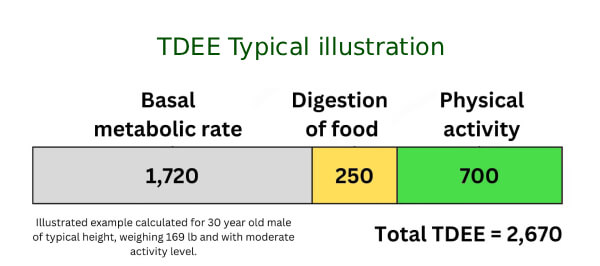
The TDEE Formula: BMR and Activity Multipliers
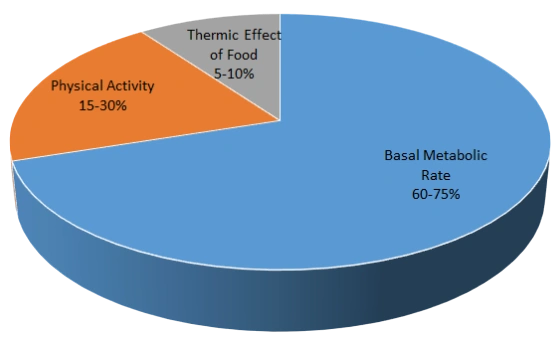
TDEE consists of four distinct components, each contributing a different proportion to your total daily energy budget: Basal Metabolic Rate (BMR) - approximately 60-70% of TDEE for sedentary individuals, representing energy used for vital organ function at rest; Thermic Effect of Food (TEF) - approximately 10% of total caloric intake, reflecting the energy cost of digesting and metabolizing food (protein has the highest TEF at ~25-30%, vs. ~3-8% for carbohydrates and fat); Non-Exercise Activity Thermogenesis (NEAT) - 15-30% depending on lifestyle, covering all incidental movement such as walking, standing, and fidgeting; and Exercise Activity Thermogenesis (EAT) - structured, intentional exercise, which adds 5-15% for most recreational exercisers.
The five validated PAL multipliers used to convert BMR to TDEE are: Sedentary (\(\times 1.2\)) - desk work, minimal movement; Lightly Active (\(\times 1.375\)) - light exercise 1-3 days/week; Moderately Active (\(\times 1.55\)) - exercise 3-5 days/week; Very Active (\(\times 1.725\)) - hard training 6-7 days/week; Extra Active (\(\times 1.9\)) - physical labor or twice-daily training. These multipliers are drawn from the FAO/WHO/UNU framework for physical activity classification.
Useful Tips 💡
- Error on the side of selecting a lower PAL multiplier when uncertain - overestimating activity inflates TDEE by 200-500 kcal/day, which converts a dietary deficit into a maintenance or surplus plan without the user realizing. Validate your actual maintenance level by tracking weight stability over 2 weeks at a specific intake.
- Recalculate TDEE whenever body weight changes by more than 3-5 kg. The Mifflin-St Jeor formula is weight-dependent: as weight decreases during a fat loss phase, both BMR and TDEE decrease proportionally, and a fixed calorie target will progressively shift from a deficit to closer to maintenance.
📋Steps to Calculate
-
Enter your age, sex, weight (kg or lbs), and height (cm or inches).
-
Select your Physical Activity Level: Sedentary (x1.2), Lightly Active (x1.375), Moderately Active (x1.55), Very Active (x1.725), or Extra Active (x1.9).
-
Optionally select the Katch-McArdle method and enter your body fat percentage for a lean-mass-adjusted BMR.
-
Click "Calculate" to view your TDEE and suggested calorie targets for weight loss, maintenance, or muscle gain.
Mistakes to Avoid ⚠️
- Overestimating activity level: a desk job plus a 1-hour gym session 3 times per week typically corresponds to Lightly Active (x1.375) or low Moderately Active (x1.55) - not Very Active. This error inflates TDEE by 200-350 kcal/day and can completely eliminate a planned deficit.
- Failing to account for NEAT reduction during a sustained calorie deficit. As the body adapts to energy restriction, unconscious movement decreases - a phenomenon supported by Rosenbaum et al. (*NEJM* 1995). This can reduce TDEE by 100-300 kcal/day independent of any change in structured exercise.
- Eating back exercise calories on top of a TDEE-based calorie target. If TDEE already includes your exercise (via the PAL multiplier), adding back workout calories creates a double-count and eliminates the intended deficit.
- Not recalculating TDEE after significant weight change: a person who loses 10 kg will have a TDEE approximately 100-200 kcal/day lower than at their original weight. Using an outdated TDEE figure means the "deficit" becomes progressively less effective over time.
Practical Applications📊
Establish your maintenance calorie level before creating a deficit (for fat loss) or surplus (for muscle gain). A deficit of 500 kcal below TDEE produces approximately 0.5 kg of fat loss per week - the rate recommended by the Academy of Nutrition and Dietetics for sustainable, muscle-preserving weight loss.
Use alongside our Calorie Calculator to align daily meal planning with your TDEE-based targets, including macronutrient distribution (protein: 1.6-2.2 g/kg bodyweight per ISSN Position Stand 2017).
Recalculate TDEE every 4-6 weeks during active weight loss or gain, since body weight changes alter both BMR and TDEE. A 5 kg reduction in weight typically decreases TDEE by 50-100 kcal/day, requiring a downward adjustment to maintain the same deficit.