Overweight Calculator
Enter your height and weight to find your BMI and see how your weight is classified against WHO thresholds.
Your BMI: →
Ponderal Index (PI):
Calculation Examples

How to Use the Overweight Calculator
Select your preferred unit system: metric (kg and cm) or imperial (lb and inches). Enter your current height and weight, then click Calculate.
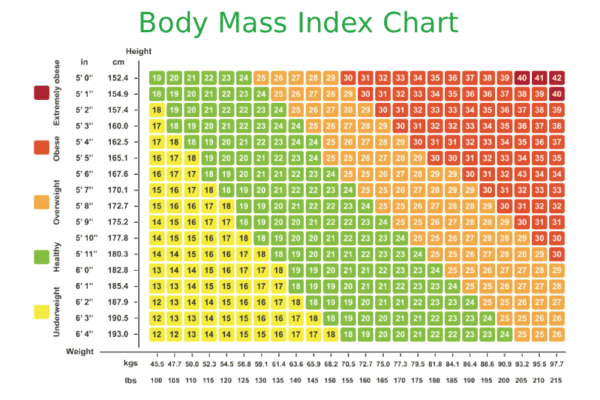
The result shows your Body Mass Index (BMI) alongside its WHO classification: Underweight (below 18.5), Normal weight (18.5-24.9), Overweight (25.0-29.9), or Obese (30.0 and above). You also see how many kilograms or pounds separate your current weight from the nearest healthy-range boundary, which gives the number a practical meaning beyond just a category label.
How the Overweight Check Is Calculated
The calculator uses the internationally standardized Body Mass Index formula: \[\text{BMI} = \frac{\text{weight (kg)}}{\text{height (m)}^2}\] When you enter imperial values, the calculator converts them automatically using \(1\ \text{lb} \approx 0.4536\ \text{kg}\) and \(1\ \text{inch} = 0.0254\ \text{m}\) before applying the formula.
The resulting BMI is compared against thresholds established by the World Health Organization in 1995 and reaffirmed in their 2000 technical report (WHO Technical Report Series 894). These thresholds apply to adults aged 18 and older and are used by health agencies in more than 190 countries as the standard first-line screening metric for weight-related health risk.
Useful Tips 💡
- Weigh yourself in the morning before eating, without shoes or heavy clothing, for the most consistent readings.
- Use the same conditions every time you measure so that changes in your BMI reflect real body composition shifts, not measurement variation.
📋Steps to Calculate
-
Select your unit system: kg/cm or lb/inches.
-
Enter your current weight and height.
-
Click Calculate to see your BMI score and WHO weight classification.
Mistakes to Avoid ⚠️
- Treating BMI as a complete health assessment for muscular individuals, athletes with high lean mass regularly score in the overweight range despite low body fat.
- Applying the standard 25.0 overweight threshold to people of Asian descent, WHO data supports a lower threshold of 23.0 for this population due to higher cardiometabolic risk at lower BMI.
- Measuring waist circumference at the wrong point, it should be taken at the midpoint between the lowest rib and the iliac crest, not at the navel.
- Dismissing a BMI in the 25-27 range as harmless, even mild overweight is associated with a statistically significant increase in type 2 diabetes risk according to data from the Nurses Health Study.
Practical Applications📊
Track weight progress during a fitness or dietary program with a consistent, repeatable metric.
Get a quick weight-status screening before a medical appointment to arrive with context.
Monitor long-term BMI trends over months or years to catch gradual drift toward higher-risk categories.