FFMI Calculator
Calculate your Fat-Free Mass Index and normalized score to assess lean muscle development relative to your height.
Calculation Examples

How to Use the FFMI Calculator
Enter your height, total body weight, and body fat percentage. For the most accurate result, use a body fat figure from a reliable measurement method: a DXA scan is the gold standard, skinfold calipers are a practical alternative, and the US Navy circumference method works well when equipment is unavailable. Visual estimates tend to be off by 3-5 percentage points, which meaningfully shifts the FFMI result.
The calculator returns four values: raw FFMI, Normalized FFMI (adjusted to a reference height of 1.8 m), total fat-free mass in kg, and your muscularity category. If your height differs significantly from 1.8 m, focus on the Normalized FFMI for comparison purposes, since the raw score tends to penalize tall athletes and favor shorter ones.
FFMI Science and Result Interpretation
The calculation follows three steps based on body composition research, including the methodology from Kouri et al. (1995).
First, fat mass is isolated: \[\text{Fat Mass} = \text{Weight} \times \frac{\text{Body Fat\%}}{100}\] Then fat-free mass (FFM) is calculated: \[\text{FFM} = \text{Weight} - \text{Fat Mass}\] Standard FFMI is then: \[\text{FFMI} = \frac{\text{FFM}}{\text{Height (m)}^2}\] Finally, the normalized score adjusts for height: \[\text{FFMI}_{\text{norm}} = \text{FFMI} + 6.1 \times (1.8 - \text{Height})\]
Reference ranges for men: below 18 (low), 18-20 (average), 20-22 (above average), 22-25 (excellent), 25-26 (superior). Values above 26 are rarely observed in drug-free athletes. For women: below 15 (low), 15-17 (average), 17-19 (athletic), 19-21.5 (superior).
Useful Tips 💡
- Use the same body fat measurement method every time you track progress, switching methods between measurements introduces systematic error.
- Take measurements in a fasted state in the morning, before training, for the most consistent baseline.
📋Steps to Calculate
-
Select your preferred units and enter your height accurately.
-
Enter your current total body weight and a verified body fat percentage.
-
Press Calculate to see your raw FFMI, Normalized FFMI, fat-free mass, and category.
Mistakes to Avoid ⚠️
- Using a visual body fat estimate, which is typically off by 3-5 percentage points and skews the FFMI result noticeably.
- Entering mismatched units, for example height in inches when the tool expects centimeters.
- Comparing your FFMI directly to elite athlete benchmarks without accounting for years of training experience.
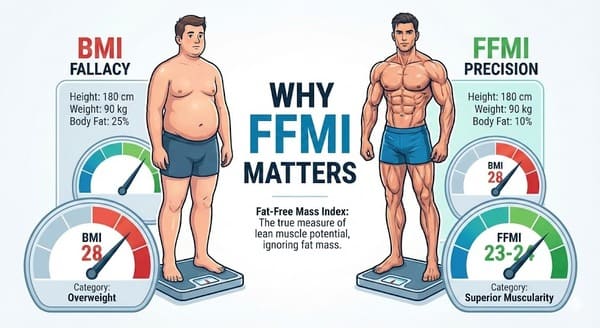
- Confusing FFMI with BMI: BMI does not distinguish between fat and muscle, so a muscular athlete can score "obese" on BMI while having an excellent FFMI.
Practical Applications📊
Track lean muscle growth during training blocks to confirm that weight gained is quality tissue, not fat.
Estimate your natural genetic ceiling for muscle mass to set realistic long-term training targets.
Adjust nutrition protocols based on changes in fat-free mass rather than total scale weight.
Benchmark your physique against drug-free athletic population data from peer-reviewed studies.