Body Fat Caliper Calculator
Estimate your body fat percentage using the skinfold caliper pinch test with validated clinical protocols.
Calculation Examples

How to Use the Body Fat Caliper Calculator
Before measuring, gather a skinfold caliper. Harpenden and Lange calipers are the clinical standard; budget plastic models with inconsistent spring tension introduce measurement error. Take all measurements on the right side of the body for consistency with the Jackson-Pollock normative data. Grasp each skinfold firmly between thumb and forefinger, pull it away from the underlying muscle, and apply the caliper jaws about 1 cm below your fingers, perpendicular to the fold. Hold the pinch while reading the dial; releasing before reading causes the fat to recoil and underestimates thickness. Take each site three times and enter the average.
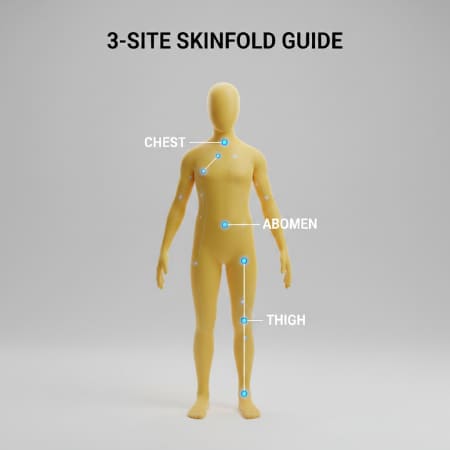
For the Jackson-Pollock 3-site protocol, men measure the chest, abdomen, and thigh; women measure the triceps, suprailiac, and thigh. If you choose the 7-site protocol, add the subscapular, midaxillary, and biceps sites. The Durnin-Womersley 4-site protocol uses the triceps, biceps, subscapular, and suprailiac. Enter the millimeter values into the corresponding fields, click Calculate, and the tool returns your body density and fat percentage alongside classification ranges by age and sex.
The Science of Skinfold Measurements
Body fat estimation from calipers is a two-step process. First, the sum of skinfolds in millimeters is entered into a regression equation to estimate body density. For the Jackson-Pollock 3-site method (men, chest, abdomen, thigh), the equation is: \[D_b = 1.10938 - (0.0008267 \times S) + (0.0000016 \times S^2) - (0.0002574 \times \text{age})\] where \(S\) is the sum of the three skinfolds in mm. The quadratic term accounts for the non-linear relationship between skinfold thickness and actual fat mass, and the age term reflects the well-documented shift of fat from subcutaneous to visceral depots with age.
Once body density is estimated, the Siri equation converts it to a fat percentage: \[BF\% = \left(\frac{4.95}{D_b} - 4.50\right) \times 100\] An alternative is the Brozek formula: \[BF\% = \left(\frac{4.57}{D_b} - 4.142\right) \times 100\] The two formulas produce slightly different results at higher body fat levels. The Siri equation is more widely used in research; the Brozek formula is considered slightly more accurate at body fat percentages above 30%.
When performed correctly with calibrated Harpenden or Lange calipers, the 3-site method correlates with hydrostatic weighing at r = 0.90 or above in trained technicians, with a standard error of estimate around 3.5 percentage points.
Useful Tips 💡
- Take measurements on dry skin without lotion, which causes the caliper to slip and underestimates thickness.
- Use the same person to take measurements at each session: inter-tester error on skinfolds can reach 3-5 mm, which meaningfully shifts the result.
📋Steps to Calculate
-
Enter your age and sex so the calculator applies the correct density coefficients.
-
Measure each skinfold site three times using a caliper and enter the average value in millimeters.
-
Select your protocol (3-site, 7-site, or Durnin-Womersley) and click Calculate.
Mistakes to Avoid ⚠️
- Using a low-cost plastic caliper with inconsistent spring tension, which produces readings that cannot be reliably compared across sessions.
- Measuring within 30 minutes of exercise, when hyperemia (increased blood flow to the skin) temporarily inflates skinfold thickness.
- Misidentifying anatomical landmarks, particularly the suprailiac (just above the iliac crest at the midaxillary line) and subscapular (45 degrees, 1-2 cm below the inferior angle of the scapula).
- Releasing the pinch before reading the caliper dial, which allows the tissue to recoil and underestimates true skinfold thickness.
Practical Applications📊
Track subcutaneous fat changes at specific body sites during a cutting or recomposition phase.
Evaluate body composition progress independently of scale weight, which conflates fat and muscle changes.
Establish a baseline for fitness assessments in athletic, clinical, or personal training settings.