Keto Calculator

Calculate your personalized keto macros and determine the precise carb limit to maintain ketosis and burn fat.

Your details and goal

Calculation Examples

Calculation Case Result
Female, 35y, Sedentary, Goal: Weight Loss 1350 kcal: 20g Net Carbs, 85g Protein, 103g Fat
Male, 28y, Active, Goal: Muscle Gain 2800 kcal: 45g Net Carbs, 180g Protein, 210g Fat
Female, 50y, Lightly Active, Goal: Maintenance 1600 kcal: 25g Net Carbs, 90g Protein, 125g Fat

How to Use the Keto Diet Calculator?

This keto calculator is designed to simplify the complexity of the ketogenic diet by providing a clear roadmap for your nutrition. To begin, enter your core metrics: age, gender, weight, and height. These factors are crucial because a keto weight loss calculator must first establish your baseline metabolic rate. Next, select your activity level and your specific goal, whether it is maintaining your current physique or achieving a caloric deficit for fat loss. The tool will instantly generate your personalized keto macros: the exact grams of fats, proteins, and carbohydrates you should consume daily.

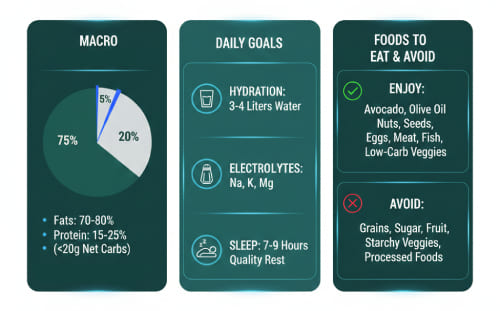
Success on keto depends on precision. Most users aim for a daily carb limit between 20g and 50g of net carbs to trigger ketosis, a metabolic state where your body burns fat for fuel instead of sugar. Our keto carb calculator breaks this down for you, showing not just the grams but also the percentage split (typically 70% fat, 25% protein, 5% carbs). We have also tuned the algorithm to account for gender differences, as the question of how many carbs per day on keto for a female often requires a slightly different approach due to hormonal sensitivities. By strictly following these calculated targets, you can avoid common pitfalls like the "keto flu" and ensure sustainable progress.

The Science Behind Keto Macros

Our keto diet calculator relies on the Mifflin-St Jeor equation, widely considered the most accurate formula for estimating Basal Metabolic Rate (BMR). It then applies a specific "keto multiplier" to adjust for the Thermic Effect of Food (TEF), as protein and fats digest differently than refined carbs. The core principle is the macronutrient ratio. Unlike standard diets, a ketogenic approach requires a drastic reduction in carbohydrates to deplete glycogen stores, forcing the liver to produce ketones.

For protein, we use a sliding scale based on your activity level, typically ranging from 1.2g to 1.7g per kilogram of lean body mass. This prevents muscle catabolism while you lose fat. The remaining caloric requirement is filled by healthy fats. This keto macro calculator dynamically adjusts these ratios based on your selected deficit (e.g., a 20% deficit is standard for sustainable weight loss). Understanding these numbers removes the guesswork, allowing you to focus on meal planning rather than complex mathematics.

Keto Macro Breakdown and daily goals

Useful Tips 💡

  • Focus on net carbs (Total Carbs minus Fiber) rather than total carbs.
  • Recalculate your macros every 5-10 lbs of weight loss to keep the data accurate.
  • Drink plenty of water and replenish electrolytes, especially in the first week.

📋Steps to Calculate

  1. Input your gender, age, height, and current weight.

  2. Select your activity level (sedentary to very active).

  3. Choose your goal (e.g., "Lose Weight" for a calorie deficit).

  4. Get your custom breakdown of Net Carbs, Protein, and Fat.

Mistakes to Avoid ⚠️

  1. Underestimating protein intake, leading to muscle loss instead of fat loss.
  2. Consuming too many "hidden carbs" in sauces and processed keto snacks.
  3. Fearing fat consumption; remember, fat is your new energy source.
  4. Not adjusting the calculator inputs as your body weight changes.

Practical Applications📊

  1. Determine your precise daily carb limit to stay in deep ketosis.

  2. Adjust your keto macros specifically for weight loss plateaus.

  3. Calculate nutrient needs for specific groups, such as keto for women or athletes.

  4. Plan meals using the exact grams of fat and protein provided by the tool.

Questions and Answers

What is a keto calculator and how does it work?

A Keto calculator is an essential digital tool designed to determine the precise distribution of macronutrients required to trigger ketosis. By analyzing your age, weight, height, and activity level, the keto diet calculator establishes a metabolic baseline. It then calculates the specific macronutrient ratio (typically high fat, moderate protein, and very low carbs) that forces your body to switch from burning glucose to burning fat for energy, which is the cornerstone of keto weight loss.

How many carbs a day on keto to stay in ketosis?

Most adults need to maintain a daily carb limit of 20 to 50 grams of net carbs to remain in ketosis. While the specific threshold varies by individual metabolic flexibility, staying under 20g of net carbs is the gold standard for beginners. Our keto carb calculator helps you find this "sweet spot" based on your activity levels, ensuring you don't accidentally consume too many hidden sugars that could stall your progress.

What formulas are used to calculate keto macros?

To ensure accuracy, our tool uses the Mifflin-St Jeor Equation to find your BMR, then adjusts it for your goal.
1. BMR: Men: '$BMR = 10 \cdot weight + 6.25 \cdot height - 5 \cdot age + 5$'; Women: '$BMR = 10 \cdot weight + 6.25 \cdot height - 5 \cdot age - 161$'.
2. TDEE: Calculated as '$TDEE = BMR \cdot ActivityFactor$'.
3. Macros: Protein is set at '$1.2g \text{--} 2.2g$' per kg of lean mass. Net carbs are capped at 20-50g. Fat is the remainder: '$Fat(g) = [TDEE \cdot Deficit - (Prot \cdot 4 + Carb \cdot 4)] / 9$'. This precise keto macro ratio ensures you burn fat while preserving muscle.

How many carbs per day on keto for a female?

When using a keto calculator for women, the recommended intake is usually 20–35 grams of net carbs daily. Women often have unique hormonal profiles that require a more nuanced approach to carbohydrate restriction. If you are highly active or during certain phases of the menstrual cycle, you may need to adjust these keto macros slightly. Our tool accounts for these gender-specific metabolic differences to provide a safe and effective weight loss path.

What are the best keto macros for weight loss?

For optimal keto weight loss, the most common ratio is 70% fat, 25% protein, and 5% net carbs. However, the exact grams depend on your calorie deficit. A 20% deficit is recommended for sustainable fat loss without muscle wasting. This keto macros calculator automatically applies this deficit to your TDEE, helping you reach your goals faster while ensuring you meet your protein targets to preserve lean muscle tissue.

Do I count total carbs or net carbs on keto?

You should always track net carbs because they are the only carbohydrates that significantly impact blood sugar and insulin levels. The formula is: '$Net \ Carbs = Total \ Carbs - Fiber - Sugar \ Alcohols$'. Since fiber is not digested by the body, it doesn't prevent ketosis. Most keto diet calculators and tracking apps focus on net carbs to allow for more nutrient-dense, high-fiber vegetables in your diet.

Why am I not losing weight on the ketogenic diet?

Stalling on keto is often caused by "carb creep" or overconsuming calories from high-fat "keto snacks." Even on a high-fat diet, a calorie surplus will prevent weight loss. Additionally, as you lose weight, your keto macros change. We recommend using the keto weight loss calculator every 5kg (10lbs) lost to adjust your targets. This ensures your macro ratio remains aligned with your new, lower body weight.
Disclaimer: This calculator is designed to provide helpful estimates for informational purposes. While we strive for accuracy, financial (or medical) results can vary based on local laws and individual circumstances. We recommend consulting with a professional advisor for critical decisions.