BMI Calculator
Calculate your Body Mass Index using the WHO formula: BMI = weight (kg) / height² (m²). Results are classified against the international WHO thresholds - Underweight, Normal weight, Overweight, and Obese - with notes on clinical limitations for athletes, older adults, and Asian populations.
Interpretation:
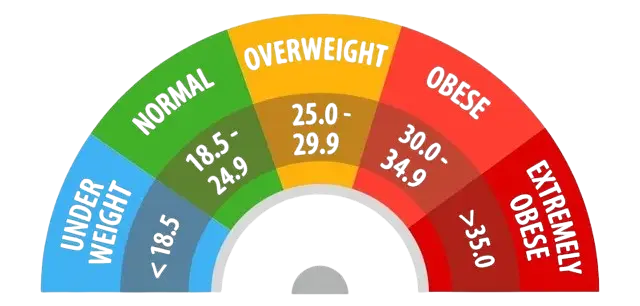
- Underweight: < 18.5
- Normal weight: 18.5 – 24.9
- Overweight: 25.0 – 29.9
- Obesity class I: 30.0 – 34.9
- Obesity class II: 35.0 – 39.9
- Obesity class III: ≥ 40.0
Important note: This calculator provides general estimates only. For accurate health assessment, please consult a qualified healthcare professional.
Calculation Examples

How to Use the BMI Calculator?
Enter your height and weight into their respective fields. Choose your units (kilograms or pounds for weight, meters or feet for height) and click "Calculate" to determine your BMI. The result displays your Body Mass Index value and the corresponding WHO weight classification: Underweight, Normal weight, Overweight, or Obese.
BMI is a validated population-level screening tool recommended by the World Health Organization for initial weight-related risk assessment. It is one of the most widely used clinical screening metrics in primary care settings globally, used alongside waist circumference and clinical history for a complete assessment.
Limitations of BMI
The Body Mass Index is a population-level screening indicator derived from height and weight. It does not measure body fat directly and has several well-documented clinical limitations. BMI cannot distinguish between fat mass and lean mass: a highly muscular athlete may register as "Overweight" at BMI 27 while carrying very low body fat, whereas an older adult with age-related muscle loss (sarcopenia, as defined by the European Working Group on Sarcopenia in Older People, EWGSOP) may have a "Normal" BMI of 22 while carrying an elevated proportion of adipose tissue.
Additionally, the standard adult WHO thresholds (overweight ≥25, obese ≥30) are not appropriate for children and adolescents - who require age- and sex-specific BMI-for-age percentiles - or for pregnant women. For Asian populations, research published in The Lancet (WHO Expert Consultation, 2004) demonstrated that metabolic risk, including Type 2 diabetes and cardiovascular disease, begins at lower BMI values, leading to recommended cut-offs of ≥23.0 for overweight and ≥27.5 for obesity in these populations. For a comprehensive health assessment, BMI should be interpreted alongside waist circumference and, where available, body fat percentage.
Useful Tips 💡
- For consistent tracking, measure weight and height under the same conditions each time - ideally in the morning before eating, without shoes, and in light clothing.
- If you are monitoring BMI over time, record your measurements in the same unit system (metric or imperial) to keep comparisons valid.
- BMI is a lagging indicator that changes slowly. For week-to-week health monitoring, focus on daily metrics such as caloric intake, activity level, and sleep quality rather than BMI alone.
📋Steps to Calculate
-
Enter your weight and height in the fields provided.
-
Select your preferred unit system: metric (kg/cm) or imperial (lbs/inches).
-
Click "Calculate" to view your BMI value and WHO weight classification.
Mistakes to Avoid ⚠️
- Mixing unit systems - for example, entering weight in kilograms but selecting the "pounds" option, which will produce a significantly incorrect result.
- Using BMI as the sole health metric for athletes or strength trainers, who often have elevated muscle mass that the formula cannot differentiate from fat mass.
- Applying the standard adult calculator to children under 18 (who require BMI-for-age percentile charts) or pregnant women (where normal weight gain affects the reading).
Practical Applications📊
Track your weight category over time as part of a personal health monitoring routine - checking every 3 to 6 months provides meaningful trend data without over-measurement.
Use BMI alongside our Calorie Calculator (TDEE) to establish a science-based caloric target for weight management.
If BMI places you near a category boundary or you have significant muscle mass, cross-reference with our Body Fat Calculator (US Navy Method) for a more accurate body composition picture.