Body Fat Percentage Calculator

Estimate body fat percentage using the US Navy circumference method developed by Hodgdon and Beckett (1984) - a validated, non-invasive technique with a reported margin of error of ±3% compared to hydrostatic weighing. Results are classified against ACE (American Council on Exercise) body composition ranges for men and women.

US Units
Metric Units

Body Fat: %

  • Body Fat (U.S. Navy Method) %
  • Body Fat Category
  • Body Fat Mass kg
  • Lean Body Mass kg
  • Ideal Body Fat (Jackson & Pollock) %
  • Body Fat to Lose kg
  • Body Fat (BMI method) %

Was this calculator helpful?

4.7/5 (17 votes)

Calculation Examples

Calculation Case Result
Male, Athlete (height 180 cm, neck 38 cm, waist 80 cm) ~10–12% body fat - Athletic range (ACE)
Female, Fitness (height 165 cm, neck 32 cm, waist 72 cm, hip 95 cm) ~22–24% body fat - Fitness range (ACE)
Male, Acceptable range target 18–24% body fat (ACE classification)
Female, Essential fat minimum 10–13% body fat - clinical minimum; below this level carries hormonal risk

How to Use the Body Fat Percentage Calculator

Enter your height, weight, neck circumference, and waist circumference. Women additionally enter hip circumference at the widest point. The calculator applies the US Navy body fat formulas: Men: $\%BF = \frac{495}{1.0324 - 0.19077 \times \log(\text{waist} - \text{neck}) + 0.15456 \times \log(\text{height})} - 450$; Women: $\%BF = \frac{495}{1.29579 - 0.35004 \times \log(\text{waist} + \text{hip} - \text{neck}) + 0.22100 \times \log(\text{height})} - 450$ (all measurements in centimetres). The result is compared against ACE body fat classification ranges to provide a health context for your estimate. Measurements should be taken in the morning before eating for best consistency.

Understanding Body Fat Ranges and Health Risks

Unlike BMI - which only uses height and weight and cannot distinguish muscle from fat - body fat percentage directly measures adipose tissue as a proportion of total body weight, providing a clinically more informative picture of metabolic health risk. The ACE (American Council on Exercise) body fat classification for men defines: Essential fat 2–5%, Athletes 6–13%, Fitness 14–17%, Acceptable 18–24%, Obese ≥25%. For women: Essential fat 10–13%, Athletes 14–20%, Fitness 21–24%, Acceptable 25–31%, Obese ≥32%. Visceral adipose tissue - fat stored around internal organs - is particularly associated with elevated risk for cardiovascular disease, Type 2 diabetes, and metabolic syndrome. A consistently elevated body fat percentage, especially above the "Acceptable" threshold, warrants consultation with a healthcare provider.

For the most precise clinical measurement, DEXA (Dual-Energy X-ray Absorptiometry) remains the gold standard, with a margin of error of approximately ±1–2%. The Navy method (±3%) provides an accessible, equipment-free alternative suitable for routine self-monitoring and progress tracking.
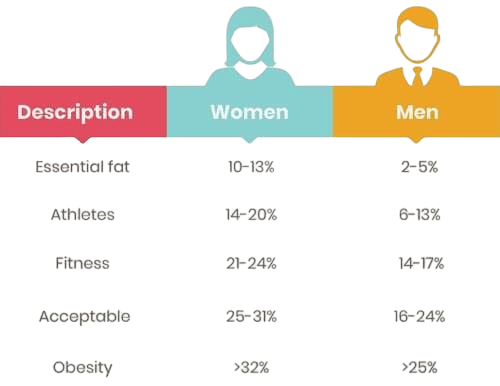
ACE Body Fat Percentage Classification chart for men and women

Useful Tips 💡

  • Take all measurements in the morning before eating or drinking, standing upright with relaxed posture - this produces the most consistent baseline for comparison across sessions.
  • Use a non-elastic cloth or flexible plastic tape measure; a fabric measure can stretch over time, introducing systematic error into trend data.
  • Re-measure every 4–6 weeks rather than weekly - body fat percentage changes slowly enough that weekly measurements often fall within measurement variability rather than reflecting true compositional change.

📋Steps to Calculate

  1. Enter your height and weight in your preferred units (metric or imperial).

  2. Measure and enter neck circumference (just below the larynx) and waist circumference (at the navel for men; at the narrowest point for women).

  3. Women: additionally enter hip circumference at the widest point of the buttocks.

  4. Select your sex and click "Calculate" to view your body fat percentage and ACE classification.

Mistakes to Avoid ⚠️

  1. Measuring at inconsistent anatomical points: waist circumference should be at the navel for men or the narrowest point for women - shifting even 2–3 cm vertically can change the result by 1–2 percentage points.
  2. Taking measurements immediately after exercise or a large meal, which temporarily increases circumference due to swelling and digestive volume.
  3. Treating the Navy method result as equivalent to DEXA accuracy. The Navy method has a reported ±3% margin of error vs. hydrostatic weighing - adequate for tracking directional change but not for precise clinical body composition assessment.
  4. Holding breath or flexing during waist measurement, which artificially reduces the reading by 2–5 cm and produces an underestimated body fat result.

Practical Applications📊

  1. Track body fat changes during a cutting or bulking phase - body fat percentage is more sensitive to body composition shifts than BMI and will reflect fat loss even when scale weight is stable (e.g., during simultaneous muscle gain).

  2. Use alongside the Calorie Calculator (TDEE) to set a calorie target informed by body composition rather than weight alone - if you know your lean mass, the Katch-McArdle formula provides a more accurate BMR than Mifflin-St Jeor.

  3. Set body fat milestones rather than weight milestones: reducing from 28% to 24% body fat in a 80 kg individual represents approximately 3.2 kg of fat lost while maintaining muscle - a more meaningful health target than "lose 5 kg".

Questions and Answers

What is body fat percentage and why is it more informative than BMI?

Body fat percentage expresses the proportion of total body weight that consists of adipose tissue. BMI (weight/height²) cannot distinguish between fat mass and lean mass - a muscular athlete and a sedentary individual with the same BMI may have very different body fat levels. Body fat percentage directly quantifies adipose tissue, making it a more clinically relevant indicator of metabolic health risk, particularly for individuals at the extremes of muscle mass (athletes, strength trainers) or who have experienced muscle loss with age (sarcopenia).

How accurate is the US Navy body fat formula?

The US Navy circumference method, developed by Hodgdon and Beckett (1984) at the Naval Health Research Center, estimates body fat percentage from neck, waist, and hip (women) circumferences. Validation studies report a margin of error of approximately ±3% compared to hydrostatic weighing (underwater weighing). DEXA (Dual-Energy X-ray Absorptiometry) is the most accurate clinical method (±1–2%) but requires specialized equipment. The Navy method offers an accessible, non-invasive alternative appropriate for routine progress tracking at home or in a gym setting, where DEXA-level precision is not required.

What is the difference between essential fat and storage fat?

Essential fat is the minimum amount of adipose tissue required for normal physiological function - including hormonal regulation, nerve insulation, organ protection, and reproductive health. For women, the essential fat minimum is approximately 10–13%; for men, 2–5% (ACE). Storage fat is accumulated adipose tissue in subcutaneous (under the skin) and visceral (around internal organs) depots. Visceral fat is metabolically active and is most strongly associated with cardiometabolic risk - elevated fasting glucose, dyslipidemia, and hypertension. Maintaining body fat above essential levels while keeping visceral fat within a healthy range is the practical goal of body composition management.

How do I take measurements for the most accurate result?

Use a non-elastic tape measure (cloth or flexible plastic). Measure the neck just below the larynx (Adam's apple), keeping the tape perpendicular to the long axis of the neck. Measure the waist at the navel for men, or at the narrowest point (typically 2–3 cm above the navel) for women. Women: measure the hips at the widest point of the buttocks. Take measurements in the morning before eating, standing upright, breathing normally (not holding a deep breath or fully exhaling). Repeat each measurement twice and use the average.

Why does the calculator require a neck measurement?

In the Navy formula, the neck circumference serves as a proxy for lean body mass and structural frame size. By incorporating the ratio between the neck (lean tissue indicator) and the waist (adiposity indicator), the formula can differentiate between individuals who have a large overall build and those with elevated abdominal adiposity. A person with a thick neck relative to their waist will produce a lower body fat estimate than someone with the same waist circumference but a smaller neck.

At what body fat percentage do health risks become clinically significant?

According to ACE classification, health risks become clinically significant when body fat exceeds the "Acceptable" range - above 24% for men or 31% for women. At these levels, risk for metabolic syndrome, Type 2 diabetes, and cardiovascular disease increases meaningfully. Conversely, body fat below essential levels - below ~5% in men or ~13% in women - is associated with hormonal disruption, reduced bone density, and impaired immune function. The clinically meaningful target for most non-athletes is maintaining body fat in the Acceptable range (men 18–24%, women 25–31%) or the Fitness range (men 14–17%, women 21–24%) for enhanced metabolic health markers.

Does body fat percentage change without a change in body weight?

Yes. Body recomposition - simultaneous fat loss and muscle gain - can change body fat percentage while total body weight remains stable. For example, gaining 2 kg of muscle while losing 2 kg of fat keeps weight constant but reduces body fat percentage from, say, 25% to ~22%. This is one reason body fat percentage is a more informative tracking metric than scale weight alone, particularly for individuals who train with resistance exercise while in a calorie-neutral or slight-deficit state.
Disclaimer: This calculator is designed to provide helpful estimates for informational purposes. While we strive for accuracy, financial (or medical) results can vary based on local laws and individual circumstances. We recommend consulting with a professional advisor for critical decisions.