Macro Calculator
Find your daily protein, carbohydrate, and fat targets based on your body metrics, activity level, and goal. Uses the Mifflin-St Jeor formula with weight-based nutrient scaling.
Estimate daily calories and macronutrients
Calculation Examples

How to Use the Macro Calculator
Enter your gender, age, height, current weight, and activity level, then select your goal: Cut (fat loss), Maintain, or Bulk (muscle gain). Click Calculate to see your daily calorie target and gram targets for protein, fat, and carbohydrates.
The calculator works in three stages. First, it computes your Basal Metabolic Rate (BMR) using the Mifflin-St Jeor equation. Second, it multiplies BMR by your activity factor to find your Total Daily Energy Expenditure (TDEE). Third, it applies a goal modifier: a 20% calorie deficit for cutting, a 10% surplus for bulking, or no change for maintenance, with a minimum floor of 1,200 kcal/day to protect metabolic health.
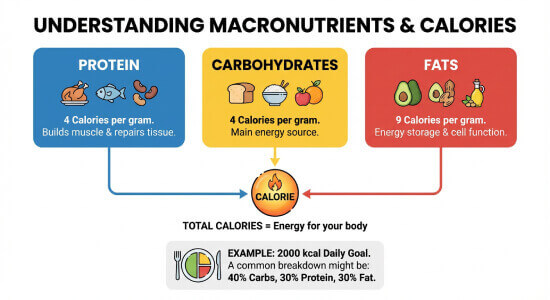
Unlike calculators that apply fixed percentage splits (e.g., "30% protein"), this tool scales nutrients directly to your body weight: 2.4 g of protein per kg for cutting, 2.0 g/kg for bulking, 1.8 g/kg for maintenance, and 0.9 g of fat per kg across all goals. The remaining calories after protein and fat are allocated to carbohydrates. Weight-based scaling reflects how protein needs relate to lean mass, not total calories — the method used by registered sports dietitians.
How Your Macros Are Calculated
The Mifflin-St Jeor equation, validated in a 2005 review by the Academy of Nutrition and Dietetics as the most accurate BMR formula for the general population, is the foundation of this calculator. The formulas are: \[\text{Men: } BMR = 10 \times W + 6.25 \times H - 5 \times A + 5\] \[\text{Women: } BMR = 10 \times W + 6.25 \times H - 5 \times A - 161\] where \(W\) is weight in kg, \(H\) is height in cm, and \(A\) is age in years. TDEE is then calculated by multiplying BMR by an activity factor ranging from 1.2 (sedentary) to 1.9 (super active).
The protein-first allocation approach is grounded in sports nutrition research. A 2017 meta-analysis by Morton et al. published in the British Journal of Sports Medicine found that protein intakes above 1.62 g/kg produced no additional muscle gain on average, but higher intakes during a caloric deficit (2.3–3.1 g/kg, per Helms et al., 2014) help preserve lean mass. This calculator uses 2.4 g/kg for cutting as a practical target within that range. The 0.9 g/kg fat floor supports testosterone production, fat-soluble vitamin absorption (A, D, E, K), and essential fatty acid requirements, consistent with ACSM dietary guidelines.
Useful Tips 💡
- Recalculate every time your weight changes by 2–3 kg. As body weight decreases during a cut, TDEE drops — eating the same calories as before will eventually stall fat loss.
- Hit your protein gram target first each day before worrying about fat and carbohydrate precision. Protein is the most metabolically important macro for both fat loss and muscle gain.
- Choose your activity level based on your total weekly movement, not just gym sessions. A person who trains 4 days per week but sits at a desk otherwise is typically "lightly active," not "very active."
📋Steps to Calculate
-
Enter your gender, age, height, and weight. Use kg and cm, or switch to lbs and inches.
-
Select your activity level based on your weekly exercise frequency, not your job activity alone.
-
Choose your goal: Cut, Maintain, or Bulk.
-
Click Calculate to see daily targets for calories, protein, fat, and carbohydrates.
Mistakes to Avoid ⚠️
- Selecting "Very Active" or "Super Active" when daily life is sedentary: overestimating activity inflates TDEE and creates a calorie surplus disguised as a maintenance or deficit target.
- Ignoring the 1,200 kcal/day minimum floor: cutting below this threshold risks nutrient deficiencies, muscle loss, and metabolic adaptation that slows future fat loss.
- Mixing unit systems: entering weight in pounds but height in centimeters, or vice versa, produces an incorrect BMR. Confirm both inputs use the same system before calculating.
- Tracking only calorie totals and ignoring gram targets: hitting 2,000 kcal from mostly fat and little protein produces a very different body composition outcome than 2,000 kcal distributed per the calculated macro split.
Applications of Macro Tracking📊
Fat loss (cut): Use the calculated protein target (2.4 g/kg) to preserve muscle during a caloric deficit and minimize the risk of metabolic adaptation.
Muscle gain (bulk): Identify the precise caloric surplus and carbohydrate target needed to fuel high-intensity training and support hypertrophy without excessive fat gain.
Maintenance and general health: Establish a stable daily intake that matches energy expenditure, supports hormonal function, and provides adequate micronutrient intake.
Diet planning: Use the gram targets as daily limits when logging food in apps like MyFitnessPal or Cronometer to replace guesswork with measurable nutritional structure.