Ponderal Index Calculator
Calculate your Ponderal Index (Rohrer's Index) for a more accurate leanness assessment than BMI, validated for adults and newborns.
Calculation Examples

How to Use This Ponderal Index Calculator
Start by selecting the correct demographic profile: Adult or Newborn. The physiological benchmarks and mathematical scaling differ fundamentally between these groups, and selecting the wrong mode will produce clinically meaningless results.
For adults, enter your weight in kilograms and height in meters (or use the Imperial toggle for pounds and feet/inches). For neonates, record weight in grams and crown-to-heel length in centimeters — precision here is critical, since the height value is cubed in the formula, meaning even a 1 cm error is amplified significantly. In clinical settings, use a calibrated medical scale and a rigid neonatal length board rather than a soft tape measure, which tends to underestimate length when infants flex their knees.
The calculator processes your inputs through the appropriate Rohrer's Index formula and instantly benchmarks the result against established clinical thresholds. For neonatologists and pediatric nurses, this output supports early identification of asymmetric Intrauterine Growth Restriction (IUGR). For adults, it provides a leanness metric that remains reliable across a wider height range than BMI.
Why the Ponderal Index Cubes the Height — The Science Explained
The Ponderal Index (PI) was developed by Swiss physician Fritz Rohrer in 1921 and is sometimes called Rohrer's Index or the Corpulence Index. Its core distinction from BMI is geometric: while BMI divides weight by height squared \((W / H^2)\), the PI divides weight by height cubed \((W / H^3)\). This difference is not arbitrary.
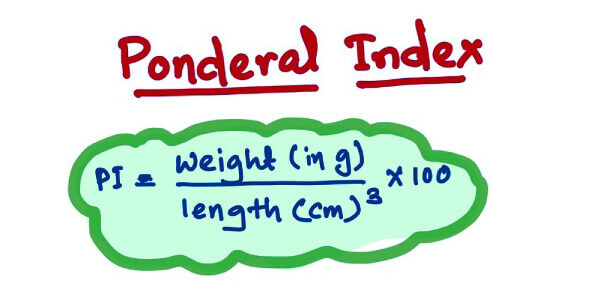
The human body is a three-dimensional object. As height increases linearly, body volume — and therefore body mass — scales cubically, not quadratically. Using the square of height (as BMI does) systematically overestimates body fat in tall individuals and underestimates it in short ones. The cube corrects for this, producing a more scale-invariant index. For adults, the standard PI formula is \(PI = Weight\,(kg) / Height\,(m)^3\), with a healthy range of approximately 11–15 \(kg/m^3\). For neonates, the formula adjusts for unit scale: \(PI = [Weight\,(g) / Length\,(cm)^3] \times 100\), with a normal healthy range of 2.2–3.0.
In neonatal medicine, the PI is a primary screening tool for asymmetric IUGR — a condition where placental insufficiency in the third trimester restricts fetal soft tissue and fat accumulation while skeletal growth continues relatively normally. A PI below 2.0 in a full-term newborn is a recognized clinical indicator warranting further assessment. This contrasts with symmetric IUGR, where both weight and length are proportionally reduced and the PI may appear normal.
Useful Tips 💡
- When measuring neonates, place the infant on a firm, flat length board with legs fully extended — soft tape around a flexed knee can underestimate length by 1–2 cm, which compounds significantly when cubed.
- Adults should measure height in the morning: spinal disc compression from daily activity can reduce standing height by up to 1–2 cm by evening, affecting the cubed denominator.
- Interpret PI alongside complementary metrics such as waist-to-hip ratio, skinfold thickness, or MUAC (mid-upper arm circumference) for a fuller picture of body composition.
📋Steps to Calculate
-
Select the Adult or Newborn profile to activate the correct physiological formula and reference ranges.
-
Enter weight and height (or length for neonates), confirming that your units are consistent throughout.
-
Read the calculated Ponderal Index and compare it against the clinical reference ranges displayed alongside the result.
Mistakes to Avoid ⚠️
- Using the Adult mode for a newborn (or vice versa), which produces a result in the wrong numerical range and against wrong reference thresholds.
- Estimating rather than measuring height precisely: because height is cubed, a 2 cm error in an adult at 1.80 m shifts the PI by approximately 0.4 units, which can move a result across a clinical boundary.
- Treating PI and BMI as interchangeable: they use different exponents, different formulas, and entirely different numerical ranges, so normal values are not comparable.
- Using the PI as a standalone diagnostic without clinical context — a neonatologist or physician must interpret any result alongside gestational age, birth history, and physical examination findings.
Clinical and Practical Applications📊
Screen newborns for asymmetric IUGR at birth: a Ponderal Index below 2.0 in a full-term neonate signals disproportionate wasting and warrants metabolic monitoring.
Assess leanness in adults whose height falls significantly outside the population mean (below 160 cm or above 190 cm), where BMI classifications lose reliability.
Monitor the effectiveness of nutritional interventions in neonatal intensive care by tracking PI changes during postnatal weight gain.
Use as a scale-invariant body composition metric in epidemiological research comparing populations with different height distributions.