ABSI Calculator
Measure abdominal obesity and premature mortality risk using your waist circumference, height, and weight.
Calculation Examples

How to Measure for the ABSI Calculator
ABSI is highly sensitive to waist circumference, so measurement technique matters more here than with BMI. Start by selecting your biological sex and entering your current age — the formula is validated for ages 2 to 85.
The most critical input is waist circumference (WC). For clinical consistency, measure at the midpoint between the lower margin of the last palpable rib and the top of the iliac crest — in practice, this is usually at the level of the navel. Stand with feet shoulder-width apart, relax your abdomen, and take the measurement at the end of a normal exhale. The tape should be snug against the skin but not compressing the soft tissue.
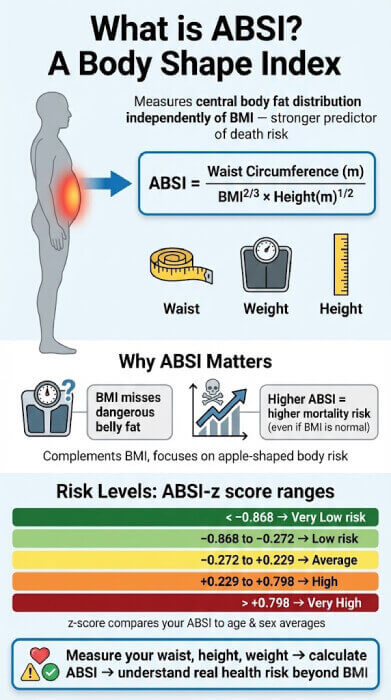
Enter your height and weight accurately alongside the waist measurement. The calculator uses all three values to determine the allometric relationship between your abdominal girth and total body size. The resulting Z-score compares your body shape against the NHANES (National Health and Nutrition Examination Survey) population dataset, placing your relative mortality risk on a scale from "Very Low" to "Very High" — a more nuanced health profile than any weight-based metric alone can provide.
ABSI Formula and Z-Score: How It Works
A Body Shape Index (ABSI) was developed by Dr. Nir Krakauer and Dr. Jesse Krakauer in 2012 to address the "obesity paradox" — the observation that some people with a high BMI show lower mortality rates than expected. ABSI resolves this by using allometric scaling to adjust waist circumference for both weight and height, making the index mathematically independent of BMI.
The formula is: \[ABSI = \frac{WC}{BMI^{2/3} \times Height^{1/2}}\] This ensures a person with a larger frame is not penalized unless their waist is disproportionately large for their size. To contextualize the raw ABSI value, the calculator derives a Z-score: \[Z = \frac{ABSI - ABSI_{mean}}{ABSI_{SD}}\] This Z-score expresses how many standard deviations your body shape deviates from the average person of the same age and sex in the NHANES reference population. A Z-score above 0.0 indicates higher-than-average risk; a score above 0.8 correlates with a meaningfully elevated standardized mortality ratio (SMR), associated with increased rates of cardiovascular disease and metabolic syndrome.
Useful Tips 💡
- Measure your waist in the morning before eating to avoid post-meal abdominal distension, which can inflate the reading by 1–3 cm.
- Use ABSI Z-score alongside BMI — the two metrics are most informative when interpreted together, not in isolation.
- Track your Z-score across months and years rather than weeks; body shape changes more slowly than total weight, and short-term fluctuations carry little signal.
📋Steps to Calculate
-
Enter your biological sex and age to load the correct NHANES population mean and standard deviation for your demographic.
-
Enter your weight, height, and waist circumference to establish the allometric baseline for the calculation.
-
Read the Z-score and risk category to understand where your body shape falls relative to your age- and sex-matched population.
Mistakes to Avoid ⚠️
- Measuring the waist at the narrowest point rather than at the level of the navel, which is the anatomical reference used in ABSI research.
- Pulling the tape too tight or holding your breath, which artificially lowers the waist reading and produces a falsely favorable Z-score.
- Looking only at the raw ABSI decimal and ignoring the Z-score; the raw value is meaningless without age- and sex-specific context.
- Treating ABSI as a body fat percentage tool — it measures proportional shape and mortality risk, not total fat mass.
Primary Diagnostic Applications📊
Identify elevated cardiovascular risk in patients with a normal or healthy BMI but high central adiposity (the "normal weight obesity" phenotype).
Supplement traditional clinical markers — blood pressure, fasting glucose, lipid panel — with a standardized body shape metric.
Provide a quantitative baseline for premature mortality prevention programs and long-term cardiometabolic monitoring.
Track body recomposition: when weight stays constant but waist circumference decreases, the ABSI Z-score captures the genuine reduction in risk.