Daily Fat Intake Calculator
Find your recommended daily fat intake in grams based on your calorie target and AMDR dietary guidelines.
Calculation Examples

How to Use the Daily Fat Intake Calculator
Enter your total daily calorie target into the input field. This number typically comes from a TDEE calculator that accounts for your Basal Metabolic Rate and activity level. Click Calculate and the tool applies the Acceptable Macronutrient Distribution Ranges (AMDR) to return your recommended fat intake as a gram range.
The result covers two figures: total daily fat and the recommended ceiling for saturated fat. The total fat range sits between 20% and 35% of your calories, following the AMDR established by the Institute of Medicine. The saturated fat cap reflects the American Heart Association guideline of staying below 10% of total calories, or below 6% for individuals managing elevated LDL cholesterol.
Fats serve functions beyond energy storage: they are required for hormone synthesis, myelin sheath maintenance in the nervous system, and absorption of fat-soluble vitamins A, D, E, and K. Knowing your gram targets makes reading nutrition labels and planning meals considerably more practical.
Understanding Dietary Fats and the Calculation Behind Them
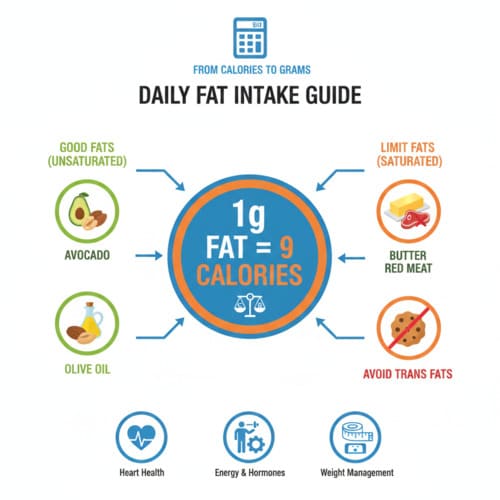
Fat contains 9 calories per gram, more than double the 4 calories per gram provided by protein or carbohydrate. The calculator uses this constant to convert your calorie-based percentage targets into grams: \[\text{Grams} = \frac{\text{Calories} \times \text{Percentage}}{9}\] For a 2,000-calorie diet at 20-35% fat, that produces a range of 44-78 grams per day.
Fat quality matters as much as quantity. Health guidelines group dietary fats into three categories. Unsaturated fats, found in olive oil, avocados, nuts, and fatty fish, are associated with reduced cardiovascular risk and should make up the bulk of your intake. Saturated fats, found in butter, full-fat dairy, and red meat, are linked to elevated LDL cholesterol at high intakes and are generally capped at under 10% of total calories by the WHO and AHA. Trans fats, primarily from partially hydrogenated oils in processed foods, raise LDL and lower HDL simultaneously and should be avoided entirely; the FDA effectively banned their use in the United States in 2018.
Useful Tips 💡
- Use a TDEE calculator first to establish an accurate calorie baseline before entering a number here.
- Prioritize whole-food fat sources such as olive oil, nuts, seeds, and fatty fish over refined vegetable oils.
📋Steps to Calculate
-
Enter your target or estimated total daily calorie intake.
-
Click Calculate to generate your personalized fat range.
-
Review the total fat range and the separate saturated fat ceiling.
Mistakes to Avoid ⚠️
- Confusing total fat with saturated fat: saturated fat is a subset of total fat, not a separate category alongside it.
- Choosing low-fat processed foods assuming they are healthier, many replace fat with added sugars that raise triglycerides.
- Overlooking hidden fats in restaurant meals, sauces, and dressings, which can add 20-40 grams invisibly.
- Applying the same fixed percentage to every person regardless of metabolic health, insulin sensitivity, or medical history.
Practical Applications📊
Calculate daily fat grams to hit specific macronutrient targets for body composition or athletic performance.
Monitor saturated fat intake against the AHA ceiling to support long-term cardiovascular health.
Adjust fat targets during a calorie deficit to maintain satiety while staying in a fat loss phase.