Calorie Deficit Calculator

Determine the calorie deficit required to reach your weight loss goals.

Calculation Examples

Calculation Case Result
Male, 35y, 85kg, 178cm, Active, Goal: 0.75kg/week Maintenance ≈ 2850 kcal, Deficit 750 kcal → Target ≈ 2100 kcal/day
Female, 28y, 68kg, 165cm, Lightly Active, Goal: 0.5kg/week Maintenance ≈ 2150 kcal, Deficit 500 kcal → Target ≈ 1650 kcal/day
Male, 42y, 95kg, 182cm, Sedentary, Goal: 1kg/week Maintenance ≈ 2600 kcal, Deficit 1000 kcal → Target ≈ 1600 kcal/day

How to Use the Calorie Deficit Calculator?

Working with this calorie deficit calculator begins by entering your core metrics: age, gender, current weight, height, and activity level. These variables allow the tool to estimate your Total Daily Energy Expenditure (TDEE), which is the total number of calories your body burns in a 24-hour period. Once your maintenance level is established, you specify your target weight loss rate. The calculator then determines the necessary reduction by subtracting the required deficit from your TDEE.

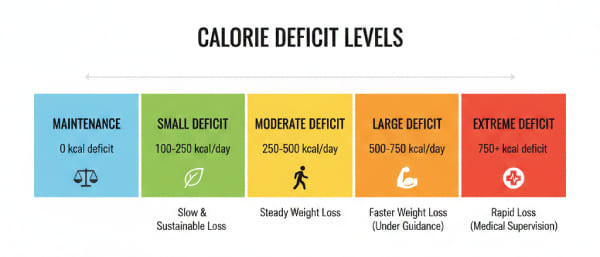
A sustainable strategy typically involves a moderate approach. For instance, creating a daily deficit of 500 calories theoretically leads to losing one pound of fat per week, based on the principle that one pound of body fat contains approximately 3,500 calories of stored energy. This tool provides these figures instantly, helping you visualize the gap between what you burn and what you consume. It is designed to offer a safe baseline that prevents the metabolic slowdown often associated with extreme "crash" dieting.

Clinical experts emphasize that a consistent calorie deficit is the primary driver of weight loss, as it forces the body to mobilize stored adipose tissue for fuel. However, the quality of your deficit is just as important as the quantity. By using a calculator to set realistic daily targets, you can avoid common pitfalls like muscle wasting or nutrient deficiencies. As your weight changes, your maintenance needs will also shift, making periodic recalculations essential for long-term success.

The Science Behind Deficit Calculations

The calculation process relies on the Mifflin-St Jeor Equation, currently considered the gold standard for estimating Basal Metabolic Rate (BMR) in healthy adults. This baseline is then adjusted using an activity multiplier, ranging from sedentary to extra active, to find your TDEE. The deficit itself is the final step, where a specific amount is subtracted to trigger weight loss without compromising essential physiological functions.

Safe caloric ranges are vital for preserving lean muscle mass and maintaining hormonal balance. While larger deficits might show faster results on the scale initially, they often lead to fatigue and increased hunger. Most health organizations recommend a deficit that does not push total intake below 1,200 calories for women or 1,500 calories for men, except under direct medical supervision. Regular monitoring and adjusting the deficit as you get closer to your goal weight ensures that your metabolism remains adaptive.

Calorie Deficit Levels Diagram

Useful Tips 💡

  • For the best results, recalculate your deficit every time you lose 5–7 kg (10–15 lbs).
  • Prioritize high-protein meals during a deficit to protect muscle tissue from breakdown.
  • Incorporate strength training to keep your BMR high while in a caloric deficit.

📋Steps to Calculate

  1. Input your age, gender, weight, height, and typical weekly activity level.

  2. Select your desired weight loss pace (e.g., 0.5 kg or 1 lb per week).

  3. Review your maintenance calories versus your new target daily intake.

Mistakes to Avoid ⚠️

  1. Overestimating physical activity, which leads to a smaller actual deficit than calculated.
  2. Setting an aggressive deficit (over 1000 calories) that triggers a "starvation response" and stalls progress.
  3. Relying solely on the calculator without tracking "hidden" calories in oils and beverages.
  4. Failing to account for metabolic adaptation as the body becomes smaller and requires less energy.

Practical Applications📊

  1. Establish a personalized caloric ceiling tailored to your unique metabolic rate.

  2. Bridge the gap between estimated energy needs and actual food intake for better accuracy.

  3. Monitor metabolic shifts by recalculating your deficit as your body composition improves.

  4. Align your physical activity with your nutritional intake to optimize fat oxidation.

Questions and Answers

What exactly defines a calorie deficit?

A calorie deficit is a state where the energy you consume through food and drink is lower than the energy your body expends to maintain itself and perform physical tasks. When this occurs, the body is forced to compensate for the energy gap by breaking down stored body fat, which results in weight loss over time.

How do I calculate the right calorie deficit for my body?

To calculate an effective deficit, you must first find your Total Daily Energy Expenditure (TDEE). This is done by calculating your Basal Metabolic Rate (BMR) and multiplying it by your activity factor. From this TDEE, you subtract a set number of calories, usually 500 for moderate loss or 750-1000 for more aggressive loss—to arrive at your daily target.

What is considered a "safe" daily calorie deficit?

For most individuals, a safe and sustainable deficit ranges from 500 to 750 calories per day. This typically results in a weight loss of 0.5 to 0.7 kg (1 to 1.5 lbs) per week. Deficits exceeding 1,000 calories can be physically stressful and may lead to muscle loss, hormonal imbalances, and significant decreases in bone density if maintained long-term.

Why am I not losing weight despite being in a calculated deficit?

This is often due to "metabolic adaptation" or inaccurate tracking. If you have been in a deficit for a long time, your body becomes more efficient and burns fewer calories. Additionally, many people underestimate their intake by 20-30% or overestimate their calories burned during exercise. Recalculating with our tool and using a food scale can help resolve this.

How many calories should I cut to lose 2 pounds per week?

Losing two pounds of fat per week generally requires a 1,000-calorie daily deficit, totaling 7,000 calories per week. While possible, this is considered the upper limit of safe weight loss and is usually recommended only for individuals with a higher starting weight or under the guidance of a nutritionist.

What formula does this calorie deficit calculator use?

Our tool utilizes the Mifflin-St Jeor equation, which is recognized by the Academy of Nutrition and Dietetics as the most accurate method for predicting energy expenditure. It integrates your BMR with the PAL (Physical Activity Level) multipliers to ensure the results align with clinical nutrition standards and NIH guidelines.

Can I lose weight without a calorie deficit?

Scientifically, no. While certain diets like Keto or Intermittent Fasting may help manage hunger or insulin levels, weight loss only occurs when there is an energy imbalance. These diets are simply different methods to help you achieve and maintain a calorie deficit more easily.
Disclaimer: This calculator is designed to provide helpful estimates for informational purposes. While we strive for accuracy, financial (or medical) results can vary based on local laws and individual circumstances. We recommend consulting with a professional advisor for critical decisions.