Mortgage Payment Calculator

Calculate your mortgage payments in seconds with our free online calculator.

US Dollars
Euros

Monthly Pay:

Mortgage Payment ()
Property Tax ()
Home Insurance ()
Other Costs ()
Total Out-of-Pocket ()
■ Principal & Interest ■ Property Taxes ■ Home Insurance ■ Other Cost
House Price
Loan Amount
Total of 360 Mortgage Payments
Total Interest
Mortgage Payoff Date
Latest Mortgage Rates: 30 Years: 6.578% | 15 Years: 5.882% | 10 Years: 5.764%

Was this calculator helpful?

4.9/5 (19 votes)

Calculation Examples

Calculation Case Result
$300,000 loan, 30 years, 6.5% annual rate Monthly P&I: 1,896.20 | Total interest: 382,633
$500,000 loan, 15 years, 5.5% annual rate Monthly P&I: 4,085.45 | Total interest: 235,381
$250,000 loan, 30 years, 7.0% annual rate (total interest) Total interest: 348,600 - more than the original principal
Extra 200/month on $300k loan at 6.5% (30yr) Loan paid off ~5 years early, saving ~65,000 in total interest

How to Use the Mortgage Calculator

Enter the loan amount (principal after down payment), annual interest rate, and loan term in years. The calculator converts the annual rate to a monthly rate (r = annual rate ÷ 12) and applies the fixed-rate annuity formula $$M = P \frac{r(1+r)^n}{(1+r)^n - 1}$$ to determine your monthly payment. The output includes your monthly principal and interest (P&I) payment, the total interest paid over the full loan term, and an amortization schedule showing how the interest-to-principal ratio shifts over time.

Note: this calculator computes principal and interest (P&I) only. Your actual total monthly housing payment (PITI) will also include property taxes, homeowners insurance, and potentially Private Mortgage Insurance (PMI) if your down payment is less than 20% of the home value.

Factors Affecting Mortgage Costs

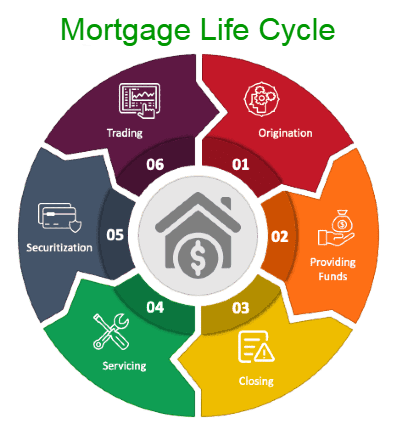
The total cost of a mortgage is determined by four primary variables: principal (loan amount = purchase price minus down payment), interest rate (the cost of borrowing, expressed as annual percentage), loan term (15, 20, or 30 years - longer terms reduce monthly payments but increase total interest paid), and loan type (fixed vs. adjustable rate). A higher down payment reduces the principal and may eliminate the PMI requirement. The relationship between rate and term is particularly significant: on a 300,000 loan, the difference between a 6% and a 7% annual rate over 30 years amounts to approximately $67,000 in total interest. A 15-year term vs. a 30-year term at the same rate cuts total interest roughly in half, at the cost of higher monthly payments.Mortgage amortization lifecycle: interest-heavy early payments shifting to principal-dominant later payments
Useful Tips 💡

  • Always compare mortgage offers using the APR (Annual Percentage Rate), not the base interest rate. APR incorporates origination fees, discount points, and other closing costs, making it the correct figure for apples-to-apples comparisons between lenders. Under CFPB Regulation Z (12 CFR Part 1026), lenders are required to disclose APR in all loan offers.
  • Request a Loan Estimate from each lender - this standardized 3-page document, required by CFPB Regulation Z, itemizes all fees and the APR, making direct comparison straightforward.

📋Steps to Calculate

  1. Enter the loan amount (home purchase price minus your down payment).

  2. Enter the annual interest rate and loan term in years.

  3. Optionally enter estimated annual property tax and homeowners insurance for a PITI estimate.

  4. Click "Calculate" to view your monthly P&I payment, amortization schedule, and total interest cost.

Mistakes to Avoid ⚠️

  1. Using the home purchase price as the loan principal without subtracting the down payment. The principal is the amount financed (purchase price minus down payment), not the total property value.
  2. Comparing loans using the nominal interest rate rather than APR. A loan with a lower interest rate but higher origination fees may cost more in total than one with a higher rate and no fees - APR combines both.
  3. Forgetting PITI components beyond P&I: property taxes, homeowners insurance, and PMI (required when down payment is below 20%) can add 300–800/month or more to total housing costs depending on location and loan size.
  4. Assuming a fixed-rate mortgage means all monthly costs are fixed. The principal and interest portion is fixed, but property tax assessments and insurance premiums change over time, meaning your total monthly payment can increase even with a fixed-rate loan.

Practical Applications📊

  1. Compare loan scenarios side by side - different terms (15 vs. 30 years) or rate offers - by calculating total interest paid for each. A lower monthly payment with a longer term often costs significantly more over the life of the loan.

  2. Use the amortization schedule to identify the optimal point for extra principal payments. Paying extra in the early years of the loan (when the interest portion of each payment is highest) produces the greatest reduction in total interest cost.

  3. Estimate your full PITI (Principal, Interest, Taxes, Insurance) by adding your estimated annual property tax and homeowners insurance to the P&I result - financial guidelines suggest total housing costs should not exceed 28% of gross monthly income (the CFPB-referenced front-end debt-to-income guideline).

Questions and Answers

What does a mortgage calculator compute?

A mortgage calculator applies the standard fixed-rate annuity formula - $M = P \frac{r(1+r)^n}{(1+r)^n - 1}$ - to determine the monthly principal and interest (P&I) payment for a fixed-rate loan. It also generates a full amortization schedule showing the interest and principal breakdown of each monthly payment, and calculates the total interest paid over the loan term. The calculator models P&I only; actual monthly housing costs (PITI) also include property taxes, homeowners insurance, and PMI where applicable.

How is the monthly mortgage payment calculated?

The monthly payment is derived from the fixed-rate annuity formula: $M = P \frac{r(1+r)^n}{(1+r)^n - 1}$, where P is the loan principal, r is the monthly interest rate (annual rate divided by 12), and n is the total number of monthly payments (loan term in years × 12). For a $300,000 loan at 6.5% annual interest over 30 years: r = 0.065/12 = 0.005417; n = 360; M = 300,000 × [0.005417 × (1.005417)³⁶⁰] / [(1.005417)³⁶⁰ − 1] = $1,896.20. This is the same calculation used in lender loan disclosure documents.

What is the difference between interest rate and APR?

The interest rate (also called the nominal rate or note rate) is the annual cost of borrowing the principal, expressed as a percentage, without accounting for fees and closing costs. APR (Annual Percentage Rate) incorporates the interest rate plus origination fees, discount points, mortgage broker fees, and other closing costs, expressing the true annual cost of the loan as a single comparable figure. Under CFPB Regulation Z (12 CFR Part 1026), US lenders are required to disclose APR in all loan offers. When comparing mortgage offers from different lenders, always compare APR rather than the base interest rate to make an accurate assessment of total loan cost.

What is PMI and when is it required?

Private Mortgage Insurance (PMI) is typically required by lenders when the borrower's down payment is less than 20% of the home's purchase price - that is, when the loan-to-value (LTV) ratio exceeds 80%. PMI protects the lender (not the borrower) in the event of default. Premiums typically range from 0.5% to 1.5% of the loan amount annually, added to the monthly payment. Under the Homeowners Protection Act (HPA, 12 U.S.C. § 4901 et seq.), borrowers have the right to request PMI cancellation once the LTV ratio reaches 80% based on the original home value.

Can I calculate a mortgage with taxes and insurance included?

The calculator generates your monthly principal and interest (P&I) payment from the annuity formula. To estimate your full PITI (Principal, Interest, Taxes, Insurance), add your estimated monthly property tax and annual homeowners insurance premium divided by 12. Property tax rates vary by municipality - the national median is approximately 1.1% of assessed value annually (Tax Foundation data). Homeowners insurance typically adds $100–$200/month depending on coverage level and location. For a comprehensive PITI estimate, input these figures in the optional fields provided.

How do extra principal payments affect the mortgage?

Any payment applied directly to the loan principal reduces the outstanding balance on which future interest is calculated, producing a compounding savings effect across the remaining term. On a $300,000 loan at 6.5% over 30 years, an additional $200/month in principal payments reduces the loan term by approximately 5 years and saves approximately $65,000 in total interest. The savings are largest when extra payments are made early in the loan term, when the interest component of each scheduled payment is highest. The full amortization schedule generated by this calculator shows the exact remaining balance at each point, enabling precise modeling of lump-sum or recurring extra payments.

What percentage of income should go toward a mortgage payment?

Traditional mortgage underwriting guidelines - referenced by the CFPB and used by FHA and Fannie Mae - recommend that total monthly housing costs (PITI) should not exceed 28% of gross monthly income (the front-end DTI ratio). Total debt obligations including the mortgage, car loans, student loans, and credit cards should generally not exceed 36–43% of gross income (the back-end DTI ratio). These are guidelines for qualification, not prescriptions - actual affordability depends on local costs of living, career stability, emergency reserves, and individual financial goals.
Disclaimer: This calculator is designed to provide helpful estimates for informational purposes. While we strive for accuracy, financial (or medical) results can vary based on local laws and individual circumstances. We recommend consulting with a professional advisor for critical decisions.