Tip Calculator

Calculate Tip Amount and Split the Bill Instantly

Was this calculator helpful?

4.7/5 (19 votes)

Calculation Examples

Calculation Case Result
$65.50 bill at 18% tip Tip: $11.79 / Total: $77.29
$120 bill split by 4 people at 20% tip $36.00 per person
15% standard gratuity on $40 bill Tip: $6.00 / Total: $46.00

How to Use the Tip Calculator

Enter the total bill amount (the pre-tax subtotal for the most accurate result), then select or enter the tip percentage. Standard ranges are 15% for adequate service, 18% for good service, and 20% or more for exceptional service in the US. If splitting the bill, enter the number of people in the group.

Click "Calculate" to see the tip amount, the total bill including tip, and the per-person share. The tool is designed for quick decisions at restaurants, bars, hotels, taxi rides, and any other service context where gratuity is customary.

How Are Tip Calculations Performed?

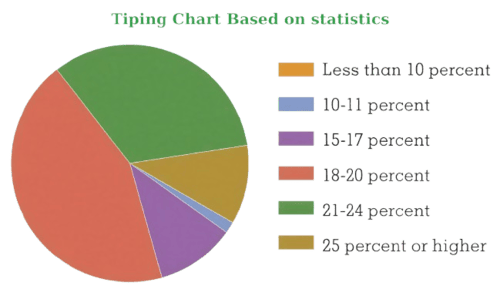
The calculator applies the standard gratuity formula: $$\text{Tip Amount} = \text{Bill Amount} \times \left(\frac{\text{Tip Percentage}}{100}\right)$$ For example, a 15% tip on a $50 bill equals $50 times 0.15 equals $7.50, giving a total of $57.50. When splitting between multiple people, the combined total (bill plus tip) is divided equally: $$\text{Per Person} = \frac{\text{Bill} + \text{Tip}}{n}$$ For a $57.50 total split between 2 people, each person pays $28.75. Note that tip is conventionally calculated on the pre-tax subtotal, not on the tax-inclusive total, though practice varies by establishment and country.Tipping Percentage Chart by Service Type and Country
Useful Tips 💡

  • In most US contexts, tip is calculated on the pre-tax subtotal rather than the tax-inclusive total. On a $100 subtotal with $10 tax, tipping 20% on $100 gives $20, while tipping on $110 gives $22. The convention varies by restaurant.
  • For a quick mental estimate, calculate 10% of the bill (move the decimal one place left), then add half of that for 15%, or double it for 20%.

📋Steps to Calculate

  1. Enter the total bill amount (ideally the pre-tax subtotal).

  2. Enter the tip percentage or select a standard rate (15%, 18%, or 20%).

  3. Enter the number of people splitting the bill, then click "Calculate" to see the tip, total, and per-person amount.

Mistakes to Avoid ⚠️

  1. Calculating tip on the tax-inclusive total rather than the pre-tax subtotal. In most countries, gratuity convention is based on the service cost before government tax is added.
  2. Applying European tipping norms (5 to 10%) when dining in the US or Canada, where 18 to 20% is the standard expectation for table service.
  3. Splitting the bill evenly when people ordered very differently, and then applying tip to the total instead of individual shares, which can lead to underpayment from lower-spending diners.
  4. Omitting alcohol from the tip calculation when it represents a significant portion of the bill. Bartenders and servers typically expect gratuity on the full service total including drinks.

Practical Applications📊

  1. Calculate a fair tip based on service quality, adjusting the percentage upward or downward from the local baseline.

  2. Split a restaurant bill accurately among a group, ensuring every person contributes the correct share including gratuity.

  3. Budget for dining and hospitality costs on trips by factoring expected gratuity into the total expense.

Questions and Answers

What is a tip calculator and how does it work?

A tip calculator computes the gratuity amount for a given bill and tip percentage, then optionally divides the total among multiple people. It applies the formula: Tip Amount equals Bill Amount multiplied by (Tip Percentage divided by 100). Adding the tip to the bill gives the total; dividing by the number of diners gives the per-person share. It eliminates the arithmetic stress of calculating percentages under time pressure and ensures the service provider receives fair compensation based on a deliberate percentage choice rather than a rounded guess.

What is the standard tip percentage for restaurants?

Tipping norms vary significantly by country and service type. In the United States and Canada, the standard for sit-down restaurant service is 15% for adequate service, 18% for good service, and 20% or more for excellent service, with some urban markets trending toward 20 to 22% as the baseline. In the United Kingdom, 10 to 12.5% is typical, and some restaurants add a discretionary service charge automatically. In many continental European countries (France, Germany, Italy), rounding up or leaving 5 to 10% is conventional, and tipping is not mandatory. In Japan and South Korea, tipping is generally not practiced and can sometimes be considered impolite. Always check local customs when traveling.

Should the tip be calculated on the pre-tax or post-tax amount?

The widely accepted convention in the United States is to calculate the tip on the pre-tax subtotal, since the tax is a government levy rather than compensation for the service rendered. However, some diners and many tip prompts on payment terminals calculate on the post-tax total. The practical difference is small: on a $100 subtotal with 10% tax, tipping 20% on the pre-tax amount gives $20, while tipping on the post-tax amount gives $22. Either is acceptable; the pre-tax method is technically more correct by convention, while the post-tax method is marginally more generous.

How do I split a bill and tip fairly among a group?

Enter the full bill total, the tip percentage, and the number of people sharing the bill. The calculator adds the tip to the bill and divides by the number of people: Per Person equals (Bill plus Tip) divided by number of people. For a $200 bill with 18% tip ($36) among 4 people: ($200 plus $36) divided by 4 equals $59 per person. If people ordered very different amounts, a fairer approach is to split individually by entering each person's sub-total separately and calculating their individual tip, then summing for the group total.

Can I use this calculator for tipping in services other than restaurants?

Yes. The same percentage formula applies across all tipping contexts. Common guidelines in the US: hotel housekeeping $2 to $5 per night; hotel concierge $5 to $20 for complex arrangements; taxi and rideshare 15 to 20%; hair stylists and barbers 15 to 20%; food delivery 10 to 15% or a minimum of $3 to $5; massage therapists 15 to 20%. For international travel, research the tipping norms for your destination country specifically, as expectations differ dramatically and over-tipping can occasionally cause offense in cultures where service charges are included or tipping is uncommon.

What is the formula used by the tip calculator?

The calculator uses two formulas. For the tip amount: $\text{Tip} = \text{Bill} \times (p/100)$, where $p$ is the tip percentage. For the per-person share when splitting: $\text{Per Person} = (\text{Bill} + \text{Tip}) / n$, where $n$ is the number of people. For example, a $80 bill at 20% tip: Tip equals $80 times 0.20 equals $16; Total equals $80 plus $16 equals $96; split between 3 people equals $32 each. These are straightforward arithmetic operations but become error-prone under social pressure, which is where the calculator adds practical value.

What is a service charge and how does it differ from a tip?

A service charge is a mandatory fee added to the bill by the establishment, typically ranging from 10 to 20% and listed as a separate line item. Unlike a discretionary tip, a service charge is legally part of the bill and must be paid. Distribution of service charge revenue to staff varies by establishment and jurisdiction: in some cases the full amount goes to front-of-house staff, in others it is pooled with back-of-house, and in some jurisdictions the business retains a portion for administrative costs. When a service charge is already included, leaving an additional tip is at your discretion and is not obligatory. Always check the bill before adding a tip on top of an existing service charge to avoid double-tipping.
Disclaimer: This calculator is designed to provide helpful estimates for informational purposes. While we strive for accuracy, financial (or medical) results can vary based on local laws and individual circumstances. We recommend consulting with a professional advisor for critical decisions.