Margin Calculator
Calculate Profit Margin, Revenue, or Costs Instantly
Calculation Examples

How to Use the Margin Calculator
Enter any two known values from the four financial variables: cost (COGS), revenue, profit, or margin percentage. Click "Calculate" to instantly receive all remaining values.
For example, entering cost and revenue gives you profit and margin percentage. Entering profit and target margin percentage gives you the required revenue. Entering revenue and margin percentage gives you the maximum allowable cost. This flexibility makes the calculator useful for pricing new products, reviewing existing margins, and building budget scenarios.
How Are Margin Calculations Performed?
The calculator applies four interrelated financial formulas. Profit: $\text{Profit} = \text{Revenue} - \text{Cost}$. Margin percentage: $\text{Margin \%} = (\text{Profit} / \text{Revenue}) \times 100$. Required revenue from target margin: $\text{Revenue} = \text{Profit} / (\text{Margin \%} / 100)$. Maximum cost from revenue and target margin: $\text{Cost} = \text{Revenue} \times (1 - \text{Margin \%} / 100)$. A critical distinction: margin is always expressed as a percentage of revenue, not of cost. A product that costs $60 and sells for $100 has a margin of 40% (profit divided by revenue) and a markup of 66.7% (profit divided by cost). These are different calculations serving different purposes, and confusing them is one of the most common pricing errors in small business.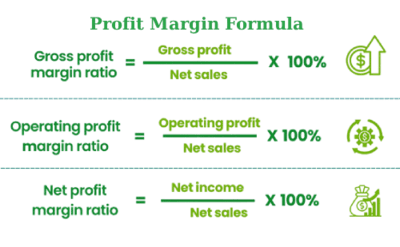
Useful Tips 💡
- Track gross margin regularly across different product lines or service categories. A declining margin trend often signals rising input costs or competitive pricing pressure before it shows up in net profit.
- Use this calculator alongside a markup calculator when setting prices. Margin tells you what percentage of each sale is profit; markup tells you how much to add to your cost. Both are needed for complete pricing analysis.
📋Steps to Calculate
-
Enter any two known values: cost, revenue, profit, or margin percentage.
-
Select the appropriate currency or confirm values are in the same unit.
-
Click "Calculate" to receive all four financial metrics simultaneously.
Mistakes to Avoid ⚠️
- Confusing margin with markup. A 50% markup (adding 50% to cost) produces only a 33.3% margin (profit as percentage of revenue). Using the wrong formula when setting prices can result in systematic underpricing that is hard to detect without explicit calculation.
- Calculating gross margin and treating it as net profit. Gross margin excludes operating expenses such as rent, salaries, marketing, and taxes. Net profit margin subtracts all expenses and is always lower than gross margin.
- Ignoring returns, refunds, and chargebacks. High return rates reduce effective revenue without reducing cost, compressing actual margin below the calculated figure. Factor return rates into pricing models for categories with significant return activity.
- Calculating margin on cost instead of revenue. Margin is profit divided by revenue. Dividing by cost gives markup. Using the wrong denominator inflates the apparent profitability of a product.
Practical Applications📊
Set product and service prices that achieve a target gross margin while remaining competitive in the market.
Monitor business financial health by tracking margin trends across product lines, time periods, or customer segments.
Build budget scenarios by calculating the maximum allowable cost for a given revenue target and desired margin percentage.