Loan Calculator

Monthly payment and full amortization schedule for any fixed-rate amortizing loan - personal, auto, or student. Results include total interest cost and the payment-by-payment breakdown of principal vs. interest across the loan term.

years months

Results:

Payment Every Month
Total of 120 Payments
Total Interest
■ Principal ■ Interest

Deferred Payment Loan: Paying Back a Lump Sum Due at Maturity

years months

Results:

Amount Due at Loan Maturity
Total Interest
■ Principal ■ Interest

Was this calculator helpful?

4.9/5 (19 votes)

Calculation Examples

Calculation Case Result
Personal loan $10,000, 3 years, 10% APR Monthly: 322.67 | Total interest: 1,616.12
Auto loan $35,000, 5 years, 4.5% APR Monthly: 652.74 | Total interest: 4,164.40
Student loan $25,000, 10 years, 5.0% APR Monthly: 265.16 | Total interest: 6,818.96
Short-term: $5,000, 2 years, 12% APR Monthly: 235.37 | Total paid: 5,648.82

How to Use the Loan Calculator

Enter three variables: the loan principal (total amount borrowed), the annual interest rate, and the loan term in years or months. Click "Calculate" to apply the fixed-rate annuity formula: $$M = P \frac{r(1+r)^n}{(1+r)^n - 1}$$ where $P$ is the principal, $r$ is the monthly interest rate (annual rate ÷ 12), and $n$ is the total number of monthly payments (years × 12). Results include the fixed monthly payment, total interest paid over the full term, and a complete amortization schedule.

This calculator models standard fully amortizing, fixed-rate loans. For variable-rate loans, balloon payment structures, or income-driven repayment plans (federal student loans), use a product-specific tool.

Understanding Loan Amortization

In a standard fixed-rate amortizing loan, each monthly payment is identical in total but its composition changes over time. Early payments are heavily weighted toward interest; later payments shift progressively toward principal. This happens because interest is calculated on the outstanding balance - as the balance decreases, so does the interest portion of each payment, and the principal portion grows correspondingly.

To illustrate: on a 10,000 personal loan at 10% over 3 years (monthly payment 322.67), the first payment consists of approximately 83.33 in interest and $239.34 in principal. By the final payment, the split is approximately 2.67 in interest and $320.00 in principal. This structure means extra payments applied to the principal in the early term have the greatest leverage on total interest savings - because they reduce the balance on which all future interest is calculated.
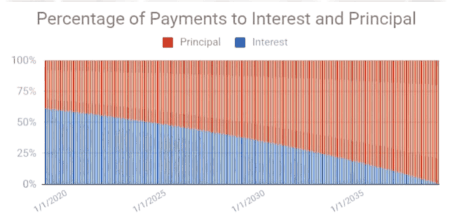
Loan amortization: interest-to-principal ratio shifting over the loan term

Useful Tips 💡

  • Compare loan offers using APR, not the nominal interest rate. Under CFPB Regulation Z (12 CFR Part 1026), lenders must disclose APR, which includes origination fees and other mandatory charges - it is the only valid basis for comparing the true cost of different loan products.
  • Extra principal payments yield the greatest interest savings when made early in the loan term, when the outstanding balance - and therefore the interest calculated on it each month - is at its highest.

📋Steps to Calculate

  1. Enter the loan principal (amount borrowed).

  2. Enter the annual interest rate and loan term in years or months.

  3. Click "Calculate" to view monthly payment, amortization schedule, and total interest.

Mistakes to Avoid ⚠️

  1. Omitting origination or processing fees from total cost analysis. A 2% origination fee on a $20,000 loan adds 400 to the actual borrowing cost - equivalent to a material increase in effective interest rate.
  2. Entering the loan term in years as the number of payments (n). A 3-year loan requires n = 36 in the formula; entering 3 produces a payment approximately 10× too high.
  3. Assuming this calculator covers the full cost of a mortgage. Personal and auto loan calculators model principal and interest only; mortgages additionally require property tax, homeowners insurance, and PMI estimates for a complete housing cost picture.
  4. Not revisiting loan options when credit score improves or market rates change. A 0.5% rate improvement on a $35,000 auto loan over 5 years saves approximately 480 in total interest.

Practical Applications📊

  1. Compare the total cost of competing loan offers - not just the monthly payment. A loan with a lower rate but high origination fees may cost more in total than one with a slightly higher rate and no fees. Always compare using APR (Annual Percentage Rate), which incorporates all mandatory costs, as required under Truth in Lending Act (TILA) and CFPB Regulation Z.

  2. Model the impact of extra principal payments before committing to a repayment plan. Adding 50/month to a 10,000 loan at 10% over 3 years reduces total interest from approximately $1,616 to 1,250 and shortens the term by roughly 5 months.

  3. Assess loan affordability against your income before applying. Standard underwriting guidelines suggest total monthly debt obligations (all loans combined) should not exceed 36% of gross monthly income - the back-end debt-to-income (DTI) ratio used by most consumer lenders.

Questions and Answers

What does a loan calculator compute?

A loan calculator applies the fixed-rate annuity formula - $M = P \frac{r(1+r)^n}{(1+r)^n - 1}$ - to determine the monthly payment for a fully amortizing loan. It also generates the complete amortization schedule showing how each payment splits between interest and principal, and calculates total interest paid over the full loan term. The calculator is appropriate for personal loans, auto loans, and fixed-rate student loans - loan types that share the same mathematical structure: fixed rate, fixed term, equal monthly payments.

How is the monthly loan payment calculated?

The monthly payment is calculated using the amortization formula, where P is the principal, r is the monthly interest rate (annual rate ÷ 12), and n is the total number of payments (years × 12). For example: a $10,000 loan at 10% annual rate over 3 years gives r = 0.10 ÷ 12 = 0.008333 and n = 36 payments. Plugging these into the formula produces a monthly payment of $322.67. This is the same calculation lenders use in their amortization tables and disclosure documents.

What is the difference between interest rate and APR?

The nominal interest rate is the annual cost of borrowing the principal, expressed as a percentage, excluding fees. APR (Annual Percentage Rate) incorporates the nominal rate plus all mandatory costs - origination fees, discount points, and processing charges - expressing the true annual cost as a single comparable figure. Under the Truth in Lending Act (TILA) and CFPB Regulation Z (12 CFR Part 1026), US lenders are required to disclose APR in all consumer loan offers. When comparing loan products, APR is the correct metric; the nominal rate alone can be misleading.

Is this calculator accurate for all loan types?

This calculator is accurate for standard fixed-rate, fully amortizing loans - where the interest rate does not change, each payment is equal, and the loan is fully repaid at the end of the term. It is not appropriate for: variable-rate loans (rate resets periodically); balloon payment loans (large lump sum due at maturity); interest-only loans; or income-driven repayment (IDR) plans for federal student loans, which base payments on income and family size rather than standard amortization. For IDR plans, the Federal Student Aid Loan Simulator (studentaid.gov) is the appropriate tool.

How does the loan term affect total cost?

Loan term directly governs the trade-off between monthly payment size and total interest paid. On a $20,000 loan at 7% APR: a 3-year term produces a monthly payment of approximately $618 and total interest of $2,238; a 5-year term reduces the monthly payment to $396 but increases total interest to $3,774. The longer term costs 69% more in total interest for a 36% reduction in monthly payment. The optimal term depends on the balance between monthly cash flow requirements and minimizing total borrowing cost.

How does interest affect total repayment?

Interest is calculated each month on the outstanding principal balance. A higher rate, longer term, or larger principal all increase total interest. On a $20,000 loan, moving from 5% to 8% APR over 5 years increases total interest from approximately $2,645 to $4,332 - a $1,687 difference on the same principal and term. The amortization schedule makes this concrete by showing the interest cost for each of the 60 payments, allowing you to see exactly where the extra cost accumulates.

How do extra principal payments reduce loan cost?

Any additional payment applied to the principal reduces the outstanding balance immediately. Since interest is calculated on the balance each month, a lower balance produces less interest in every subsequent period - a compounding savings effect. On a $0,000 loan at 10% over 3 years, adding $50/month to the scheduled principal payment saves approximately $366 in total interest and shortens the term by about 5 months. The earlier in the loan term extra payments are made, the greater the savings - because the outstanding balance, and therefore monthly interest, is at its highest in the early periods.

Can I calculate student loan payments with this tool?

Yes, for fixed-rate federal Direct Loans and private student loans with a standard repayment structure, this calculator produces accurate monthly payments and total interest figures. It is not suitable for income-driven repayment (IDR) plans - including IBR, PAYE, and SAVE - which calculate payments as a percentage of discretionary income rather than using the standard amortization formula. For IDR plan estimates, use the Federal Student Aid Loan Simulator at studentaid.gov/loan-simulator.
Disclaimer: This calculator is designed to provide helpful estimates for informational purposes. While we strive for accuracy, financial (or medical) results can vary based on local laws and individual circumstances. We recommend consulting with a professional advisor for critical decisions.