Amortization Calculator

Generate a complete amortization schedule showing the exact interest and principal breakdown for every payment - and model how extra principal payments reduce total interest and shorten the loan term.

years
%
Extra payments reduce your loan balance, potentially shortening the loan term and reducing total interest.

Please enter loan details and calculate.

Was this calculator helpful?

4.8/5 (20 votes)

Calculation Examples

Calculation Case Result
First payment: 200,000 loan, 30 years, 6% annual Monthly: 1,199.10 | Interest: $1,000.00 | Principal: $199.10 | Balance: $199,800.90
Payment 180 (year 15) of same loan Interest: ~640 | Principal: ~$559 | Balance: ~$127,000 - principal portion now growing rapidly
200k loan at 6% (30yr) + 200/month extra Term reduced by ~6 years | Total interest savings: ~$57,000
Refinancing break-even: 3,000 closing costs, $150/month savings Break-even at 20 months ($3,000 ÷ $150); refinancing is beneficial if staying beyond 20 months

How to Use the Amortization Calculator

Enter the loan amount (principal), annual interest rate, and loan term in years. Select your payment frequency (monthly is standard for most consumer loans). Click "Calculate" to generate the full amortization schedule. The output includes: your fixed monthly payment derived from the annuity formula $M = P \frac{r(1+r)^n}{(1+r)^n - 1}$; a complete table listing every payment period with its interest portion, principal portion, and remaining balance; and the total interest paid over the life of the loan.

The schedule also allows you to enter an additional monthly principal payment to model the savings in total interest and the reduction in loan term - one of the most practically useful features for borrowers evaluating payoff acceleration strategies.

Understanding Loan Amortization

Amortization is the process of repaying a debt through a fixed schedule of equal periodic payments, where each payment covers both accrued interest and a portion of the principal. The key feature of an amortization schedule is that the composition of each payment changes over time, even though the total payment amount remains constant.

In the early periods, the outstanding balance is high, so the interest component - calculated as $I = B \times r$ (where $B$ is the current balance and $r$ the monthly rate) - dominates. As the principal decreases, the interest portion shrinks and the principal portion grows. To illustrate: on a $200,000 loan at 6% annual interest over 30 years (monthly payment $1,199.10), the first payment consists of $1,000.00 in interest and $199.10 in principal. By payment 180 (year 15), the split is approximately $640 in interest and $559 in principal. By the final payment, virtually the entire $1,199.10 goes to principal. This structure explains why the total interest on a 30-year loan can exceed the original principal - and why front-loaded extra payments have the greatest leverage on total cost.
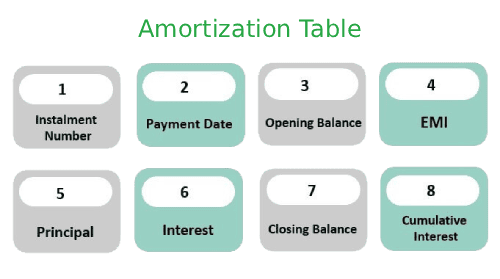
Amortization schedule table: interest and principal breakdown per payment period

Useful Tips 💡

  • Extra principal payments have the greatest impact when made early in the loan term - the outstanding balance is highest then, so each dollar applied to principal saves the most in future interest. A single $1,000 lump-sum payment in year 1 of a 30-year mortgage saves more in total interest than the same payment made in year 20.
  • For US mortgage holders: the interest portion of each payment shown in the amortization schedule corresponds to potential mortgage interest deductions under IRC § 163(h). Sum the annual interest column in the schedule to prepare for tax planning discussions with your accountant.

📋Steps to Calculate

  1. Enter the loan principal (amount borrowed), annual interest rate, and loan term in years.

  2. Select payment frequency (monthly for standard consumer loans).

  3. Optionally enter an additional monthly principal payment to model payoff acceleration.

  4. Click "Calculate" to generate the full amortization schedule.

Mistakes to Avoid ⚠️

  1. Applying an extra payment amount to the total payment rather than specifically to the principal. Extra payments only accelerate payoff when directed to the principal balance; paying extra into an escrow account or general payment does not have the same effect.
  2. Assuming the amortization schedule applies to adjustable-rate mortgages (ARMs) without recalculating for each rate adjustment. The schedule generated by this tool assumes a fixed rate throughout the term; ARM schedules require recalculation at each reset date.
  3. Confusing the remaining principal balance with the total amount still owed. The remaining balance shown in the schedule is the outstanding principal; the total amount still owed if no extra payments are made also includes all future interest not yet accrued.
  4. Not recalculating after refinancing. Refinancing resets the amortization clock - you begin front-loading interest again on the new loan. Generating a new schedule for the refinanced loan is essential for accurately comparing total cost.

Practical Applications📊

  1. Compare the true total cost of different loan terms (15 vs. 30 years) by reviewing total interest in the schedule, not just monthly payment. A 300,000 mortgage at 6.5% over 15 years pays approximately 170,000 in total interest; over 30 years, approximately $383,000 - a 213,000 difference for a $760 reduction in monthly payment.

  2. Model extra payment strategies before committing. Adding 200/month to a 200,000 mortgage at 6% (30-year) saves approximately $57,000 in total interest and reduces the term by about 6 years. The schedule shows the cumulative impact payment by payment.

  3. Evaluate refinancing by generating an amortization schedule for the new loan terms and comparing total remaining interest to the schedule of your current loan, factoring in closing costs to identify the break-even point.

Questions and Answers

What is an amortization schedule and what does it show?

An amortization schedule is a complete table detailing every payment in a fixed-rate loan: the payment number, total payment amount, the portion allocated to interest, the portion allocated to principal, and the remaining loan balance after each payment. The interest portion of each payment is calculated as $I = B \times r$ (where $B$ is the current outstanding balance and $r$ is the monthly interest rate). The principal portion is the total payment minus the interest portion. As the balance decreases over time, the interest component shrinks and the principal component grows - even though the total monthly payment remains constant throughout the loan term.

How does an amortization schedule work mathematically?

The schedule is generated in two steps. First, the fixed monthly payment is calculated using the annuity formula: $M = P \frac{r(1+r)^n}{(1+r)^n - 1}$. Then, for each payment period: (1) interest is calculated as $I_t = B_{t-1} \times r$; (2) principal repaid is $P_t = M - I_t$; (3) the new balance is $B_t = B_{t-1} - P_t$. This iteration continues for all $n$ periods, producing the complete schedule. The process is mathematically precise - the final payment will always bring the balance to exactly zero (subject to small rounding adjustments in the last period).

Can I use this calculator for a mortgage amortization schedule?

Yes. Enter the loan amount (purchase price minus down payment), the annual interest rate, and the term (typically 15 or 30 years). The schedule will show the interest and principal breakdown for each of the 180 or 360 monthly payments. Note that this calculator models principal and interest (P&I) only - your total monthly mortgage payment (PITI) also includes property taxes, homeowners insurance, and PMI if applicable, which are not reflected in the amortization schedule.

How do extra principal payments affect the amortization schedule?

Any additional payment applied to the principal reduces the outstanding balance immediately. Since the next period's interest is calculated on the new lower balance - $I = B \times r$ - a lower balance produces less interest in every subsequent period, creating a compounding savings effect across the remaining term. On a $200,000 mortgage at 6% over 30 years, adding $200/month to the principal reduces total interest from approximately $231,600 to $174,400 (saving ~$57,000) and shortens the term from 360 to approximately 289 payments. The earlier in the loan term extra payments are made, the greater the proportional savings.

Can I use the amortization calculator for a car loan?

Yes. Auto loans use the same fixed-rate annuity formula and amortize in exactly the same way as mortgages and personal loans. Enter the vehicle loan amount (purchase price minus down payment and trade-in), the annual interest rate, and the term (typically 24–84 months). The schedule will show the monthly interest and principal breakdown and help you identify when you reach positive equity in the vehicle - i.e., when the remaining loan balance falls below the vehicle's current market value.

Is this calculator useful for evaluating mortgage refinancing?

Yes. Generate an amortization schedule for your proposed refinanced loan and compare its total remaining interest against the total remaining interest on your current schedule. Factor in closing costs to calculate the break-even point: Break-even (months) = Closing Costs ÷ Monthly Payment Savings. If you plan to stay in the property beyond the break-even period, refinancing is generally beneficial. If not, the upfront costs may outweigh the monthly savings.

How does the amortization schedule help with tax planning?

The interest column in an amortization schedule provides the annual total of mortgage interest paid - a figure relevant for the US mortgage interest deduction under IRC § 163(h), which allows qualified homeowners to deduct mortgage interest paid on up to $750,000 of qualified residence indebtedness (for loans originated after December 15, 2017). Sum the interest values for each year in the schedule to obtain your annual deductible interest figure. Confirm specific deductibility eligibility and limits with a licensed tax professional, as individual circumstances vary.

Which formula does the amortization calculator use?

The calculator uses two formulas. The monthly payment formula: $M = P \frac{r(1+r)^n}{(1+r)^n - 1}$, where $P$ is the principal, $r$ is the monthly interest rate (annual rate ÷ 12), and $n$ is the total number of payments. The per-period interest formula: $I_t = B_{t-1} \times r$, where $B_{t-1}$ is the remaining balance at the start of each period. These are the standard fixed-rate loan formulas used in consumer lending across all major jurisdictions, consistent with loan disclosure requirements under the Truth in Lending Act (TILA) and CFPB Regulation Z.
Disclaimer: This calculator is designed to provide helpful estimates for informational purposes. While we strive for accuracy, financial (or medical) results can vary based on local laws and individual circumstances. We recommend consulting with a professional advisor for critical decisions.