Discount Calculator
Calculate Sale Prices and Shopping Savings in Seconds
Discounted Price: $
Savings: $
Total with Tax (if applicable): $
Please enter valid numbers for original price, discount value, and quantity.
Calculation Examples
📋Steps to Calculate
-
Enter the original price of the product.
-
Enter the discount percentage or fixed discount amount.
-
Click "Calculate" to see the final sale price, amount saved, and effective discount percentage.
Mistakes to Avoid ⚠️
- Adding consecutive discounts together. A 20% discount followed by a 10% discount saves 28% of the original price, not 30%, because the second percentage is applied to the reduced amount.
- Confusing fixed-amount coupons with percentage discounts when comparing offers. A $15 off coupon on a $60 item equals 25% off, but the same coupon on a $200 item is only 7.5% off.
- Using the sale price as the starting point when attempting to recover the original MSRP, which produces a systematically lower result than the true original price.
Practical Applications📊
Verify the true final price during seasonal sales, flash promotions, or clearance events before completing a purchase.
Set competitive markdown prices for retail or e-commerce products while maintaining target profit margins.
Confirm that stacked or sequential discounts are being applied correctly at checkout rather than added together incorrectly.
Questions and Answers
What is a discount calculator and how does it work?
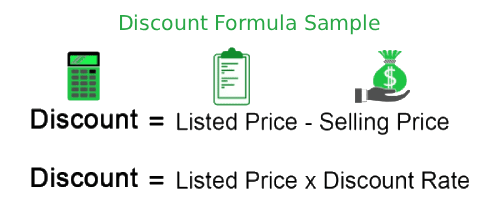
A discount calculator determines the final sale price of an item after a percentage or fixed reduction is applied, and shows the exact amount saved. For a percentage discount, it applies the formula: Sale Price equals Original Price multiplied by (1 minus Discount divided by 100). For a fixed discount, it simply subtracts the coupon value from the original price. It also works in reverse: given a known sale price and discount rate, it recovers the original price using Original Price equals Sale Price divided by (1 minus Discount divided by 100). This reverse function is particularly useful for verifying whether a retailer's stated "original price" is accurate or artificially inflated to make the markdown appear larger.
How do you calculate a discount percentage manually?
To find what percentage discount is being offered when you know both the original and sale prices, divide the amount saved by the original price and multiply by 100: $\text{Discount \%} = \left(\frac{\text{Original Price} - \text{Sale Price}}{\text{Original Price}}\right) \times 100$. For example, an item originally priced at $80 selling for $60 represents a saving of $20, which is $20 divided by $80, multiplied by 100, equal to 25%. This calculation is useful for comparing promotional offers expressed in different formats, such as "$20 off" versus "25% off," to identify which represents the better value at a given price point.
How do stacked or sequential discounts work?
Stacked discounts are applied sequentially, not additively. Each successive discount is calculated on the price remaining after the previous discount, not on the original price. For a 20% discount followed by an additional 10% discount: the first reduces a $100 item to $80, and the second reduces $80 by 10% to $72. The total saving is $28, which represents a 28% effective discount, not 30%. The general formula for two stacked discounts $d_1$ and $d_2$ expressed as decimals is: $\text{Effective Discount} = 1 - (1 - d_1)(1 - d_2)$. For any number of sequential discounts, multiply the remaining-price factors together: $\text{Final Price} = P \times (1-d_1) \times (1-d_2) \times \ldots \times (1-d_n)$.
How do you find the original price after a discount?
Use the reverse discount formula: Original Price equals Sale Price divided by (1 minus Discount Rate expressed as a decimal). If an item is on sale for $75 after a 25% discount, the original price is $75 divided by (1 minus 0.25), which equals $75 divided by 0.75, equal to $100. This calculation is useful when a retailer displays only the sale price and discount percentage without the original price, or when you want to verify that a stated original price is consistent with the claimed discount percentage. A common error is simply adding the discount percentage back to the sale price ($75 plus 25% equals $93.75), which gives the wrong answer because the percentage is being applied to the wrong base.
How do I calculate a discount in Microsoft Excel?
In Excel, enter the original price in cell A1 and the discount percentage in cell B1. In cell C1, enter the formula =A1*(1-B1/100) to calculate the sale price. To calculate the amount saved, use =A1-C1 or equivalently =A1*(B1/100). For stacked discounts, chain the factors: =A1*(1-B1/100)*(1-C1/100), where B1 and C1 hold the two discount percentages. For reverse calculation to find the original price from a known sale price and discount, use =A1/(1-B1/100). These formulas are useful for managing price lists, promotional planning spreadsheets, or comparing multiple offers across a product range.
What is the difference between a percentage discount and a fixed discount?
A percentage discount reduces the price by a proportion of the original, so the absolute saving scales with the item's price. A 20% discount saves $10 on a $50 item but $40 on a $200 item. A fixed discount reduces the price by a set monetary amount regardless of the original price, so its effective percentage varies by item. A $15 off coupon represents 30% on a $50 item but only 7.5% on a $200 item. When comparing offers, convert both types to a consistent format (either absolute saving or percentage) at the specific price point in question to determine which provides greater value. Fixed discounts favor higher-priced items; percentage discounts are proportionally identical across all price points.
How do retailers calculate markdowns for clearance pricing?
Retailers typically calculate markdowns as a percentage reduction from the original retail price (MSRP or regular selling price). A standard clearance markdown progression might move an item from full price to 25% off, then to 40% off, then to 60% off if unsold. Each markdown is calculated from the original price, not from the previous sale price, unless the retailer explicitly states "additional X% off the sale price." The distinction matters: 25% off then an additional 40% off the sale price produces a 55% effective total discount, while 25% off followed by a separate 40% off the original produces only a straight 40% discount at the final stage. Checking which base price each markdown applies to is essential for accurate clearance budgeting.
Disclaimer: This calculator is designed to provide helpful estimates for informational purposes. While we strive for accuracy, financial (or medical) results can vary based on local laws and individual circumstances. We recommend consulting with a professional advisor for critical decisions.