VAT Calculator

Add or Remove VAT Instantly for Invoices and Accounting

Please enter the amount and VAT rate, then click Calculate.

Was this calculator helpful?

4.9/5 (18 votes)

Calculation Examples

Calculation Case Result
Remove 20% UK VAT from 500 gross Net: 416.67 / VAT: 83.33
Add 19% German VAT to 200 net Gross: 238.00
Remove 5% UAE VAT from 1050 AED gross Net: 1000 AED / VAT: 50 AED

How to Use the VAT Calculator

Select whether you want to add VAT to a net price or remove VAT from a gross total, enter the applicable rate (such as 20% for the UK standard rate or 5% for the UK reduced rate), and enter the amount. The tool returns the net price, VAT amount, and gross price simultaneously.

This calculator is used by business owners preparing VAT-compliant invoices, freelancers calculating quotes for VAT-registered clients, accountants reconciling gross receipts, and travelers verifying the tax component of prices in countries where VAT is included in the displayed price.

How VAT Calculations Work

Three formulas cover all VAT calculation scenarios. To find the gross amount from a net price: $GA = NA \times (1 + \text{VAT rate} / 100)$. To find the VAT amount alone from a net price: $VA = NA \times (\text{VAT rate} / 100)$. To remove VAT and recover the net amount from a known gross price: $NA = GA \div (1 + \text{VAT rate} / 100)$. The reverse calculation (gross to net) is the most commonly mishandled: a frequent error is simply subtracting the VAT percentage from the gross price, which gives the wrong result because VAT is calculated on the net base, not on the gross total. At 20%, subtracting 20% from a 120 gross gives 96, not the correct 100.Value Added Tax Calculation: Net, VAT, and Gross Amount Breakdown
Useful Tips 💡

  • Verify that you are applying the correct VAT rate for the specific goods or services. Many jurisdictions have reduced rates (5% in the UK for domestic energy and children's car seats) that differ from the standard rate.
  • If you are VAT-registered, record the VAT amount separately from the net amount in your accounts. Input VAT (paid on purchases) and output VAT (charged on sales) must be reported separately on your VAT return.

📋Steps to Calculate

  1. Enter the amount (net price or gross total depending on your calculation direction).

  2. Select or enter the applicable VAT rate for your jurisdiction.

  3. Choose the calculation type (add VAT, remove VAT, or VAT amount only) and click "Calculate".

Mistakes to Avoid ⚠️

  1. Selecting "add VAT" when you already have the gross price. This compounds the tax and produces a figure that is higher than the correct VAT-inclusive total.
  2. Entering the VAT-inclusive gross price but treating it as the net base for calculation, which overstates both the net amount and the VAT due.
  3. Applying the wrong country rate when switching between jurisdictions. The UK standard rate of 20% differs from Germany's 19%, France's 20%, Ireland's 23%, and Hungary's 27%, and the reduced rates differ even more significantly.
  4. Attempting reverse VAT calculation by subtracting the VAT percentage directly from the gross price instead of dividing by (1 plus the rate), which produces a systematically incorrect net figure.

Practical Applications📊

  1. Calculate the VAT amount to display separately on invoices issued to VAT-registered business clients, as required by tax authority regulations in most VAT jurisdictions.

  2. Recover the net amount from a gross price for expense reporting, input tax credit claims, or budget planning where only the VAT-inclusive total is available.

  3. Verify VAT compliance on cross-border transactions by applying the correct destination-country rate when selling goods or services internationally.

Questions and Answers

What is a VAT calculator and what does it calculate?

A VAT calculator determines any one of three related figures from the other two: the net price (before VAT), the VAT amount, and the gross price (VAT-inclusive total). Given a net price and a VAT rate, it adds the appropriate tax to produce the gross. Given a gross price and a rate, it removes the embedded VAT to recover the net. Given net and gross, it determines the effective VAT rate. These calculations underpin invoicing, expense reporting, VAT return preparation, and cross-border pricing decisions for businesses operating in any of the more than 170 countries that operate a VAT or GST system.

How do you add VAT to a net price?

Multiply the net price by (1 plus the VAT rate expressed as a decimal). For the UK standard rate of 20%: $\text{Gross} = \text{Net} \times 1.20$. A net price of 500 becomes a gross price of 600, with 100 representing the VAT. For the reduced UK rate of 5%: $\text{Gross} = \text{Net} \times 1.05$. The VAT amount alone is: $\text{VAT} = \text{Net} \times (\text{Rate}/100)$. This is the calculation used when raising a VAT invoice: the net amount and VAT amount must be shown separately, with the gross as the total payable.

How do you remove VAT from a gross price?

Divide the gross price by (1 plus the VAT rate expressed as a decimal): $\text{Net} = \text{Gross} \div (1 + \text{Rate}/100)$. For a gross of 120 at 20% VAT: $\text{Net} = 120 \div 1.20 = 100$. The VAT amount is then $120 - 100 = 20$. The most common error is subtracting the VAT percentage directly from the gross ($120 - 20\% = 96$), which gives the wrong answer because 20% of 120 is 24, not 20. VAT is charged on the net, not on the gross, so division is the correct operation for reverse calculation.

What is the difference between VAT and sales tax?

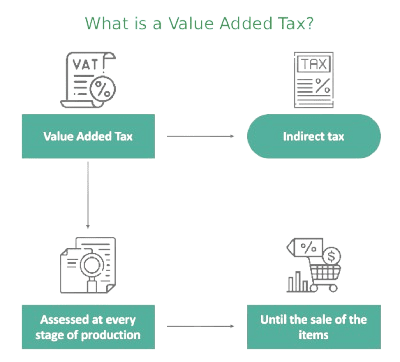
Both are consumption taxes, but they differ in where they are collected in the supply chain. Sales tax is collected only at the final point of sale to the end consumer; businesses in the supply chain do not pay or collect it on intermediate transactions. VAT is collected at every stage of production and distribution, but each business in the chain can reclaim the VAT it paid on its inputs (input tax credit), so the net tax burden at each stage falls only on the value added. The end consumer bears the same total tax cost in both systems, but VAT creates a self-auditing mechanism because each business has an incentive to hold invoices from suppliers to claim back input tax.

Which VAT rates apply in different countries?

VAT rates vary significantly by country and product category. In Europe, standard rates range from 17% in Luxembourg to 27% in Hungary. The UK standard rate is 20% with a reduced rate of 5% for domestic energy and certain goods. Germany applies 19% standard and 7% reduced. France uses 20% standard, 10% intermediate, and 5.5% reduced. Ireland has a 23% standard rate. Outside Europe, Australia and New Zealand apply 10% and 15% GST respectively. The UAE introduced a 5% VAT in 2018. Many countries exempt essential categories such as basic food, healthcare, and education from VAT entirely, or apply a zero rate which requires reporting but charges no tax. Always verify the current rate with the relevant national tax authority, as rates are subject to legislative change.

How do I calculate VAT for a UK business invoice?

UK VAT invoices must separately state the net amount, the VAT rate applied, the VAT amount, and the gross total payable. To calculate: apply the relevant rate (20% standard, 5% reduced, or 0% zero-rated) to the net price to determine the VAT amount, then add both to produce the gross. For example, a net charge of 850 at 20% VAT produces a VAT amount of 170 and a gross total of 1020. If you are not VAT-registered (below the 90,000 UK registration threshold as of 2024), you cannot charge VAT on your invoices and must not include a VAT number. Consult HMRC guidance or a qualified accountant for VAT registration obligations specific to your business.

What is zero-rated VAT and how does it differ from VAT-exempt?

Zero-rated VAT means the supply is within the scope of VAT and must be reported on VAT returns, but the rate charged is 0%, so no tax is collected from the customer. VAT-registered businesses making zero-rated supplies can still reclaim input VAT on their purchases. Common zero-rated items in the UK include most food (excluding restaurant meals and certain snacks), children's clothing, books and newspapers, and exports of goods outside the UK. VAT-exempt supplies, by contrast, are outside the VAT system entirely: businesses cannot charge VAT on exempt supplies and also cannot reclaim input VAT attributable to those supplies. Examples include most financial services, insurance, and residential property rentals. The distinction matters for partial exemption calculations when a business makes both taxable and exempt supplies.

Can I use this calculator for global VAT and GST rates?

Yes. The calculator accepts any numeric rate, making it applicable to any VAT or GST jurisdiction worldwide. Enter the rate for your specific country and transaction type: 19% for Germany, 21% for Spain or the Netherlands, 25% for Denmark or Sweden, 15% New Zealand GST, 10% Australian GST, or 18% Indian GST on standard goods. For countries with multiple tiers, run separate calculations for each applicable rate. The underlying formula is identical regardless of jurisdiction: only the rate value changes. For cross-border B2B transactions within the EU, note that the reverse charge mechanism may apply, shifting VAT accounting responsibility to the buyer, in which case the seller issues an invoice at 0% with a reverse charge notation.
Disclaimer: This calculator is designed to provide helpful estimates for informational purposes. While we strive for accuracy, financial (or medical) results can vary based on local laws and individual circumstances. We recommend consulting with a professional advisor for critical decisions.