Factor Calculator
Enter any integer to get its complete factor list, factor pairs, and prime factorization instantly.
Calculation Examples

How to Use the Factor Calculator
Type your number into the field. The calculator accepts positive integers, negative integers, and zero. Numbers up to 12 digits are processed in under a second. Press Calculate or hit Enter and the results appear sorted from the most negative divisor to the largest positive one. Factor pairs and prime factorization are shown automatically below the main list. A single click copies everything to the clipboard.
How Factors Are Calculated
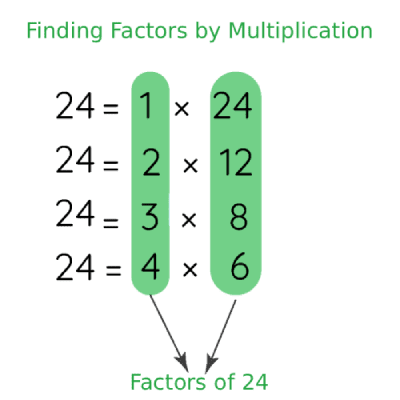
For any integer \(n\), the tool tests every candidate divisor \(i\) from 1 up to \(\sqrt{|n|}\). Each time \(i\) divides \(n\) without a remainder, both \(i\) and \(n \div i\) are added to the factor list as a complementary pair. This approach cuts the work roughly in half compared to testing every integer up to \(|n|\) directly.
Prime factorization runs in the same loop using repeated division: once a prime factor is found, the algorithm divides it out completely before moving to the next candidate. The result is the unique canonical decomposition guaranteed by the Fundamental Theorem of Arithmetic.
Useful Tips 💡
- Negative inputs return both positive and negative factors, which is the standard mathematical convention for divisors.
- Results for 12-digit numbers appear in well under a second thanks to the square-root iteration limit.
📋Steps to Calculate
-
Enter any integer, for example 120, -54, or 1000000.
-
Click Calculate or press Enter.
-
View the complete sorted factor list, factor pairs, and prime factorization.
Mistakes to Avoid ⚠️
- Forgetting negative factors: every integer has both positive and negative divisors, so 6 has eight factors total, not four.
- Assuming prime numbers have only two factors: including negatives, a prime p has four divisors: 1, -1, p, and -p.
- Entering a decimal and expecting integer factors: the calculator is built for integers only.
- Confusing factors with multiples: factors divide evenly into n, multiples are products of n with other integers.
Practical Applications📊
Simplify fractions and find the Greatest Common Factor (GCF) or Least Common Multiple (LCM) quickly.
Build prime factor trees for algebra coursework or exam preparation.
Verify divisibility and factorization steps when solving polynomial equations.