Relative Fat Mass Calculator
Estimate your body fat percentage using height and waist circumference, without a scale.
Results
Estimated body fat percentage (RFM): — %
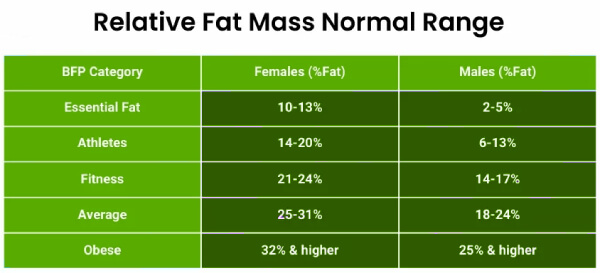
Interpretation (approximate ranges):
- • Below average — generally good (men <15–18%, women <22–25%)
- • Average / Healthy range — men ≈14–24%, women ≈21–32%
- • Above average / Elevated risk — men >25%, women >33%
- • High / Obesity range — men ≥30%, women ≥38–40% (varies by age/ethnicity)
Calculation Examples

How to Use the RFM Calculator
An accurate Relative Fat Mass (RFM) result depends on two measurements: height and waist circumference. No weight input is needed. Start by selecting your biological sex, since fat distribution patterns differ significantly between men and women and the formula uses different constants for each.
The key variable is waist circumference. For the measurement position used in the original RFM validation study, place the tape at the top of the iliac crest (the upper rim of the hip bone). Keep the tape horizontal and snug against the skin without compressing the tissue. Stand straight, breathe out naturally, and record the measurement at the end of a normal exhale. For height, measure in the morning if possible — spinal compression from daily activity can reduce standing height by up to 1–2 cm by evening.
Enter both values in consistent units (either both in centimeters or both in inches). The calculator applies the sex-specific linear formula to produce a body fat percentage estimate that, in large-scale validation research, correlates more closely with DXA (dual-energy X-ray absorptiometry) scan results than BMI does — all without requiring a scale.
How Relative Fat Mass Is Calculated
The Relative Fat Mass index was developed by Orison Woolcott and Richard Bergman at Cedars-Sinai Medical Center and published in Scientific Reports in 2018. It emerged from a systematic comparison of over 300 anthropometric formulas against DXA scan data, with the height-to-waist ratio consistently outperforming weight-based alternatives.
The formulas are: \[RFM_{men} = 64 - \left(20 \times \frac{Height}{Waist}\right)\] \[RFM_{women} = 76 - \left(20 \times \frac{Height}{Waist}\right)\] The height-to-waist ratio captures the fact that a larger frame can accommodate proportionally more mass without elevated metabolic risk — provided that mass is not concentrated in the abdominal region. Because height and waist use the same unit of measurement, the ratio is dimensionless, making the formula equally valid in metric and imperial systems. This approach is particularly effective at identifying "normal weight obesity" — individuals with a healthy BMI but clinically elevated visceral fat — a phenotype that BMI completely misses.
Useful Tips 💡
- Use a non-elastic tape measure — fabric tapes stretch over time and can underestimate waist circumference by 1–2 cm.
- If your result falls near a category boundary, treat the waist measurement itself as the primary indicator of metabolic risk rather than the exact percentage.
- Combine your RFM result with physical performance markers and routine blood work (fasting glucose, triglycerides, HDL) for a complete metabolic picture.
📋Steps to Calculate
-
Select your biological sex to apply the correct formula constant (64 for men, 76 for women).
-
Enter your height and waist circumference using the same units throughout (cm or inches).
-
Review your estimated body fat percentage and the corresponding health classification based on validated clinical thresholds.
Mistakes to Avoid ⚠️
- Measuring the waist at the narrowest point (the natural waist) rather than at the iliac crest level used in the original Woolcott-Bergman study.
- Applying the calculator to children or adolescents: the linear height-to-waist relationship changes significantly during pubertal growth, making adult RFM norms invalid for this group.
- Assuming RFM is definitive for elite bodybuilders: while more accurate than BMI for muscular individuals, no formula based solely on waist and height perfectly separates dense muscle from fat at extreme body compositions.
- Entering height in feet and waist in centimeters, or vice versa: the formula requires both values in the same unit system or the ratio — and the result — will be wrong.
Primary Diagnostic Applications📊
Estimate body fat percentage without laboratory equipment such as hydrostatic weighing or DEXA scanning.
Detect elevated visceral adiposity linked to type 2 diabetes and hypertension in individuals with a normal BMI.
Track fat loss during caloric restriction phases when scale weight fluctuates due to hydration or glycogen changes.
Monitor how fat distribution shifts with age and assess the impact of lifestyle interventions over years.