Exponent Calculator
Quickly Solve Powers and Exponential Expressions.
Calculation Examples

How to Use the Exponent Calculator
Enter your base number (the number being raised to a power) and your exponent (the power to which the base is raised). The calculator handles positive integers, negative numbers, and fractions.
For example, to find 2 to the power of 5, enter 2 as the base and 5 as the exponent. To compute a square root, enter 0.5 as the exponent, since raising a number to the power of one half equals its square root. Click "Calculate" to see the result along with the expanded form of the expression.
How Exponents Are Computed
A base number raised to an exponent represents repeated multiplication. For positive integer exponents: \(3^4\) means \(3 \times 3 \times 3 \times 3 = 81\). For negative exponents, the result is the reciprocal of the positive power: \(2^{-3} = 1/2^3 = 1/8\). For fractional exponents, the numerator indicates the power and the denominator indicates the root: \(16^{1/2} = \sqrt{16} = 4\), and \(8^{2/3} = \sqrt[3]{8^2} = \sqrt[3]{64} = 4\). For very large exponents, the calculator applies logarithmic computation to maintain precision without integer overflow.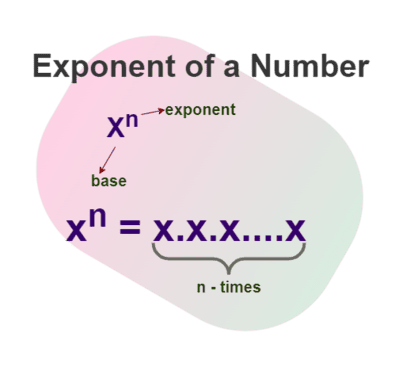
Useful Tips 💡
- For very large exponents, verify results using a logarithmic check: if \(a^b = x\), then \(b \times \log(a)\) should equal \(\log(x)\).
- When entering fractional exponents, convert them to decimal form if the interface does not support fraction notation directly. For example, enter 0.333 for the cube root (one third).
📋Steps to Calculate
-
Enter the base number.
-
Enter the exponent value (positive, negative, or fractional).
-
Click "Calculate" to receive the result and the expanded multiplication form.
Mistakes to Avoid ⚠️
- Calculating a to the power of negative b as the negative of a to the power of b. The correct interpretation is 1 divided by a to the power of b.
- Misapplying order of operations with chained exponents. The expression 2 to the power of 3 to the power of 2 evaluates right to left as 2 to the power of 9, which equals 512, not (2 to the power of 3) squared, which equals 64.
- Entering a percentage directly as an exponent. If your exponent represents a 5% rate, enter 0.05, not 5.
- Confusing the exponential function e to the power of x with its inverse, the natural logarithm ln(x).
Practical Applications📊
Finance: Calculating compound interest and exponential growth over time using power-based formulas.
Science: Modeling radioactive decay, bacterial population growth, and astronomical distances expressed in scientific notation.
Computer Science: Computing data storage sizes, binary values, and algorithm complexity expressed as powers of 2.