You will see TDEE on almost every fitness app, calorie tracker and diet plan. It stands for Total Daily Energy Expenditure, and it is the number of calories your body burns in a full day, including everything from sleeping to walking to digesting lunch. Nearly every weight plan starts from this figure, so it helps to understand what it contains, how it is estimated and where the estimate can go wrong.
TDEE in Plain Words
TDEE is your daily energy budget. If you eat about as many calories as your TDEE, your weight tends to stay stable. If you eat less, you create a deficit and usually lose weight over time. If you eat more, you create a surplus and usually gain. The idea is simple. The hard part is that nobody can measure the budget exactly without lab equipment, so every TDEE you read online is an estimate.
What TDEE Is Made Of
Your daily burn comes from four parts:
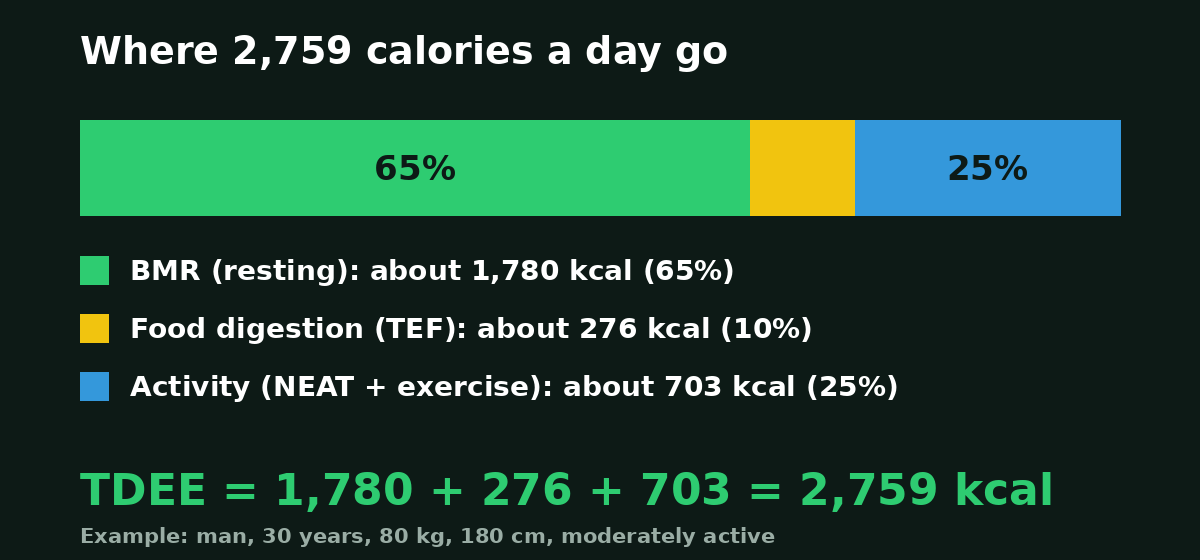
- BMR (basal metabolic rate). The energy needed to keep you alive at complete rest: breathing, circulation, body temperature, cell repair. For most people it is the largest share, often around 60 to 70 percent of the total.
- TEF (thermic effect of food). Digesting and absorbing food costs energy. A common estimate is roughly 10 percent of the calories you eat, with protein costing more than fat or carbohydrate.
- NEAT (non-exercise activity thermogenesis). Everything active that is not a workout: walking to the shop, climbing stairs, cooking, fidgeting, standing at a desk. It varies a lot between people.
- EAT (exercise activity thermogenesis). Deliberate exercise such as running, lifting or cycling. For many people this is the smallest part of the day.
The takeaway is that a one-hour workout rarely changes TDEE as much as people hope, while a daily routine with more walking can add up quickly.
How to Calculate TDEE
The usual method has two steps. First estimate your BMR, then multiply it by an activity factor.
Step 1: Estimate BMR
The Mifflin-St Jeor equation is widely used and tends to perform well for most adults:
- Men: BMR = 10 × weight (kg) + 6.25 × height (cm) − 5 × age + 5
- Women: BMR = 10 × weight (kg) + 6.25 × height (cm) − 5 × age − 161
Step 2: Multiply by an activity factor
| Activity level | Description | Factor |
|---|---|---|
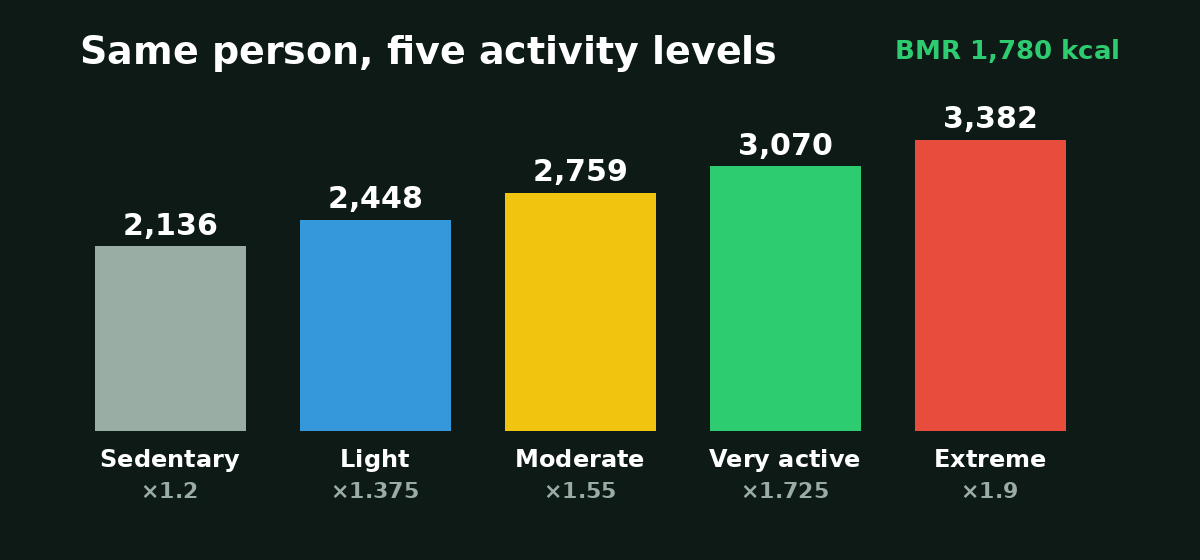
| Sedentary | Desk job, little exercise | 1.2 |
| Lightly active | Light exercise 1 to 3 days a week | 1.375 |
| Moderately active | Exercise 3 to 5 days a week | 1.55 |
| Very active | Hard exercise 6 to 7 days a week | 1.725 |
| Extremely active | Physical job plus daily training | 1.9 |
Worked Example
Take a 30-year-old man who weighs 80 kg and is 180 cm tall.
- BMR = 10 × 80 + 6.25 × 180 − 5 × 30 + 5 = 800 + 1,125 − 150 + 5 = 1,780 kcal
- Moderately active: 1,780 × 1.55 = about 2,759 kcal
The same man at other activity levels would land at roughly 2,136 (sedentary), 2,448 (lightly active), 3,070 (very active) and 3,382 (extremely active) calories. Picking the wrong level is the most common source of error, because people tend to overrate how active they are.
Here is a second case: a 35-year-old woman, 65 kg, 165 cm, lightly active. BMR = 650 + 1,031 − 175 − 161 = about 1,345 kcal. Multiplied by 1.375, her TDEE is roughly 1,850 kcal.
How to Use Your TDEE
- To lose weight: eat below TDEE. A deficit of 300 to 500 calories a day is a common starting point and is easier to sustain than a very aggressive cut. A rough rule of thumb says about 7,700 kcal equals one kilogram of body fat, but real weight change is less tidy because the body adapts.
- To maintain weight: eat close to TDEE and check the scale trend over a few weeks.
- To gain muscle: a modest surplus of about 200 to 300 calories, combined with resistance training and enough protein, is a typical approach.
Avoid going far below your BMR for long periods without medical guidance. Very low intakes make it hard to get enough nutrients and are difficult to keep up.
Why Your Real TDEE May Differ
Formulas use age, sex, height and weight, but they cannot see several things that matter:
- Muscle mass. Muscle uses more energy than fat, so two people with the same weight can burn different amounts.
- Genetics and hormones. Individual BMR can differ from the formula by several hundred calories.
- Daily movement. Step count and posture shift NEAT more than most people expect.
- Adaptation. After weeks of dieting, energy use can drop a little, partly because you weigh less and partly because the body conserves energy.
Treat the result as a starting point. Track your weight and intake for two to three weeks, then adjust by 100 to 200 calories if the trend does not match your goal.
Common Mistakes
- Choosing an activity level that is too high. Three gym sessions do not make you "very active" if you sit the rest of the day.
- Adding exercise calories twice. The activity factor already includes your workouts, so do not add the watch's calorie count on top.
- Trusting a single number. Daily TDEE changes with sleep, steps and illness. Look at weekly averages.
- Confusing TDEE with BMR. Eating at BMR is a deficit for almost everyone, because BMR leaves out all activity.
Calculate It Online
Our TDEE calculator does both steps for you. If you only need the resting figure, use the BMR calculator. To turn the result into a plan, try the calorie deficit calculator and the macro calculator.
Frequently Asked Questions
Is TDEE the same as maintenance calories?
Yes. Maintenance calories is just another name for the amount that keeps your weight steady.
What is the difference between TDEE and BMR?
BMR is the energy you burn at complete rest. TDEE is BMR plus food digestion, daily movement and exercise, so it is always higher.
How often should I recalculate TDEE?
Recalculate after a weight change of about 5 kg, or when your activity level changes in a lasting way.
Can I eat less than my TDEE forever?
No. A deficit is meant to be temporary. Once you reach your goal weight, your TDEE at the new weight becomes the new maintenance level.