Two savings accounts advertise 4.9 percent and 4.85 percent. The second one looks worse, but depending on how the rate is stated, it can actually pay you more. The reason is APY, which stands for annual percentage yield. This guide explains what APY is, how it differs from APR and the plain interest rate, how to calculate it and how to use it to compare accounts.
APY in Plain Words
APY is the real return you earn on money over one year, after counting compound interest. Compounding means that interest is added to your balance, and the next interest payment is calculated on the larger amount. The more often it is added, the higher the yield for the same stated rate.
In the United States, banks must state the APY on deposit accounts, which makes it a fair basis for comparing savings accounts, certificates of deposit (CDs) and money market accounts.
The APY Formula
APY = (1 + r / n)n − 1
- r is the stated annual interest rate as a decimal (5 percent = 0.05)
- n is the number of compounding periods per year (12 for monthly, 365 for daily)
Worked Example
An account pays a 5 percent annual rate, compounded monthly.
- r / n = 0.05 / 12 = 0.0041667
- (1.0041667)12 = 1.05116
- APY = 1.05116 − 1 = 5.116 percent
If you deposit $10,000, you end the year with about $10,511.62, which is $511.62 of interest. A plain 5 percent with no compounding would give only $500.
How Compounding Frequency Changes the Yield
Take the same 5 percent rate and change only how often interest is added:
| Compounding | Periods per year | APY |
|---|---|---|
| Annually | 1 | 5.000% |
| Semiannually | 2 | 5.063% |
| Quarterly | 4 | 5.095% |
| Monthly | 12 | 5.116% |
| Daily | 365 | 5.127% |
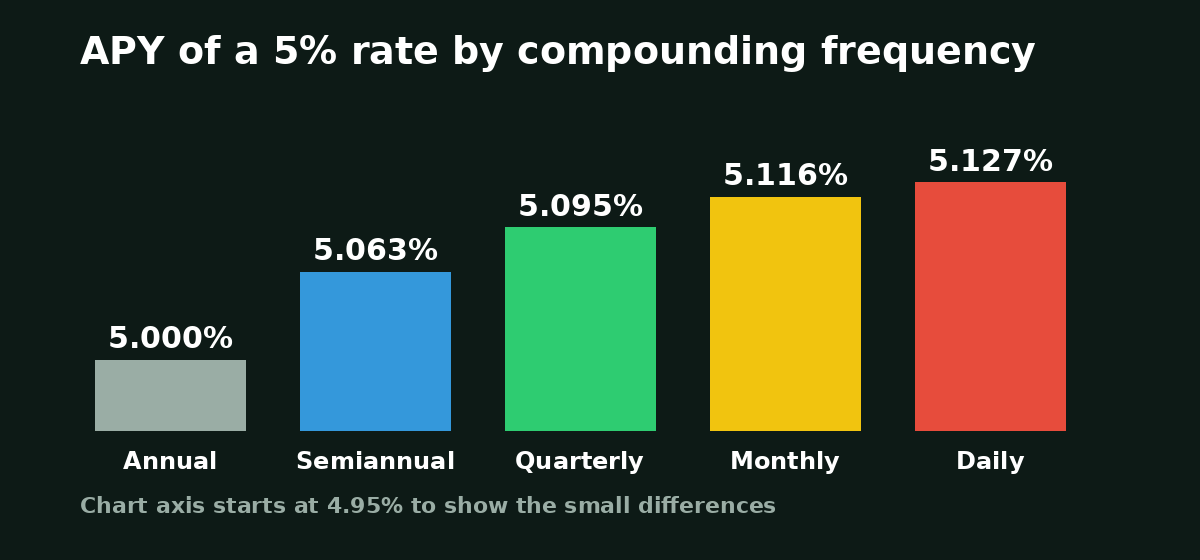
The gains flatten out quickly. Going from annual to monthly adds about 0.12 percentage points, while going from monthly to daily adds only about 0.01. Even continuous compounding, the theoretical limit, tops out at around 5.127 percent for a 5 percent rate.
APY vs APR vs Interest Rate
- Interest rate (nominal rate). The stated yearly rate before compounding.
- APR (annual percentage rate). Common on loans and credit cards. It reflects the yearly cost of borrowing and, for loans, usually includes certain fees. Traditionally it does not include compounding inside the year.
- APY. Includes compounding. It is the standard way to describe what you earn on savings.
A simple way to remember it: APR is how lenders describe what you pay, and APY is how banks describe what you earn. The two are not directly comparable, because one ignores compounding and the other includes it. Always compare APY with APY, and APR with APR.
Using APY to Compare Accounts
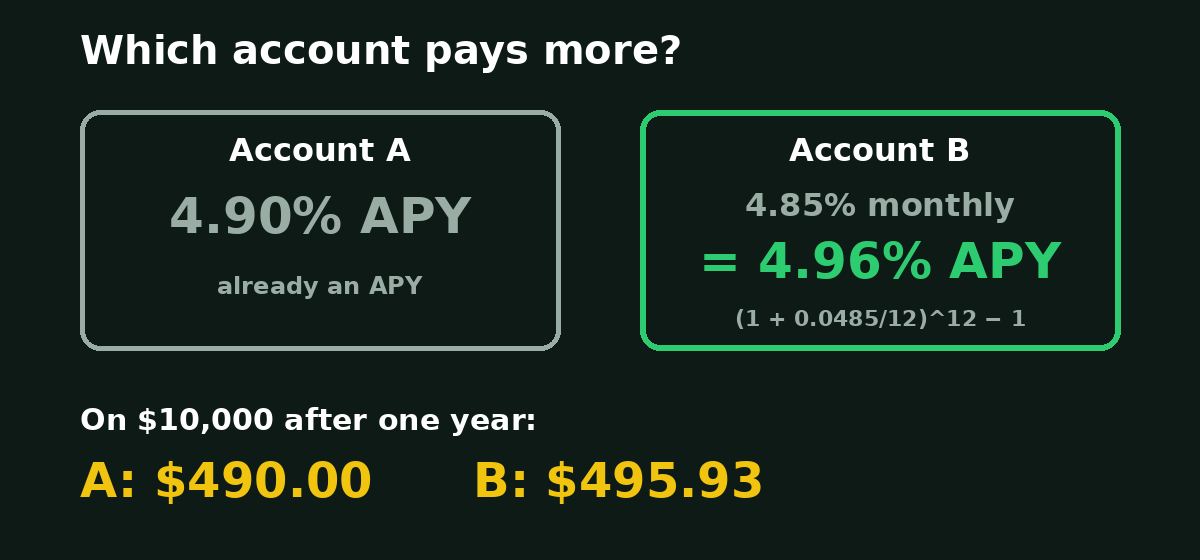
Back to the opening example. Account A advertises a 4.90 percent APY. Account B advertises a 4.85 percent rate compounded monthly.
- Account A: APY is already stated, 4.90 percent.
- Account B: (1 + 0.0485 / 12)12 − 1 = 4.96 percent.
Account B pays slightly more even though its headline number is lower. This is why the APY, not the headline rate, is the figure to compare.
How Long Until Money Doubles?
The rule of 72 gives a quick estimate: divide 72 by the APY percentage. At 5 percent, 72 / 5 = 14.4 years. The exact figure is about 14.2 years, so the shortcut is close enough for planning. At 4 percent it gives 18 years, and at 8 percent it gives 9.
Going the Other Way: From APY to the Stated Rate
Sometimes you know the APY and want the stated rate for a given compounding schedule. Rearrange the formula: r = n × ((1 + APY)1/n − 1). For a 5 percent APY with monthly compounding, r = 12 × (1.051/12 − 1) = about 4.889 percent. With daily compounding it is about 4.879 percent. The more often interest is added, the lower the stated rate needed to reach the same yield.
APY on Savings Accounts vs CDs
A regular savings account usually has a variable APY that the bank can change at any time. A certificate of deposit locks your money for a fixed term, such as 6 months or 5 years, and normally fixes the rate for that period. The trade-off is access: taking money out of a CD early typically costs a penalty, often some months of interest. If you value flexibility, compare savings accounts. If you want certainty about the rate, compare CDs of the same length. In both cases, compare the APY, not the stated rate.
What APY Does Not Tell You
- Rates can change. Most savings accounts have a variable rate, so the advertised APY may drop later. CDs usually lock the rate for the term.
- Fees can eat the yield. A monthly maintenance fee reduces your real return, especially on small balances.
- Minimum balances and tiers. Some accounts pay the top APY only above a certain balance.
- Taxes and inflation. Interest is usually taxable, and a yield below the inflation rate means your money loses buying power even though the balance grows.
Common Mistakes
- Comparing APY with APR. They measure different things.
- Looking only at the headline rate. Compounding frequency changes the real yield.
- Forgetting the time frame. APY describes one year. Over several years you need the full compound interest calculation with deposits and withdrawals.
- Ignoring fees and balance requirements. The best advertised yield is not always the best account.
Calculate It Online
Use our APY calculator to convert a stated rate and compounding frequency into the real yield. To project a balance over several years with regular deposits, try the savings calculator. For the borrowing side of the same question, the loan calculator shows the cost of a loan at a given rate.
Frequently Asked Questions
Is a higher APY always better?
For savings, yes, if everything else is equal. Check for fees, balance minimums and whether the rate is fixed or variable.
What is the difference between APY and interest rate?
The interest rate is the stated yearly rate. APY includes the effect of compounding, so it is equal to or higher than the rate.
Is APY the same as APR?
No. APR is mainly used for borrowing and does not include compounding within the year. APY is used for deposits and does.
Does APY apply to loans?
Not in the usual sense. Loans and credit cards are quoted with APR, while APY is the figure for what you earn on deposits.