Most people think about sleep in hours: "I got six" or "I need eight." Sleep scientists also describe it in cycles, repeating stretches of about 90 minutes during which the brain moves through light sleep, deep sleep and dream sleep. A bedtime calculator uses that rhythm to suggest times when you are more likely to wake near the end of a cycle. This guide explains what a sleep cycle is, how to calculate a bedtime or wake-up time from it, how much sleep adults and children need, and where the cycle method has limits.
What Happens in a Sleep Cycle
Sleep has four stages, usually grouped into non-REM and REM sleep:
- Stage N1: the lightest stage, a few minutes of drifting off.
- Stage N2: light sleep with slower heart rate and body temperature. It takes up roughly half of the night.
- Stage N3: deep, slow-wave sleep, important for physical recovery. It is hardest to wake from.
- REM sleep: rapid eye movement sleep, when most vivid dreaming occurs, linked with memory and mood.
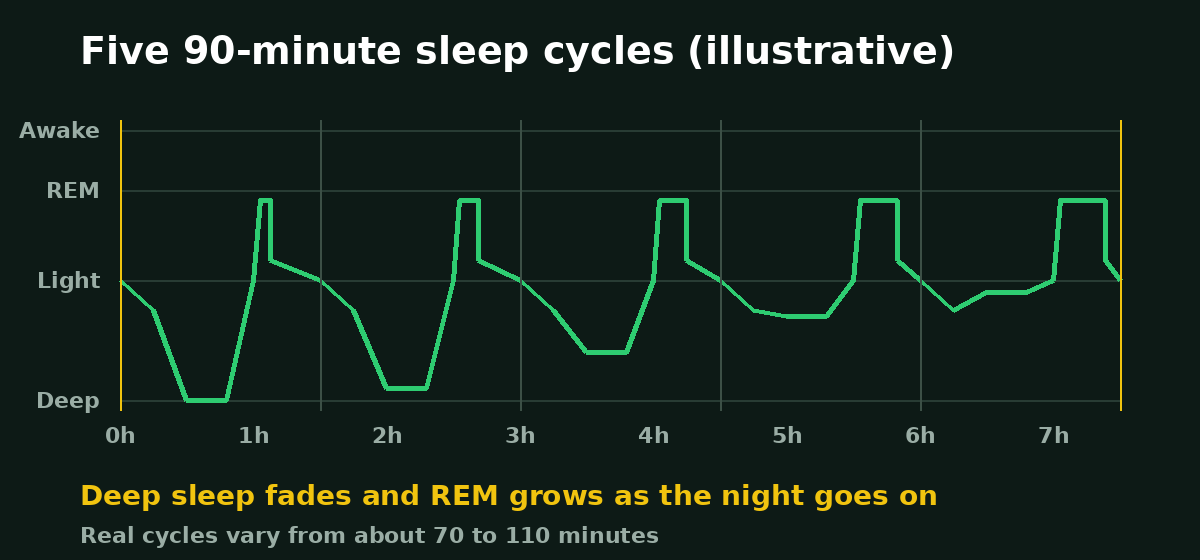
One full cycle lasts about 90 minutes on average, although it varies from person to person and from night to night, often between 70 and 110 minutes. Deep sleep is concentrated in the first half of the night, while REM periods grow longer toward the morning. That is why cutting the end of your sleep short tends to cost you REM.
How Much Sleep Do You Need?
Recommendations come from expert panels such as the National Sleep Foundation and the American Academy of Sleep Medicine. Typical ranges are:
| Age group | Recommended sleep per 24 hours |
|---|---|
| School-age children (6 to 12) | 9 to 12 hours |
| Teenagers (13 to 18) | 8 to 10 hours |
| Adults (18 to 64) | 7 to 9 hours (at least 7) |
| Older adults (65+) | 7 to 8 hours |
Needs vary, so use these as a guide. If you wake rested and stay alert during the day, your amount is probably right for you.
How to Calculate a Bedtime From Your Wake-Up Time
- Choose the time you must wake up.
- Choose how many cycles you want. Five cycles equals 7.5 hours, and six cycles equals 9 hours.
- Subtract the cycles from the wake-up time.
- Subtract about 15 minutes more for the time it takes you to fall asleep. Adults commonly take 10 to 20 minutes.
Example. You need to wake at 6:30.
- Five cycles (7.5 hours) plus 15 minutes to fall asleep: 6:30 minus 7 hours 45 minutes = 10:45 pm.
- Six cycles (9 hours) plus 15 minutes: 6:30 minus 9 hours 15 minutes = 9:15 pm.
- Four cycles (6 hours) plus 15 minutes: 6:30 minus 6 hours 15 minutes = 12:15 am. Four cycles is below what most adults need, so use it only occasionally.
How to Calculate a Wake-Up Time From Your Bedtime
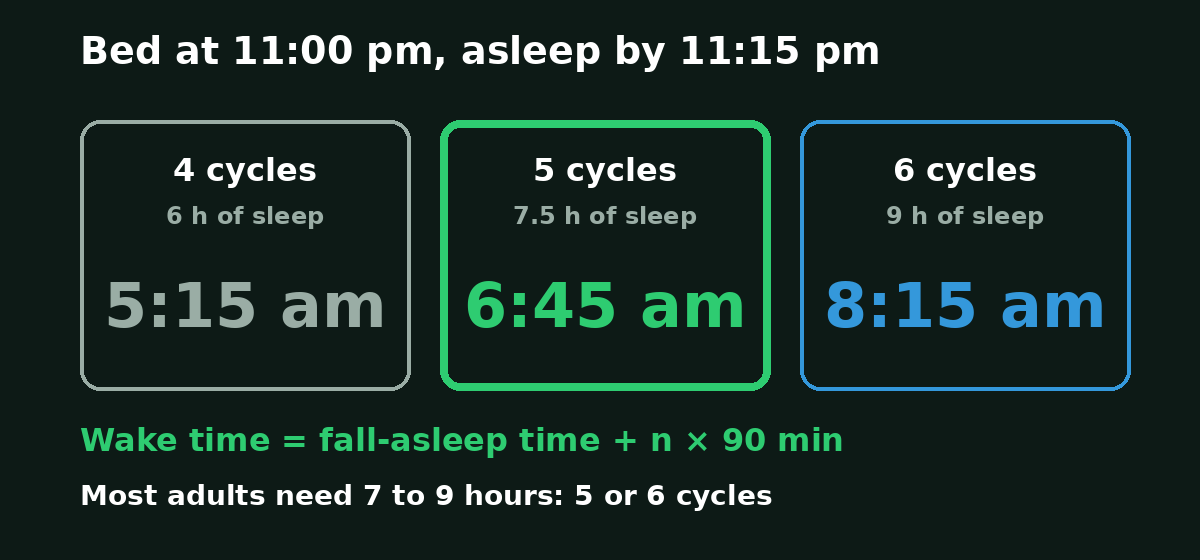
Reverse the process: add 15 minutes for falling asleep, then add multiples of 90 minutes. If you go to bed at 11:00 pm and fall asleep at about 11:15 pm:
- After 4 cycles (6 hours): 5:15 am
- After 5 cycles (7.5 hours): 6:45 am
- After 6 cycles (9 hours): 8:15 am
Does Waking at the End of a Cycle Really Help?
This is the part that is often oversold. Waking from deep sleep can cause sleep inertia, the groggy, slow feeling that lasts several minutes to an hour. In theory, waking from lighter sleep at the end of a cycle reduces it. In practice, real cycles are not exactly 90 minutes, they change during the night, and your alarm will not match them perfectly. Consumer devices that claim to detect stages are only approximate.
Treat the cycle method as a practical way to plan a consistent schedule that gives you enough total sleep. Total sleep time, regular timing and sleep quality matter more than hitting a precise cycle boundary. Missing the target by 10 or 15 minutes is not a problem.
Habits That Improve the Result
- Keep a consistent schedule. Go to bed and wake up at similar times, including weekends. A shifting schedule is a common cause of tiredness.
- Watch caffeine timing. Caffeine has a half-life of roughly five to six hours in many adults, so an afternoon coffee can still be active at bedtime. Sensitivity varies.
- Dim the lights and screens before bed. Bright light in the evening can delay sleepiness.
- Keep the bedroom cool, dark and quiet.
- Limit alcohol near bedtime. It may help you fall asleep but tends to fragment sleep later in the night.
- Get daylight in the morning. It helps anchor your body clock.
Sleep Debt: Can You Catch Up?
If you lose an hour of sleep each night for a week, you accumulate a deficit of about seven hours. Sleeping longer on a weekend can help you recover somewhat, but one long night does not erase the effects of a short week, and large swings in schedule can make weekday mornings harder. A better approach is to move your bedtime earlier by 15 to 30 minutes every few days until you reach your target.
Common Mistakes
- Forgetting the time to fall asleep. Lying down at 10:45 does not mean you are asleep at 10:45.
- Aiming for a perfect cycle count and ignoring total sleep. Six hours is not enough for most adults even if it equals four tidy cycles.
- Using the same cycle length for everyone. Your own cycle may be shorter or longer than 90 minutes.
- Hitting snooze. Short fragments of extra sleep are not restful and can increase grogginess.
When Sleep Problems Need a Doctor
See a doctor if you regularly struggle to fall asleep, wake often, snore loudly with pauses in breathing, feel very sleepy during the day despite enough hours, or if sleep problems last more than a few weeks. These can be signs of conditions such as insomnia or sleep apnea, which are treatable.
Calculate It Online
Use our sleep calculator to get bedtimes or wake-up times based on cycles. To see how rest affects your energy needs, try the TDEE calculator.
Frequently Asked Questions
How many sleep cycles do I need per night?
Most adults need about five to six cycles, which is roughly 7.5 to 9 hours in bed from falling asleep to waking.
Is 6 hours of sleep enough?
For most adults it falls below the recommended 7 hours. Some people feel fine on less, but research links regularly short sleep with poorer attention, mood and health.
What time should I go to bed if I wake at 7 am?
For five cycles plus 15 minutes to fall asleep, aim for 11:15 pm. For six cycles, aim for 9:45 pm.