Your heart rate is the simplest live measure of how hard your body is working. Train too gently and you get little benefit. Train too hard, too often, and you accumulate fatigue instead of fitness. Target heart rate zones turn "go easy" and "push hard" into numbers you can read from a watch or chest strap. This guide explains how to estimate your maximum heart rate, how to calculate zones with two different methods, and how to use them without chasing numbers blindly.
Step 1: Estimate Your Maximum Heart Rate
Maximum heart rate (HRmax) is the highest number of beats per minute your heart can reach during all-out effort. The most accurate way to find it is a supervised exercise test. For everyone else, there are formulas based on age:
- Classic formula: HRmax = 220 − age
- Tanaka formula: HRmax = 208 − 0.7 × age
The classic formula is the most widely known, but it is rough. Studies of large groups show that individual maximums can differ from the formula by 10 to 12 beats per minute or more in either direction. The Tanaka formula, based on a larger analysis of research data, tends to fit older adults better.
Example, age 40: 220 − 40 = 180, and 208 − 0.7 × 40 = 180. Both formulas agree here.
Example, age 60: 220 − 60 = 160, while 208 − 0.7 × 60 = 166. The gap widens with age.
Step 2: Calculate Zones as a Percentage of Maximum
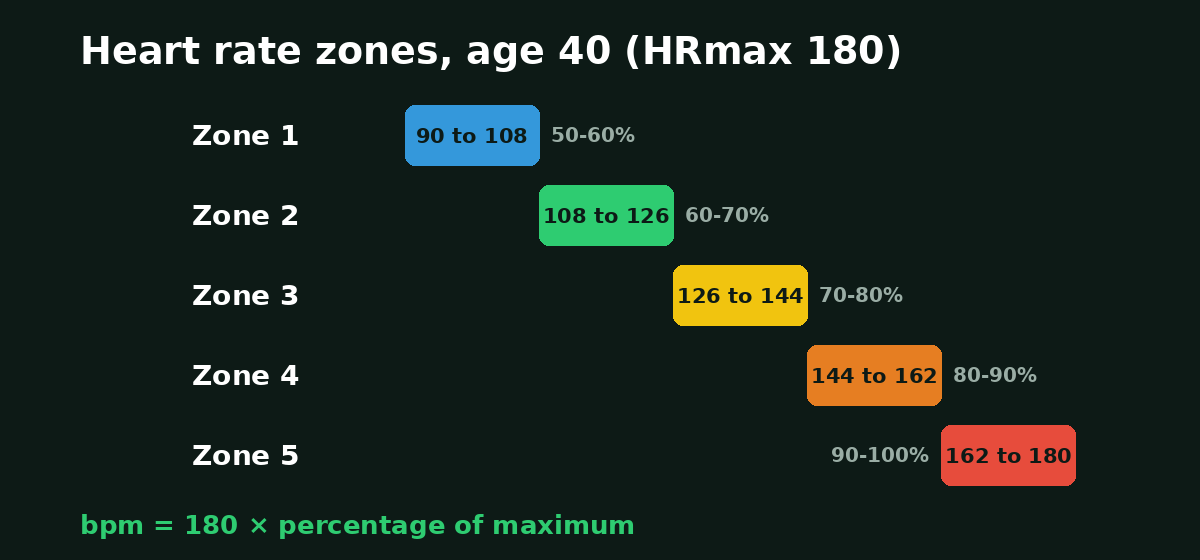
The simplest method multiplies your HRmax by a percentage range. A common five-zone model looks like this:
| Zone | % of HRmax | How it feels | Typical purpose |
|---|---|---|---|
| 1 | 50 to 60% | Very easy, full conversation | Warm-up, recovery |
| 2 | 60 to 70% | Easy, can talk in sentences | Base endurance, fat use |
| 3 | 70 to 80% | Moderate, shorter sentences | Aerobic fitness |
| 4 | 80 to 90% | Hard, a few words at a time | Threshold, faster pace |
| 5 | 90 to 100% | Maximal, cannot talk | Short intervals |
Worked example for a 40-year-old with HRmax 180:
- Zone 1: 180 × 0.50 = 90 to 180 × 0.60 = 108 bpm
- Zone 2: 108 to 126 bpm
- Zone 3: 126 to 144 bpm
- Zone 4: 144 to 162 bpm
- Zone 5: 162 to 180 bpm
Step 3: Use the Karvonen Method for a More Personal Result
The percentage method ignores how fit you are. The Karvonen method adds your resting heart rate, which reflects fitness, and works with your heart rate reserve, the gap between resting and maximum:
Target HR = (HRmax − HRrest) × intensity + HRrest
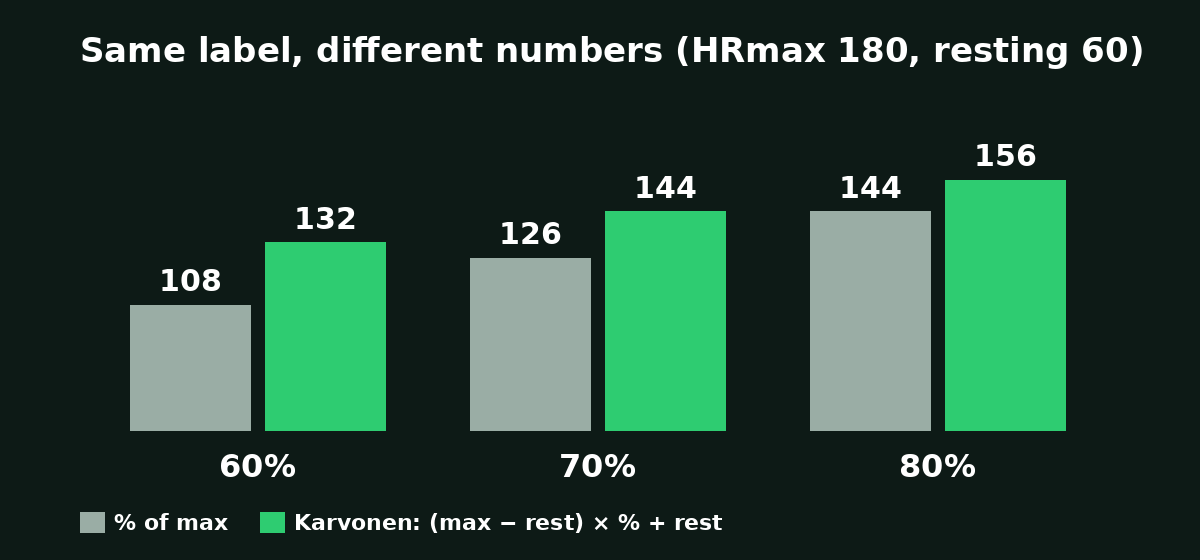
Measure your resting heart rate in the morning, lying still, before getting up. Take the average over a few days. Say your HRmax is 180 and your resting rate is 60. The reserve is 120.
- At 60 percent: 120 × 0.60 + 60 = 132 bpm
- At 70 percent: 120 × 0.70 + 60 = 144 bpm
- At 80 percent: 120 × 0.80 + 60 = 156 bpm
- At 90 percent: 120 × 0.90 + 60 = 168 bpm
Notice that Karvonen gives higher beats per minute for the same label than the simple percentage method. At 70 percent the simple method gives 126 bpm, while Karvonen gives 144 bpm. This is not a mistake. The two methods define "70 percent" differently, so do not mix their numbers. Pick one method and stay with it.
How Much Exercise Do You Need?
Public health guidelines from the World Health Organization recommend at least 150 to 300 minutes of moderate-intensity aerobic activity per week, or 75 to 150 minutes of vigorous activity, or a mix. The US Centers for Disease Control describes moderate intensity as roughly 64 to 76 percent of maximum heart rate and vigorous intensity as roughly 77 to 93 percent. For HRmax 180 that is about 115 to 137 bpm for moderate and 139 to 167 bpm for vigorous activity.
The Talk Test: A Free Backup
Heart rate formulas are estimates, so it helps to cross-check with how you feel:
- If you can sing, you are in the lowest zone.
- If you can talk comfortably in full sentences, you are in moderate territory.
- If you can only say a few words, intensity is vigorous.
If the number on your watch says "zone 2" but you are gasping, trust your body and check the settings. Heat, dehydration, poor sleep, caffeine, stress and illness can all raise heart rate for the same effort.
Resting Heart Rate as a Fitness Signal
A typical resting heart rate for adults is 60 to 100 beats per minute. Regular endurance training often lowers it, because the heart pumps more blood per beat. A gradual drop over weeks suggests improved fitness. A rise of several beats above your normal for a few days can be a sign of fatigue, illness or poor recovery.
Common Mistakes
- Treating the formula as exact. Your true maximum may be well above or below the estimate.
- Training in zone 3 all the time. Many people drift into a moderate "gray zone" on every session. A mix of easy days and a few hard sessions usually works better.
- Using wrist sensors without checking them. Optical sensors can lag or misread during intervals. A chest strap is more reliable.
- Mixing methods. Percentage-of-max and Karvonen zones give different numbers.
- Ignoring conditions and medications. Beta blockers and some other drugs lower heart rate, which makes standard formulas misleading.
When to See a Doctor
Talk to a doctor before starting vigorous exercise if you have heart disease, high blood pressure, diabetes, chest pain or dizziness during activity, or if you have been inactive for a long time. Stop exercising and seek medical help if you experience chest pain, severe breathlessness or fainting.
Calculate It Online
Our target heart rate calculator gives your zones from your age and resting heart rate. Pair it with the pace calculator to plan runs by speed, and the calorie calculator to estimate energy needs.
Frequently Asked Questions
What is a good target heart rate for fat burning?
Fat contributes the largest share of energy at lower intensities, roughly zones 1 and 2. Total calories burned matter more for fat loss than the zone alone, so harder sessions can be just as effective.
What is a dangerous heart rate during exercise?
There is no single number. Exceeding your estimated maximum briefly is not automatically dangerous, but symptoms such as chest pain, dizziness or severe breathlessness are warning signs at any heart rate.
Does fitness lower my maximum heart rate?
Not in a meaningful way. Maximum heart rate depends mainly on age and genetics. Fitness mostly lowers resting heart rate and the rate at a given effort.