Trajectory Calculator
Model the flight path of any projectile: enter launch speed, angle, and height.
Results
Calculation Examples

How to Use the Trajectory Calculator
The calculator takes three inputs and returns a complete kinematic profile of the flight. Enter the Initial Velocity \(v_0\) in meters per second — this is the speed of the object at the exact moment of release. Set the Launch Angle \(\alpha\) in degrees: 0° means a purely horizontal throw, 90° is a straight vertical launch upward. Finally, enter the Initial Height \(h_0\) in meters — the vertical distance between the launch point and the landing surface. A ball thrown from a second-floor window, for example, might have \(h_0 = 4\) m.
After clicking Calculate, the tool returns maximum height above the landing level, horizontal range (total ground distance covered), total flight time, and impact velocity at the moment the object reaches the ground. A 140-point parabolic curve is plotted on the interactive canvas so you can visualize how changing the launch height or angle reshapes the flight path. The model uses a standard gravitational acceleration of \(g = 9.81 \, m/s^2\) and assumes no air resistance, which is the accepted baseline for classical kinematics problems per NIST standard reference data.
How Projectile Trajectory Calculations Work
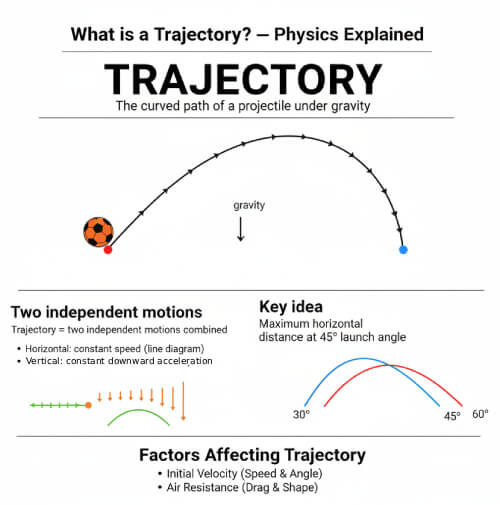
Projectile motion is governed by the independence of horizontal and vertical motion — a principle established by Galileo Galilei and formalized in Newtonian mechanics. The initial velocity is decomposed into two perpendicular components:
\[v_x = v_0 \cdot \cos(\alpha), \quad v_y = v_0 \cdot \sin(\alpha)\]
Because gravity acts only vertically, \(v_x\) remains constant throughout the flight. The vertical velocity changes with time as:
\[v_y(t) = v_y - g \cdot t\]
The calculator finds the time to peak when the vertical velocity equals zero (\(t_{peak} = v_y / g\)), then solves the full quadratic displacement equation for total flight time:
\[0 = h_0 + v_y \cdot t - \frac{1}{2} g \cdot t^2\]
Horizontal range is \(R = v_x \cdot t_{total}\). Impact velocity combines both components at the moment of landing:
\[v_{impact} = \sqrt{v_x^2 + v_{y,land}^2}\]
Useful Tips 💡
- For maximum range on level ground (\(h_0 = 0\)), use a launch angle of 45°. When the launch point is higher than the landing point, the optimal angle shifts below 45° — closer to 30°–40° depending on height.
- The impact velocity is always higher than the initial velocity when the object lands below its launch point, because gravitational potential energy converts to kinetic energy during the descent.
- Time to peak equals exactly half the total flight time only when launch height and landing height are equal (\(h_0 = 0\)).
📋Steps to Calculate
-
Enter the initial speed in m/s and the launch angle in degrees (0° for horizontal, 90° for vertical).
-
Input the initial height in meters if the launch point is elevated above the landing surface.
-
Click Calculate to generate the flight data and the interactive parabolic path graph.
Mistakes to Avoid ⚠️
- Confusing initial height (the elevation of the launch point) with maximum height (the highest point reached during flight).
- Entering angles in radians instead of degrees: at \(\alpha = 1\) radian (57.3°), the calculator will produce a correct result for that angle, but most users intend to enter whole-degree values.
- Assuming the model accounts for air resistance: drag reduces real-world range by 20–40% for small projectiles at typical speeds, so treat results as an upper-bound ideal estimate.
- Omitting the initial height of the thrower or launch platform, which can add 1.5–2 m and meaningfully extend the calculated range.
Practical Applications📊
Optimizing launch angles in javelin, discus, and basketball to maximize range or control the entry angle at the target.
Predicting the path of water streams from fire hoses or irrigation nozzles based on pressure and nozzle height.
Providing a computational benchmark for physics students to verify manual kinematic solutions against a reference result.
Estimating fall distance and impact zone for objects projected from height in construction and industrial safety assessments.