CPM Calculator
Calculate cost per thousand impressions, total ad budget, or total reach from any two known campaign values.
Result
Enter any two values — the third will be calculated automatically (all values in the selected currency).
Calculation Examples

How to Use the CPM Calculator
Select the variable you want to find: CPM rate, total campaign cost, or total impressions. Enter the two values you already know and click Calculate. The tool solves for the third automatically.
For example, if you have a fixed budget of $5,000 and a platform CPM of $10, the calculator returns the expected reach of 500,000 impressions. If you ran a campaign and want to know your actual CPM, enter the total spend and the delivered impression count. The result lets you compare cost efficiency across channels: a $3 CPM on a display network versus a $25 CPM on LinkedIn tells a very different story about audience targeting costs, even before considering conversion rates.
Always use actual delivered impressions from your ad manager dashboard rather than estimated or projected figures when evaluating a completed campaign. Estimated reach numbers provided before a campaign are typically broader than what is actually delivered.
Understanding the CPM Formula
CPM stands for Cost Per Mille, from the Latin word for thousand. It is the standard unit for impression-based advertising pricing across programmatic, social, and display channels. The three formulas the calculator uses are: \[\text{CPM} = \frac{\text{Total Cost}}{\text{Total Impressions}} \times 1{,}000\] \[\text{Total Cost} = \frac{\text{Total Impressions} \times \text{CPM}}{1{,}000}\] \[\text{Total Impressions} = \frac{\text{Total Cost}}{\text{CPM}} \times 1{,}000\]
Standardizing to a per-thousand basis allows advertisers to compare inventory across publishers of vastly different scales: a niche blog with 50,000 monthly views and a national news site with 50 million views can both quote a CPM that sits on the same scale. Without this normalization, comparing raw costs would be meaningless.
Useful Tips 💡
- Check whether your platform reports gross spend (including fees) or net spend before entering the cost figure, since agency fees of 10-15% are common and will inflate your apparent CPM.
- CPM rates typically rise 30-50% in Q4 due to increased advertiser competition during the holiday season: factor this into budget forecasts.
📋Steps to Calculate
-
Identify which two values you already have: cost, impressions, or CPM rate.
-
Enter those two values into the corresponding fields.
-
Click Calculate to instantly find the third variable.
Mistakes to Avoid ⚠️
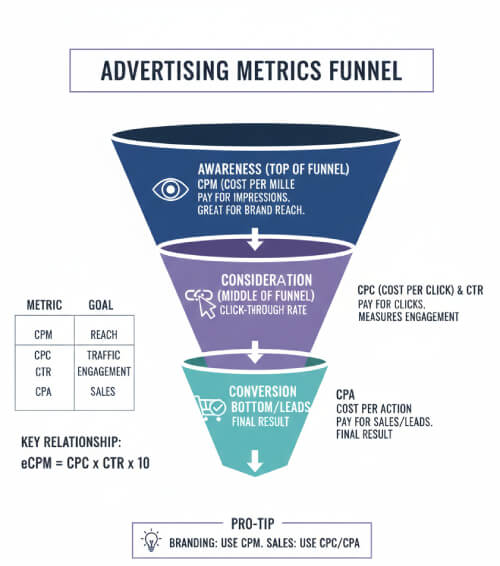
- Confusing CPM with CPC: CPM charges for impressions regardless of whether anyone clicks, while CPC charges only when a user clicks the ad.
- Entering raw impression counts without dividing: the formula already handles the per-thousand normalization, so enter the full number (for example 500,000, not 500).
- Using projected or estimated impressions instead of actual delivered impressions when evaluating a completed campaign.
- Ignoring ad frequency: high impression frequency on a small audience raises effective CPM while producing diminishing returns on brand recall.
Practical Applications in Media Buying📊
Benchmark brand awareness campaign costs across Google Display, Meta, LinkedIn, and programmatic platforms.
Compare programmatic direct buys against real-time bidding (RTB) auction CPMs to identify the more cost-efficient channel.
Calculate effective CPM (eCPM) for publishers to assess the revenue value of their ad inventory per thousand page views.
Forecast video ad budgets on YouTube or connected TV, where CPMs typically run significantly higher than display.