Attrition Rate Calculator

Quantify workforce turnover and evaluate organizational stability through standardized HR metrics and attrition calculation models.

Calculation Examples

Calculation Case Result
Corporate Office: 200 start, 210 end, 15 leavers 7.32% Attrition Rate
High Turnover Sector: 50 start, 40 end, 12 leavers 26.67% Attrition Rate
Voluntary Focus: 8 resignations out of 10 total departures 80% Voluntary Ratio

How to use the Attrition Rate Calculator?

Effective attrition calculation requires precise data points concerning your workforce movement within a specific reporting window. To obtain valid results, you must identify the exact headcount at the beginning and the conclusion of your period.
1. Data Collection: Aggregate the total number of departures. For more granular insights, distinguish between involuntary separations and voluntary departures, as the latter often reflects internal culture or compensation issues.
2. Period Selection: Decide whether you are generating a monthly attrition formula report or an annualized attrition rate.

This tool utilizes the arithmetic mean of your start and end headcount to neutralize the impact of mid-period hiring surges or layoffs. This methodology aligns with SHRM standards, ensuring your employee attrition rate is comparable to global attrition rate benchmarks. Monitoring these figures allows HR directors to identify retention trends before they impact operational efficiency.

The Mathematics of Workforce Shrinkage

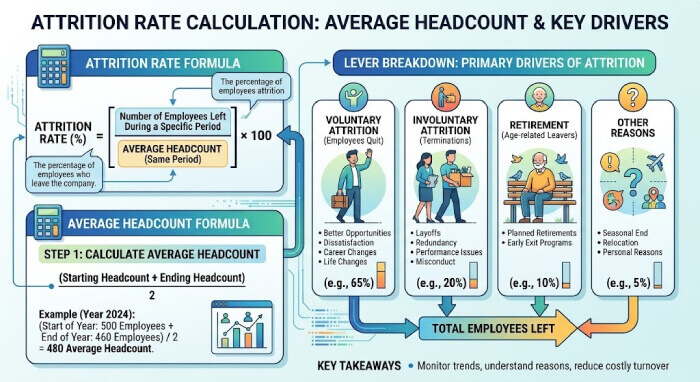
The employee attrition rate formula is a core KPI in human capital management, representing the velocity at which staff leave the organization relative to the average workforce size. Unlike turnover, which often implies replacement, attrition metrics focus on the overall reduction in force.

The calculation begins with determining the Average Headcount: $$Average \, Headcount = \frac{Headcount_{start} + Headcount_{end}}{2}$$
Subsequently, the attrition percentage calculation formula is applied: $$Attrition \, Rate \, (\%) = \left( \frac{Total \, Leavers}{Average \, Headcount} \right) \times 100$$

If you are analyzing data mid-year, the annualized attrition calculator logic projects these findings to a 12-month equivalent. This is vital for long-term fiscal planning and recruitment budgeting. While a "healthy" attrition percentage varies by sector, maintaining a low voluntary attrition rate is universally regarded as a sign of high employee engagement and competitive positioning.

Useful Tips 💡

  • To avoid skewed data, ensure that seasonal contractors are categorized separately from your permanent average headcount.
  • When using a monthly attrition formula, remember that short-term spikes (e.g., after bonus payouts) may not reflect annual trends.
  • Consistency in data entry is key; always use the same day of the month for start/end headcount snapshots.

📋Steps to Calculate

  1. Input the total employee count at the beginning of the analysis period.

  2. Input the total employee count at the end of the analysis period.

  3. Enter the Total Leavers (include all departures) and specify voluntary exits if known.

  4. Execute the calculation to view the attrition percentage and mean headcount.

Mistakes to Avoid ⚠️

  1. Using only the starting headcount as the denominator, which fails to account for growth or contraction during the period.
  2. Excluding employees who both joined and departed within the same measurement window.
  3. Confusing attrition with turnover; attrition often accounts for roles that will not be immediately backfilled.
  4. Failing to annualize monthly data when presenting reports to executive leadership.

Strategic Applications of Attrition Data📊

  1. Risk Assessment: Identify departments with an annualized attrition rate exceeding industry norms.

  2. Retention Analysis: Correlate high voluntary attrition with exit interview data to refine HR policies.

  3. Workforce Planning: Use historical attrition calculation results to forecast future hiring requirements.

  4. Financial Reporting: Quantify the impact of employee loss on organizational productivity and onboarding costs.

Questions and Answers

What is an attrition rate calculator?

An attrition rate calculator is a professional analytical tool used by HR departments to determine the percentage of the workforce that has left during a specific interval. By performing a systematic attrition calculation, an organization can measure its retention health. This tool specifically focuses on the attrition percentage calculation formula, providing data that is essential for benchmarking against competitors and identifying internal labor risks.

How to calculate employee attrition rate?

To calculate the employee attrition rate, you divide the number of departures by the average headcount for the period, then multiply by 100. The average headcount is the sum of your employees at the start and end of the period divided by two. For example, if you have 10 leavers and an average headcount of 100, your attrition is 10%. This formula is the standard metric used in human resources to track workforce stability.

Why should businesses distinguish between voluntary and involuntary attrition?

Distinguishing the voluntary attrition rate is critical because it highlights "preventable" losses—employees leaving due to dissatisfaction, better offers, or culture fit. In contrast, involuntary attrition (layoffs or terminations) is usually driven by the employer. High voluntary attrition is a leading indicator of management issues and significantly higher recruitment costs, making it the most important component of an attrition calculation.

How is the annualized attrition rate determined?

The annualized attrition rate is a projection of your current attrition data over a full 12-month period. If your quarterly rate is 3%, your annualized rate would be approximately 12%. This metric is vital for stakeholders to understand the long-term trajectory of workforce depletion and to set realistic hiring targets for the fiscal year.

What is the standard monthly attrition formula?

The monthly attrition formula calculates the rate of departure for a single month: $(Total \, Departures / Average \, Monthly \, Headcount) \times 100$. While monthly data can be volatile due to seasonal factors, it is an excellent way for HR teams to measure the immediate impact of new organizational changes or policy implementations.

What are typical attrition rate benchmarks?

While attrition rate benchmarks vary wildly by industry, a total rate between 10% and 15% is often seen as standard for office-based sectors. Tech and retail industries frequently experience attrition percentages of 20% to 35%. Comparing your internal attrition calculation to these standards helps determine if your retention programs are effective or if you are losing talent to competitors at an unsustainable rate.

Is a 0% attrition rate desirable?

Counterintuitively, a 0% attrition rate is rarely the goal. Some attrition (healthy attrition) allows for "new blood," fresh perspectives, and the removal of underperformers. However, the objective of any attrition rate calculator analysis is to ensure that the loss of high-performers (regrettable attrition) is minimized and that the voluntary attrition rate remains within manageable parameters.
Disclaimer: This calculator is designed to provide helpful estimates for informational purposes. While we strive for accuracy, financial (or medical) results can vary based on local laws and individual circumstances. We recommend consulting with a professional advisor for critical decisions.