Profit Calculator
Calculate net profit and profit margin percentage from your revenue and total cost figures.
1 USD = USD
Note: enter current exchange rate (e.g. from Google, xe.com, wise.com). If same currency - rate = 1.Total cost (buy currency): 0.00 USD
Total cost (sell currency): 0.00 USD
Revenue: 0.00 USD
Total profit: 0.00 USD
Profit per unit: 0.00 USD
Profit margin: 0.00%
Markup on cost: 0.00%
Calculation Examples

How to Use the Profit Calculator
Enter two values: your total revenue and your total costs for the same time period. Revenue is every dollar received from sales, services, or other income before any deductions. Total costs should include everything spent to generate that revenue: cost of goods sold (COGS), labour, rent, utilities, marketing, software, and any other operating expenses.
Click Calculate and the tool returns your net profit in currency terms and your profit margin as a percentage. A positive result means revenue exceeded costs. A negative result means you operated at a loss for the period.
For the most accurate result, make sure revenue and costs cover the same period. Using monthly revenue against annual costs, or gross revenue against only direct costs, produces misleading margins. If you want a gross profit figure rather than net, enter only COGS as the cost input and note that the result excludes operating expenses.
The Profit Formula and How It Works
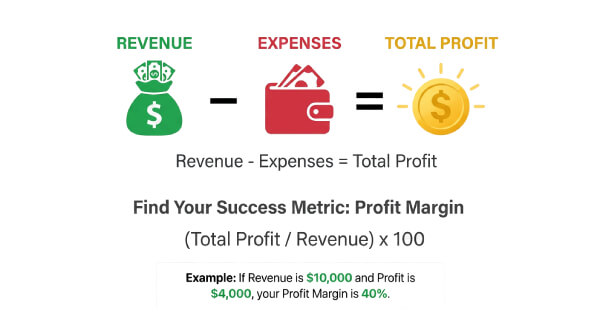
Profit is what remains from revenue after all costs are subtracted: \[\text{Profit} = \text{Total Revenue} - \text{Total Costs}\] The profit margin expresses that remainder as a percentage of revenue: \[\text{Profit Margin (\%)} = \frac{\text{Profit}}{\text{Total Revenue}} \times 100\]
Margin is often more useful than absolute profit because it allows comparison across businesses of different sizes. A business earning $10,000 profit on $50,000 revenue has a 20% margin; a business earning $100,000 profit on $1,000,000 revenue has the same 20% margin. Both are equally efficient at converting revenue into profit, even though the dollar amounts differ by a factor of ten.
These formulas follow the income statement structure defined by Generally Accepted Accounting Principles (GAAP) and International Financial Reporting Standards (IFRS). The distinction between gross profit (revenue minus COGS only) and net profit (revenue minus all costs) is fundamental to financial analysis and is worth understanding before interpreting the calculator output.
Useful Tips 💡
- Include all costs that are easy to forget: bank fees, payment processing charges (typically 1.5-3% of revenue), software subscriptions, and depreciation.
- Run a what-if scenario by reducing costs by 10% to see the margin impact before committing to a cost-cutting initiative.
📋Steps to Calculate
-
Enter total revenue for the period.
-
Enter total costs for the same period, including all fixed and variable expenses.
-
Click Calculate to see net profit in dollars and profit margin as a percentage.
Mistakes to Avoid ⚠️
- Omitting indirect costs such as utilities, insurance, and administrative salaries, which understates true costs and overstates margin.
- Mixing time periods, for example entering monthly revenue against annual rent, which distorts the result entirely.
- Confusing markup with margin: markup is calculated as profit divided by cost, while margin is profit divided by revenue. A 25% markup produces a 20% margin, not a 25% margin.
- Ignoring taxes: net profit before tax and net profit after tax are different figures, and only the after-tax number reflects cash actually available for distribution.
Practical Applications📊
Identify which products or services have the highest and lowest margins to guide pricing and discontinuation decisions.
Evaluate the full cost impact of advertising spend or shipping fees on e-commerce net profit per order.
Compare profit margins across quarters to detect cost creep or revenue decline before it compounds.