Friction Force Calculator
Calculate static or kinetic friction force on flat or inclined surfaces using the coefficient of friction and normal force.
Calculation Steps
Calculation Examples

How to Use the Friction Force Calculator
Select the friction type first: static (object at rest) or kinetic (object already sliding). The coefficient of friction \(\mu\) differs between these two states for the same material pair, so choosing the correct type matters before entering any numbers.
Enter the coefficient of friction \(\mu\) for your material combination. If you do not know the value, standard engineering tables list coefficients for common pairs such as steel on steel, rubber on concrete, or wood on wood. Then provide either the normal force \(N\) in Newtons directly, or the object mass \(m\) in kilograms and the surface incline angle \(\theta\) in degrees. The calculator derives the normal force automatically: \(N = mg\cos\theta\) for inclined surfaces and \(N = mg\) for horizontal ones. It then computes the friction force and compares it against the gravitational component \(mg\sin\theta\) to predict whether the object will remain stationary or begin sliding.
The Physics of Friction: Formulas and Principles
Dry friction between solid surfaces is described by the Amontons-Coulomb model. The core relationship is: \[F_f = \mu \cdot N\]
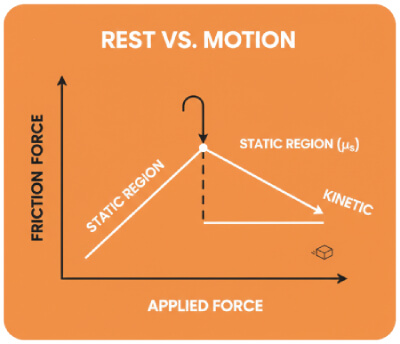
Static friction acts as a self-adjusting resistive force that matches the applied force up to a maximum threshold: \[F_{s,\max} = \mu_s \cdot N\] When the applied force exceeds this threshold, motion begins. Once sliding starts, friction drops to the kinetic value: \[F_k = \mu_k \cdot N\] In nearly all material pairs, \(\mu_s > \mu_k\), which is why more force is needed to start an object moving than to keep it sliding. This difference is what makes anti-lock braking systems effective: keeping wheels rolling (static friction) produces more stopping force than locked wheels skidding (kinetic friction).
On an inclined plane at angle \(\theta\), the normal force is the perpendicular component of gravity: \[N = m \cdot g \cdot \cos\theta\] The gravitational component driving the object down the slope is \(mg\sin\theta\). The object remains stationary as long as \(\mu_s \cdot mg\cos\theta \geq mg\sin\theta\), which simplifies to \(\mu_s \geq \tan\theta\).
Useful Tips 💡
- The coefficient of friction depends on both materials in contact and the surface condition: rubber on dry asphalt gives roughly 0.7-0.8, while rubber on wet ice drops to around 0.1.
- Always use the static coefficient when checking whether motion will start; switch to kinetic only after motion has begun.
📋Steps to Calculate
-
Select the motion state: static (at rest) or kinetic (already sliding).
-
Enter the coefficient of friction for your material pair.
-
Enter the object mass and surface incline angle, or the normal force directly.
-
Review the friction force result and the motion prediction.
Mistakes to Avoid ⚠️
- Entering weight (in Newtons) and mass (in kg) interchangeably: weight equals mass times g, and they are not the same quantity.
- Using the kinetic coefficient to determine whether an object starts moving: that decision always requires the static coefficient.
- Entering the full weight as the normal force on an inclined surface without applying the cosine correction, which overstates friction.
- Assuming friction increases with contact area: under the Amontons-Coulomb model, friction force is independent of apparent contact area.
Practical Applications📊
Determine whether an object will remain stationary or slide down an inclined surface given the friction coefficient and angle.
Estimate the required friction coefficient for vehicle braking and tire grip under different road conditions.
Analyze sliding forces in mechanical assemblies, conveyor belts, and material handling equipment.