Random Password Generator
Generate Strong, Secure Passwords for Maximum Protection
Calculation Examples

How to Use the Random Password Generator
Choose the desired password length. For most accounts, 12 to 16 characters provides a strong balance between security and usability; for high-value accounts such as banking or email, 20 characters or more is recommended. Select which character types to include: uppercase letters, lowercase letters, numbers, and special symbols.
Enable "Exclude Similar Characters" to remove visually ambiguous pairs (1 and l, 0 and O, I and |) that make passwords harder to type accurately. Click "Generate" to produce a unique, cryptographically secure password. Copy it directly to your clipboard and store it in a password manager. Never reuse the same password across multiple accounts: credential stuffing attacks exploit password reuse across breached databases.
The Science of Password Entropy
Password strength is measured in entropy bits, which quantifies how many guesses an attacker would need to exhaust all possible combinations. Entropy is calculated as: $$E = L \times \log_2(R)$$ where $L$ is password length and $R$ is the size of the character pool. A standard character set of 94 printable ASCII characters (uppercase, lowercase, digits, symbols) gives: a 12-character password: $E = 12 \times \log_2(94) \approx 12 \times 6.55 = 78.6\text{ bits}$; a 16-character password: $E \approx 104.8\text{ bits}$; a 20-character password: $E \approx 131\text{ bits}$. NIST SP 800-63B guidance considers 112 bits of entropy sufficient for the highest security applications. Each additional character adds approximately 6.55 bits; each additional character type in the pool adds a smaller incremental gain. This tool uses a Cryptographically Secure Pseudo-Random Number Generator (CSPRNG), sourced from OS-level entropy, ensuring the selection is statistically unpredictable and resistant to algorithmic prediction.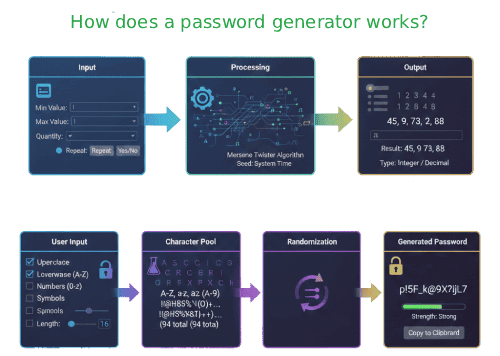
Useful Tips 💡
- Use a password manager (such as Bitwarden, 1Password, or KeePass) to store generated passwords. A password manager allows you to use a unique 20-character random password for every account without needing to memorize any of them.
- Enable all four character types unless a specific site restricts certain symbols. Restricting the character pool reduces entropy: a 16-character password with only lowercase letters has approximately 75 bits of entropy versus 104 bits with the full 94-character set.
📋Steps to Calculate
-
Set the desired password length (minimum 12 characters recommended; 16 or more for sensitive accounts).
-
Select character types: uppercase, lowercase, numbers, and symbols. Enable more types to increase entropy.
-
Click "Generate" and copy the result directly to your clipboard or password manager.
Mistakes to Avoid ⚠️
- Reusing passwords across multiple accounts. A single data breach at one service exposes every account where that password is used. Credential stuffing attacks automate this exploitation at scale.
- Using only lowercase letters or numbers. Each character type restriction significantly reduces the search space. Lowercase only: 26 possible characters per position. Full set: 94. The difference at 12 characters is $26^{12}$ versus $94^{12}$, approximately 95 trillion versus 475 quadrillion combinations.
- Saving passwords in plaintext: browser bookmarks, email drafts, notes apps, or spreadsheets. Plaintext storage means any device compromise exposes all credentials. Use an encrypted password manager with a strong master password.
- Generating passwords for security-critical applications using a non-cryptographic PRNG. General-purpose PRNGs are predictable given knowledge of the seed. Only CSPRNG-based generators are appropriate for password generation.
Practical Applications📊
Generate unique, high-entropy passwords for email, banking, and social media accounts to eliminate the credential reuse vulnerability that enables most account takeover attacks.
Create strong Wi-Fi network passwords and router admin credentials to prevent unauthorized access to home or office networks.
Produce unique API keys, temporary access tokens, and application secrets during software development where randomness and uniqueness are security requirements.