Car CO2 Emissions Calculator
Measure Your Vehicle CO2 Emissions and Annual Carbon Footprint
Calculation Examples

How to Use the Car CO2 Emissions Calculator
Enter your vehicle fuel efficiency (L/100km or MPG) and the distance you drive per year. Select your fuel type: petrol (gasoline), diesel, or electric. The tool displays your total annual CO2 output in kilograms and metric tonnes.
This allows you to visualize your carbon footprint and compare it against national and global averages. If you are evaluating a new vehicle, enter the efficiency figures for the model you are considering to compare its annual emissions against your current car, a hybrid, or a battery electric vehicle on your local electricity grid.
How CO2 Emissions Calculations Work
The calculator multiplies fuel consumption by fuel-specific CO2 emission factors to convert litres of fuel into kilograms of CO2 equivalent. The core formula is: \[\text{CO}_2\text{ (kg/year)} = \text{Distance (km)} \times \frac{\text{Fuel consumption (L/100km)}}{100} \times \text{Emission factor (kg CO}_2\text{/L)}\] Standard emission factors used are: petrol at 2.31 kg CO2 per litre, diesel at 2.68 kg CO2 per litre, and LPG at 1.61 kg CO2 per litre. These factors are derived from the carbon content of each fuel and the stoichiometry of complete combustion, consistent with IPCC AR6 guidance. For electric vehicles, emissions are calculated from the electricity consumption (kWh/100km) multiplied by the grid carbon intensity of the user's country or region, since tailpipe emissions are zero but upstream generation emissions vary significantly.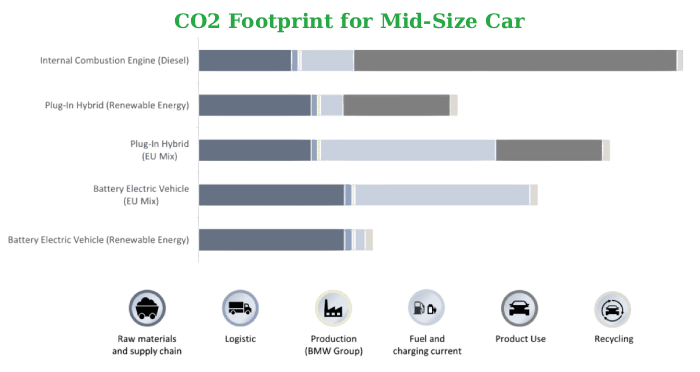
Useful Tips 💡
- Use your actual fuel consumption from recent fill-ups rather than the manufacturer's official rating. Real-world consumption is typically 15 to 25% higher than test-cycle figures, which significantly affects the emissions estimate.
- For electric vehicles, look up your country's grid carbon intensity in grams of CO2 per kWh. The same EV produces vastly different lifecycle emissions depending on whether the grid is powered predominantly by renewables or fossil fuels.
📋Steps to Calculate
-
Enter your vehicle fuel type (petrol, diesel, LPG, or electric) and fuel efficiency (L/100km or MPG).
-
Enter your annual driving distance in kilometres or miles.
-
Click "Calculate" to receive your annual CO2 output in kg and metric tonnes, with a comparison to average vehicle benchmarks.
Mistakes to Avoid ⚠️
- Looking only at tailpipe emissions for electric vehicles. Battery EVs produce zero direct tailpipe CO2, but their manufacturing process (especially battery production) and the carbon intensity of electricity generation both contribute to lifecycle emissions. A full well-to-wheel comparison is needed for accurate environmental assessment.
- Using manufacturer MPG or L/100km ratings without adjustment. Official test-cycle figures are measured under controlled conditions and typically overstate real-world fuel efficiency by 15 to 25%, leading to underestimated emissions.
- Ignoring vehicle load. Carrying 100 kg of additional weight increases fuel consumption by approximately 1 to 2%, which compounds meaningfully over high annual mileage.
Practical Applications📊
Personal carbon tracking: Calculating your annual vehicle emissions to identify offset requirements or set a reduction target.
Vehicle comparison: Evaluating the long-term environmental cost difference between petrol, diesel, hybrid, and electric models before purchasing.
Commuter planning: Quantifying the CO2 savings from carpooling, switching to public transport, or shifting to remote work days.