Length Conversion Calculator
Convert between metric and imperial length units instantly. Inches to meters, feet to centimeters, miles to kilometers, and more — using exact international standards.
Calculation Examples

How to Use the Length Conversion Calculator
This length converter handles everyday measurements and precision engineering work equally well. Getting a result takes three steps: enter a numeric value, select the source unit, and choose the target unit. The converted result appears immediately.
Supported units span both major systems: millimeters, centimeters, meters, and kilometers on the metric side; inches, feet, yards, and miles on the imperial side. All conversions use exact factors defined by the International Yard and Pound Agreement of 1959 and maintained by BIPM (Bureau International des Poids et Mesures). The general conversion formula is: $$L_{\text{target}} = L_{\text{source}} \times \text{Factor}$$ The tool is suitable for construction measurements, tailoring, scientific research, or simply checking a height in a different unit system while traveling.
Metric to Imperial and Back: The Math
Every conversion in this calculator traces back to one anchor point: since 1959, one inch is defined as exactly 0.0254 meters. This single constant, agreed upon internationally, makes all other metric-to-imperial conversions derivable with perfect precision.
The three most commonly needed formulas are:
\[ \text{Inches to meters:} \quad m = \text{in} \times 0.0254 \] \[ \text{Meters to inches:} \quad \text{in} = m \div 0.0254 \] \[ \text{Feet to meters:} \quad m = \text{ft} \times 0.3048 \]
The metric system is base-10, so within it all shifts are decimal: 1 meter = 100 centimeters = 1,000 millimeters. Cross-system conversions (feet to meters, inches to centimeters) require irrational-looking decimals, which is precisely where manual calculation goes wrong. A rounding error of just 0.001 on the conversion factor, when applied to a 10-meter structural beam, produces a 0.4-inch discrepancy — enough to matter in millwork or aerospace tolerances. Our calculator applies full-precision BIPM and NIST constants so your results meet the requirements of professional technical drawings, legal documentation, and scientific publication.
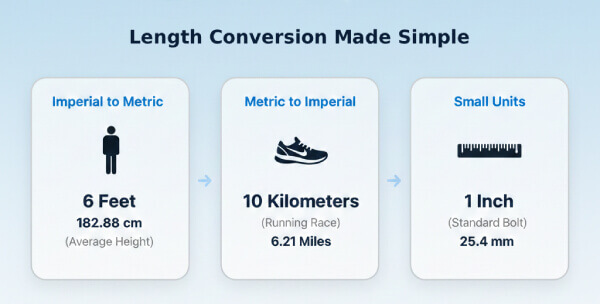
Useful Tips 💡
- When converting inches to meters for technical work, always use the full factor 0.0254, not the rounded approximation 0.025. The difference grows with scale.
- Within the metric system, conversions are just decimal shifts: 1 m = 100 cm = 1,000 mm. No factor memorization needed.
- For imperial-to-metric construction work, keep a reference: 1 foot = 0.3048 m, 1 inch = 2.54 cm, 1 yard = 0.9144 m.
📋Steps to Calculate
-
Enter a numeric value into the input field (use decimals, not fractions: enter 0.75 rather than 3/4).
-
Select the source unit from the first dropdown (e.g., inches).
-
Select the target unit from the second dropdown (e.g., meters).
-
Read the converted result instantly. The output shows full decimal precision.
Mistakes to Avoid ⚠️
- Confusing inches to meters with inches to centimeters: the factor for centimeters (2.54) is exactly 100 times larger than for meters (0.0254). Mixing them up produces a 100x error in your result.
- Entering fractional values like 3/4 instead of the decimal equivalent 0.75. Most calculators interpret a slash as a division operator or return an error.
- Using the survey mile (1,609.347 m) instead of the international mile (1,609.344 m) for standard conversions. The difference is negligible for everyday use but matters in geodetic and legal contexts.
- Rounding conversion constants mid-calculation in multi-step conversions (e.g., inches to feet to meters). Apply the full-precision factor only at the final step to prevent error accumulation.
Practical Applications of Length Conversion📊
Construction and engineering: Convert between imperial blueprint dimensions and metric site measurements when working on international or mixed-standard projects.
E-commerce and shipping: Translate package dimensions from inches to centimeters or meters for international freight labels and customs declarations.
Travel and everyday use: Convert height, road distance, or clothing size measurements when moving between countries that use different unit systems.
Education and science: Quickly switch between metric and imperial units during physics, chemistry, or engineering coursework without manual calculation.