Pressure Converter Calculator
Convert between PSI, bar, kPa, MPa, atm, mmHg, and torr instantly. Uses NIST and BIPM-standard constants for automotive, industrial, and scientific pressure calculations.
Calculation Examples

How to Use the Pressure Converter
Enter the pressure value you want to convert, select the source unit from the first dropdown (PSI, bar, kPa, MPa, atm, mmHg, torr), then choose the target unit. The result appears immediately.
The calculator covers both common units used in everyday applications — tire pressure in bar or PSI, atmospheric readings in hPa — and specialized units for industrial and laboratory work such as MPa, GPa, and torr. All conversions pass through the Pascal (Pa) as the SI base unit using the formula: $$P_{\text{target}} = P_{\text{source}} \times \text{Conversion Factor}$$ One practical note before you start: check whether your measurement is gauge pressure (relative to atmospheric pressure, labeled psig or barg) or absolute pressure (relative to perfect vacuum, labeled psia or bara). The converter works with absolute values; if your reading is gauge, add 1 atm (101.325 kPa / 14.696 psi) to get the absolute figure first.
Technical Standards and Pressure Units
All conversion factors in this calculator are anchored to the Pascal (Pa), the SI unit of pressure defined as one Newton per square meter: \[1\text{ Pa} = 1\text{ N/m}^2\] From this base, all other units are derived using constants maintained by NIST and BIPM:
- 1 bar = 100,000 Pa exactly (ISO 80000-4)
- 1 atm = 101,325 Pa exactly (IUPAC standard)
- 1 psi = 6,894.757 Pa (derived from the international pound and foot definitions)
- 1 mmHg = 133.322 Pa (conventional millimeter of mercury)
- 1 torr = 133.322 Pa (defined to equal 1 mmHg for practical purposes)
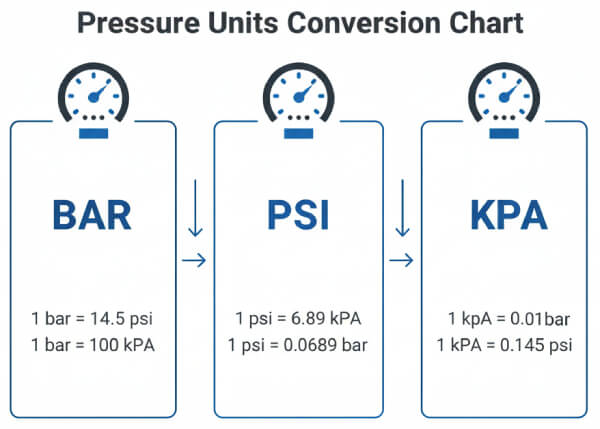
A common source of error in engineering calculations is using the rounded factor 14.5 for bar-to-PSI conversion instead of the precise value 14.50377. At 200 bar — a typical hydraulic system pressure — this rounding produces a 0.15 PSI error per bar, or 30 PSI cumulatively. In hydraulic safety specifications and pressure vessel certifications, that margin is not acceptable. The calculator applies the full-precision factor automatically.
Useful Tips 💡
- Always confirm whether your instrument reads gauge pressure (psig, barg) or absolute pressure (psia, bara) before converting. Gauge pressure omits atmospheric pressure (~14.696 psi at sea level); mixing the two types introduces a systematic error equal to 1 atm.
- For high-pressure applications above 100 bar, use MPa rather than kPa to avoid unwieldy numbers. 1 MPa = 10 bar = 145.038 PSI.
- Standard atmospheric pressure is 101.325 kPa = 1.01325 bar = 14.696 psi = 760 mmHg. Use this reference to cross-check any calibration reading.
📋Steps to Calculate
-
Enter the pressure value into the input field.
-
Select the source unit (e.g., bar, PSI, kPa, atm, mmHg).
-
Choose the target unit from the second dropdown.
-
Read the converted result instantly. For gauge pressure readings, add 1 atm to convert to absolute first.
Mistakes to Avoid ⚠️
- Confusing bar with millibar (mbar): 1 bar = 1,000 mbar. Entering a millibar reading into a bar field produces a result 1,000 times too large.
- Treating mmHg and torr as identical in high-precision work: they differ by about 0.000014% due to their different historical definitions. For clinical or metrological applications, use the correct unit explicitly.
- Ignoring gauge vs. absolute pressure: a tire inflated to 2.4 bar gauge is actually at 3.41 bar absolute at sea level. Using gauge values in absolute-pressure formulas (e.g., gas law calculations) gives incorrect results.
- Using the rounded bar-to-PSI factor of 14.5 in engineering calculations. The precise value is 14.50377. At pressures above 100 bar this rounding accumulates to several PSI of error.
Practical Applications📊
Automotive: Convert tire pressure between bar, PSI, and kPa. Most European vehicles specify pressure in bar; U.S. spec sheets use PSI. Correct conversion matters for fuel efficiency and tire longevity.
Industrial engineering: Translate hydraulic and pneumatic system specifications between MPa, PSI, and bar for equipment sourced from different countries.
Science and HVAC: Convert vacuum readings between mmHg, torr, and Pa for laboratory setups; convert refrigerant pressures between PSI and kPa for HVAC system diagnostics.
Meteorology: Convert weather station readings between hPa, mbar, atm, and inHg to normalize data across different instrument standards.