Volume Conversion Calculator
Convert between liters, gallons, cubic meters, milliliters, and cubic feet instantly. Uses SI and NIST-standard constants for precise liquid and solid volume calculations.
Calculation Examples

How to Use the Volume Conversion Calculator
This volume converter handles liquid measurement, industrial tank sizing, shipping calculations, and laboratory work in one place. To get a result: enter a numeric value, select the source unit from the dropdown, then choose the target unit. The converted figure appears immediately.
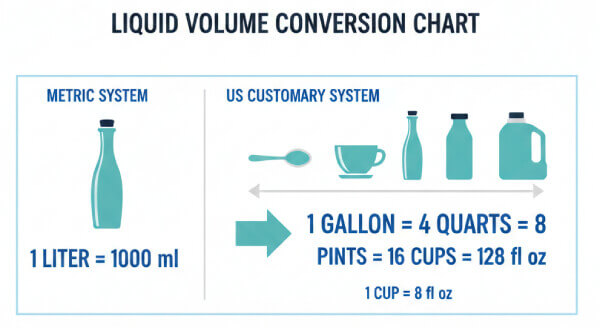
The calculator supports metric units (milliliters, liters, cubic meters) and imperial units (fluid ounces, pints, quarts, US gallons, Imperial gallons, cubic feet, cubic inches). The general conversion formula is: $$V_{\text{target}} = V_{\text{source}} \times \text{Conversion Factor}$$ One important distinction the tool handles automatically: US and Imperial gallons are not the same. A US gallon is approximately 3.785 liters; an Imperial (UK) gallon is approximately 4.546 liters — a 20% difference that causes real errors in fuel, shipping, and recipe calculations if overlooked.
Understanding Volume Conversion Factors
All conversion factors in this calculator are derived from definitions set by the SI (International System of Units) and verified against NIST and BIPM standards. The cleanest anchor point is the relationship between cubic meters and liters: one liter is defined as exactly one cubic decimeter, so: \[ 1 \text{ m}^3 = 1{,}000 \text{ L} \] From there, all other metric-to-metric conversions are decimal shifts. Cross-system conversions require fixed empirical constants:
- 1 US gallon = 3.785411784 L (exact, by U.S. legal definition)
- 1 Imperial gallon = 4.54609 L (exact, by UK Weights and Measures Act 1985)
- 1 cubic foot = 28.316846592 L (derived from the international foot of 0.3048 m)
The practical consequence: if a fuel tanker is rated at 1,000 US gallons, it holds 3,785 liters. The same rating in Imperial gallons means 4,546 liters — a 761-liter difference. For industrial procurement, logistics, and laboratory reagent ordering, using the wrong gallon definition is a costly mistake. This calculator selects the correct constant automatically based on the unit you choose.
Useful Tips 💡
- Always specify US Gallons or Imperial Gallons explicitly. They differ by about 20%: 1 Imperial gallon = 1.20095 US gallons. Mixing them up in a fuel or chemical order is a significant and costly error.
- For temperature-sensitive liquids (chemicals, petroleum products), note that volume conversion gives you a result at standard conditions. Actual volume can vary by up to 1% with temperature changes, which matters for precise industrial metering.
- Within the metric system, volume conversions are decimal shifts: 1 L = 1,000 mL = 0.001 m³. No factor memorization is needed.
📋Steps to Calculate
-
Enter the numeric volume value into the input field.
-
Select the source unit (e.g., US gallons, liters, or m³).
-
Choose the target unit for the conversion.
-
Read the result instantly. For gallons, confirm whether you need US or Imperial before selecting.
Mistakes to Avoid ⚠️
- Confusing fluid ounces (volume) with avoirdupois ounces (weight). They measure completely different physical quantities and cannot be directly compared without knowing the density of the substance.
- Using the rounded factor 3.8 for US gallons to liters in precision work. The exact value is 3.785411784 L. At 1,000 gallons, rounding to 3.8 overstates the volume by 14.6 liters.
- Writing "m to L" as if meters can convert directly to liters. Liters measure volume (three-dimensional); meters measure length (one-dimensional). The correct notation is m³ to L, and 1 m³ = 1,000 L exactly.
- Rounding intermediate conversion factors in multi-step calculations. Apply the full-precision constant at the final step only to prevent compounding error.
Practical Applications of Volume Conversion📊
Engineering and construction: Size water tanks, concrete pours, and HVAC systems by converting between cubic meters, liters, and cubic feet.
Logistics and shipping: Convert cargo volume between cubic feet and cubic meters for container planning and international freight documentation.
Laboratory and science: Switch between milliliters, liters, and cubic centimeters for solution preparation, titration, and chemical storage calculations.
Cooking and daily use: Convert recipe volumes between US cups, fluid ounces, and milliliters, or fuel quantities between gallons and liters when traveling internationally.