Time Conversion Calculator
Convert between seconds, minutes, hours, days, weeks, and years instantly. Uses BIPM-standard definitions for precise results in work scheduling, programming, and scientific calculations.
Note: Astronomical units (sidereal day, synodic month, sidereal year) use precise average values. Calendar-based units (month, year, decade, etc.) are based on the Gregorian calendar average year of exactly 365.2425 days = 31,556,952 seconds.
Calculation Examples

How to Use the Time Conversion Calculator
Select the source unit from the "From" dropdown — options range from seconds and minutes to weeks and years. Enter the numeric value, then choose the target unit. The result appears immediately.
The tool handles both simple everyday conversions (a 7.5-hour shift to minutes for a payroll entry) and technical ones (total seconds in a multi-year period for a software TTL configuration). Fractional inputs are supported: entering 1.5 hours returns 90 minutes exactly. The underlying formula is: $$T_{\text{target}} = T_{\text{source}} \times \text{Factor}$$ All conversion factors follow BIPM and NIST standards. For year-scale conversions, the calculator uses the Julian year of 365.25 days to account for the average leap year cycle, consistent with the definition used in astronomy and the SI prefixes for time.
How Time Unit Conversions Work
Time below the day level uses a sexagesimal (base-60) system inherited from Babylonian astronomy: 60 seconds per minute, 60 minutes per hour. Above the day, the system switches to decimal multiples (7 days per week, 365.25 days per year). This mixed-base structure is why mental arithmetic with time is error-prone and why a calculator is more reliable than manual conversion.
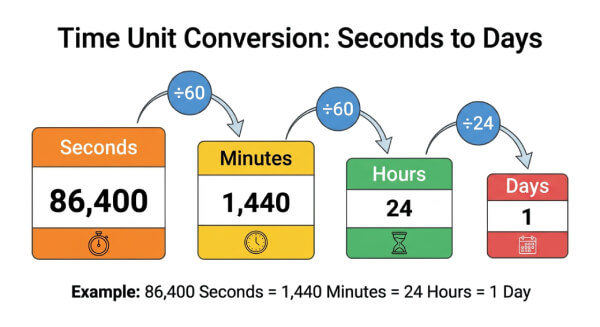
The core conversion chain, verified against BIPM definitions, is: \[1\text{ minute} = 60\text{ s}\] \[1\text{ hour} = 3{,}600\text{ s}\] \[1\text{ day} = 86{,}400\text{ s}\] \[1\text{ Julian year} = 31{,}557{,}600\text{ s}\]
For year-scale work, the distinction between calendar year (365 days), leap year (366 days), and Julian year (365.25 days average) matters. A software system configured with 365 days per year accumulates a 21,600-second (6-hour) error per leap year cycle. Over a 4-year certificate validity period, that drift can cause premature expiry warnings or missed renewal triggers. This calculator uses 365.25 days for any conversion involving years, which eliminates that class of error for most technical and scientific purposes.
Useful Tips 💡
- For fractional time inputs, use decimals rather than mixed notation: enter 1.5 hours instead of 1h 30m. The calculator handles decimal hours, minutes, and seconds correctly.
- When converting years to seconds for technical use, remember that 1 Julian year = 31,557,600 seconds. Using 365 days (31,536,000 s) instead introduces a 21,600-second error per year.
- For payroll and billing, convert total minutes to decimal hours by dividing by 60, not by rounding to the nearest quarter-hour, to avoid systematic underpayment or overpayment over time.
📋Steps to Calculate
-
Select the source unit from the first dropdown (e.g., hours, seconds, days).
-
Enter the numeric value. Use decimals for fractional units (e.g., 1.5 for one and a half hours).
-
Select the target unit from the second dropdown.
-
Read the result instantly. Very large values (e.g., years to seconds) display in scientific notation.
Mistakes to Avoid ⚠️
- Selecting the wrong conversion direction: "seconds to minutes" divides by 60; "minutes to seconds" multiplies by 60. The label order in the dropdown determines which operation runs.
- Multiplying by 60 twice to get hours from seconds instead of multiplying by 3,600 directly. Both give the same result, but chaining two rounded intermediary steps introduces avoidable rounding error.
- Using exactly 365 days per year for multi-year calculations. A 4-year period has 1,461 days (including one leap year), not 1,460. The Julian year average of 365.25 days handles this automatically.
- Entering formatted time strings like "1:30" or "2h 45m" instead of plain decimal numbers. Most calculators parse only numeric input; formatted strings return zero or an error.
Practical Applications📊
Work and payroll: Convert hours and minutes to decimal hours or total seconds for billing systems, timesheet software, and overtime calculations.
Programming and IT: Calculate TTL values, session timeouts, and token expiry periods in seconds from human-readable hour or day inputs.
Science and data logging: Convert experiment durations between seconds and hours for instrument logs, or normalize multi-year observation periods to seconds for statistical analysis.
Fitness and sports: Convert race times, interval training splits, and workout durations between seconds, minutes, and hours for performance tracking.