Acreage Calculator
Convert square feet, meters, or lot dimensions to acres. Uses official NIST surveying standards for real estate, farming, and land assessment.
Calculation steps:
Final results:
Square Feet: 0.00
Square Meters: 0.00
Acres: 0.0000
Hectares: 0.0000
Calculation Examples

How to Use the Acreage Calculator
Whether you are a real estate agent, a farmer, or a homeowner verifying a property deed, knowing the precise parcel size is essential for appraisal, zoning, and planning. The calculator accepts data in two formats:
1. Total Area: If your property deed or survey already lists a square footage or square meter figure, enter it directly.
2. Lot Dimensions: For rectangular and square plots, enter length and width in your preferred unit.
The tool applies conversion factors from the U.S. Survey system and supports both imperial and metric units, making it equally useful for domestic lot checks and international land assessments. Beyond the raw number, knowing your acreage helps with practical decisions: sizing an irrigation system, budgeting fencing, calculating crop density, or verifying that a lot meets your municipality's minimum area requirement before you make an offer. Results display in decimal acres and simplified fractions so you can communicate the figure clearly to lenders, agents, or contractors.
The Mathematics of Acreage
The acre is a unit of area in the U.S. customary and imperial systems. Historically, it approximated the area one yoke of oxen could plow in a day. Today it has a precise mathematical definition rooted in the International Yard and Pound Agreement of 1959.
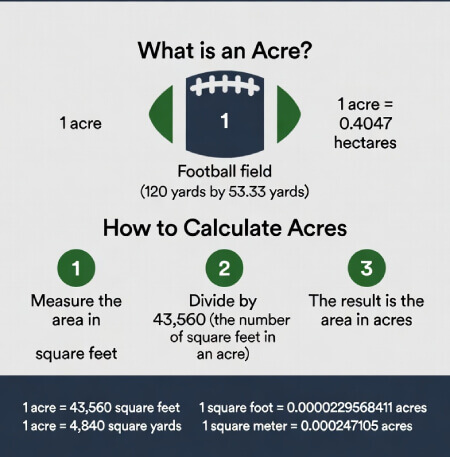
The primary conversion from square footage is:
$$\text{Acres} = \frac{\text{Total Area in Square Feet}}{43{,}560}$$
For a rectangular plot measured in feet:
$$\text{Acres} = \frac{\text{Length (ft)} \times \text{Width (ft)}}{43{,}560}$$
One acre is exactly 43,560 square feet, equivalent to a rectangle 66 feet wide by 660 feet long (one chain by one furlong). When you input metric data, the calculator first converts square meters to square feet using the NIST-defined constant \(1 \text{ m}^2 = 10.76391 \text{ sq ft}\), then applies the acre formula. This two-step approach preserves maximum precision across unit systems and matches the methodology used in professional surveying software. For large agricultural parcels, even a 0.01-acre error translates to over 400 square feet, which is why adherence to published constants matters.
Useful Tips 💡
- The football field rule: one acre is roughly 76% of an American football field including end zones (a full field is about 1.32 acres). This quick mental image helps when walking a property.
- For L-shaped or triangular lots, split the area into rectangles and triangles, calculate each separately, sum them, then divide by 43,560.
- Always confirm whether a listing states "Net Acreage" or "Gross Acreage" — gross figures include public easements, utility corridors, and road right-of-ways that you cannot build on.
📋Steps to Calculate
-
Enter the Total Area (sq ft or sq m) or the Lot Dimensions (length and width).
-
Select your Unit of Measurement: Feet, Meters, Yards, or Rods.
-
Read the Acreage Result along with the total square footage breakdown.
-
Use the Clear button to calculate additional parcels or individual sections of a larger property.
Mistakes to Avoid ⚠️
- Assuming 1 acre equals 100 x 100 feet: it does not. One acre is approximately 208.71 x 208.71 feet as a square, or any shape totaling 43,560 sq ft.
- Using slope measurements on hilly terrain: property deeds and legal descriptions always use horizontal (map) distance, not the longer ground-surface distance. Slope measurements will overstate your acreage.
- Mixing units without converting: entering length in feet and width in yards gives a result roughly 3x too small because 1 yard equals 3 feet.
- Ignoring the U.S. Survey Acre vs. International Acre distinction: they differ by about 4 square feet per acre, negligible for most residential lots but relevant for very large rural parcels.
Practical Industry Applications📊
Real estate: Cross-check the lot size in an MLS listing against the official county tax map before making an offer.
Agriculture: Calculate crop yield per acre and determine exact seed, fertilizer, or pesticide quantities for each field section.
Construction: Verify that a parcel meets the minimum lot-size and setback requirements in your local building code before submitting permit applications.
Landscaping: Estimate material quantities (sod, mulch, gravel) and grading costs for large residential or commercial estate projects.
Questions and Answers
How many square feet are in 1 acre?
How do I calculate acreage for an irregular-shaped lot?
$$\text{Triangle Area} = \frac{\text{base} \times \text{height}}{2}$$
Sum all section areas in square feet, then divide by 43,560 for the total acreage. For highly irregular or curved boundaries, a licensed topographic survey or GIS software (such as ArcGIS or QGIS) is the recommended approach. Courts and lenders generally require a professional survey for parcels where shape complexity could affect the acreage by more than 1%.
What is the difference between an acre and a hectare?
Is an acre a square or a circle?
How big is a quarter-acre in feet?
Does this calculator account for land elevation?
What is "Gross Acreage" vs "Net Acreage"?
What is the formula for converting square meters to acres?
$$\text{Acres} = \frac{\text{Area in m}^2}{4{,}046.856}$$
This constant (the number of square meters in one international acre) is derived from the NIST definition of the international yard. Our calculator applies this constant at full precision, so metric-to-acre conversions are accurate to six significant figures, suitable for professional land assessment and international real estate transactions.