Hypotenuse Calculator
Find the hypotenuse of any right triangle from two legs, one leg and an angle, or area and one leg. Uses the Pythagorean theorem and trigonometric ratios with full step-by-step solutions.
Calculation Examples

How to Find the Hypotenuse of a Right Triangle
Select the input method that matches your known values — the calculator supports three modes:
1. Two legs (a and b): The most common case. Enter both perpendicular sides and the calculator applies the Pythagorean theorem directly.
2. One leg and one acute angle: Enter one side length and either acute angle (\(\alpha\) or \(\beta\)). The calculator selects the correct sine or cosine ratio automatically based on whether the known leg is opposite or adjacent to the given angle.
3. Area and one leg: The calculator derives the second leg from \(b = 2A/a\), then applies the Pythagorean theorem.
Enter values, verify that units are consistent (do not mix inches and centimeters), and click Calculate. The result shows the hypotenuse, any missing leg, both acute angles, and the area. A classic check: legs of 3 and 4 always give a hypotenuse of exactly 5 — if your result differs, verify your inputs. These formulas apply only to right triangles (one 90° angle). For oblique triangles, the Law of Cosines is required.
Geometric Formulas and Principles
All three calculation modes derive from two foundational principles of Euclidean geometry:
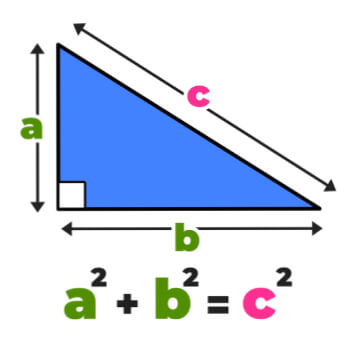
1. Pythagorean theorem (both legs known): \[c = \sqrt{a^2 + b^2}\] where \(a\) and \(b\) are the legs (the two sides that form the right angle) and \(c\) is the hypotenuse. This relationship was proven by Euclid in Elements (c. 300 BCE) and remains the standard for right-triangle geometry in engineering and construction worldwide.
2. Trigonometric ratios (one leg and one acute angle known): \[c = \frac{a}{\sin\alpha} \quad \text{(leg opposite to angle } \alpha\text{)}\] \[c = \frac{b}{\cos\alpha} \quad \text{(leg adjacent to angle } \alpha\text{)}\]
3. Area method (area and one leg known): first recover the second leg \(b = 2A/a\), then apply the Pythagorean theorem.
A key property worth remembering for common construction scenarios: in a 30-60-90 triangle, the sides follow the exact ratio \(1 : \sqrt{3} : 2\), so the hypotenuse is always twice the shortest leg. In a 45-45-90 triangle (isosceles right triangle), both legs are equal and the hypotenuse is \(a\sqrt{2}\). These special cases allow exact results without a calculator when the angle is known.
Useful Tips 💡
- The hypotenuse is always the longest side of a right triangle. If your calculated hypotenuse is shorter than either leg, a unit mismatch or incorrect field entry is the almost certain cause.
- For the 30-60-90 special triangle, the hypotenuse equals twice the shortest leg exactly. No calculator is needed if you know this ratio.
- When measuring a physical object to find its diagonal, measure the two perpendicular sides (width and height) rather than trying to measure the diagonal directly — perpendicular measurements are easier to take accurately.
📋Steps to Calculate
-
Select the input mode: two legs, one leg and one angle, or area and one leg.
-
Enter the values and confirm all inputs use the same unit (cm, m, inches, or feet).
-
Click Calculate to see the hypotenuse, missing leg, both acute angles, and the triangle area.
Mistakes to Avoid ⚠️
- Applying the Pythagorean theorem to non-right triangles: the formula c = square root of (a squared plus b squared) holds only when one angle is exactly 90 degrees. For oblique triangles, the Law of Cosines is required.
- Forgetting to take the square root: adding the squares of the legs gives c squared, not c. A common manual error is reporting the squared value — for example, writing 25 instead of 5 for legs of 3 and 4.
- Confusing opposite and adjacent sides when using trigonometric ratios: the opposite side is across from the reference angle; the adjacent side is next to it. Swapping them switches sine and cosine, giving an incorrect hypotenuse.
- Entering the hypotenuse into a leg field when working backwards: to find a missing leg from the hypotenuse and the other leg, subtract the squares, not add them.
Practical Applications in Construction and Design📊
Construction and framing: Calculate rafter lengths, stair stringer lengths, and diagonal bracing dimensions directly from rise and run measurements.
Architecture and surveying: Verify that building foundations and room corners are square using the 3-4-5 rule — a corner is exactly 90° when the diagonal across 3 and 4 unit legs measures exactly 5 units.
Display technology: Find the diagonal screen size of a monitor or TV from its width and height. A 16:9 screen with a width of 48 inches and height of 27 inches has a diagonal (hypotenuse) of exactly 55 inches.
Ladder safety: Determine the minimum ladder length to reach a given height at a safe working angle, per OSHA 29 CFR 1926.1053 guidelines requiring a 4:1 height-to-base ratio.