Average Calculator
Find the arithmetic mean of any set of numbers. Enter values separated by commas or spaces and see the sum, count, and step-by-step calculation instantly.
Enter numbers separated by commas or spaces.
Calculation Examples

How to Use the Average Calculator
Type or paste your numbers into the input field, separated by commas, spaces, or line breaks. The calculator accepts positive integers, negative values, and decimals. Click Calculate to see three results immediately: the arithmetic mean, the total sum of all values, and the count of numbers entered.
The sum and count are shown alongside the mean so you can verify the calculation yourself: divide the sum by the count and you get the mean. This transparency is useful when checking a grade average, auditing a financial data set, or teaching a student how the formula works. For grade averaging specifically, note that this tool computes an unweighted mean — all values contribute equally. If your school weights assignments differently (e.g., finals count double), you need a weighted average calculation, which multiplies each score by its weight before summing.
How to Calculate the Average: Formula and Steps
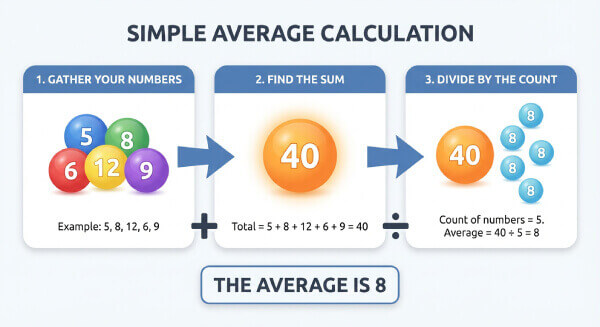
In mathematics and statistics, "average" most commonly refers to the arithmetic mean: the sum of all values divided by the count of values. The formula is: \[\bar{x} = \frac{1}{n}\sum_{i=1}^{n}x_i = \frac{x_1 + x_2 + \cdots + x_n}{n}\] where \(\bar{x}\) is the mean, \(n\) is the number of values, and \(x_i\) represents each individual value.
For example, to find the average of 4, 8, and 12: sum = \(4 + 8 + 12 = 24\), count = 3, mean = \(24 / 3 = 8\). The arithmetic mean has one important sensitivity: it responds to every value in the set, including outliers. A single extreme value pulls the mean toward it. For the set {10, 10, 10, 100}, the mean is 32.5 — which does not resemble any of the actual values. In such cases, the median (the middle value in sorted order, here 10) is a more representative measure of central tendency. The calculator computes the arithmetic mean; if your data has significant outliers, consider whether the mean is the most appropriate statistic for your purpose.
Useful Tips 💡
- Use a period (.) as the decimal separator, not a comma. If your locale uses commas for decimals, convert them before entering (e.g., write 3.14, not 3,14).
- Before using a simple arithmetic mean, check whether your data needs a weighted average instead. If a final exam is worth 40% of your grade and quizzes are worth 10% each, a simple average of all scores will give a misleading result.
- To average just two numbers quickly: add them and divide by 2. For 76 and 100: \((76 + 100) / 2 = 88\).
📋Steps to Calculate
-
Enter your numbers separated by commas, spaces, or line breaks.
-
Check that no letters, currency symbols, or extra punctuation are included.
-
Click Calculate to see the mean, total sum, and count of values.
Mistakes to Avoid ⚠️
- Including non-numeric characters (currency signs, percent symbols, letters) in the input: the parser treats them as invalid and may exclude the value or return an error, silently changing your count.
- Using a simple average for data that requires a weighted average: if a 100-point final and a 10-point quiz are averaged equally, the quiz has ten times more influence per point than it should.
- Ignoring outliers: a single extreme value can shift the mean dramatically. For the dataset of five, six, five, five, and one hundred, the mean is 24 despite four of the five values being near five. Always inspect your data visually before interpreting the mean.
- Forgetting to update the input when new data arrives: the mean of scores entered last month does not automatically include new scores. Re-enter the full updated list each time.
Practical Applications📊
Academic grade tracking: Find the unweighted average across multiple test scores, quizzes, or assignments to track progress toward a target grade.
Business and finance: Calculate average monthly revenue, average order value (AOV), average daily expenses, or average transaction size from a list of figures.
Sports statistics: Compute mean scores, race times, batting averages, or performance metrics across a season or training block.
Science and data analysis: Find the mean of repeated experimental measurements to reduce the effect of random error and obtain a best estimate of the true value.