Percentage Calculator
Solve the three core percentage problem types, finding the percent of a number, calculating percent increase or decrease, and computing percent difference, with the underlying formula shown for each result.
Calculation Examples

How to Use the Percentage Calculator
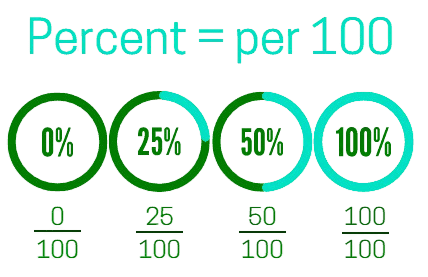
Select your problem type and enter the required values. The fundamental ratio formula underpinning all percentage calculations is: \[ \text{Percentage} = \left( \dfrac{\text{Part}}{\text{Whole}} \right) \times 100 \] The calculator applies the appropriate algebraic rearrangement depending on which quantity is unknown (part, whole, or percentage) and displays the formula used alongside the result. 
The Three Core Types of Percentage Problems
All percentage problems reduce to three mathematical structures:
1. Percent of a Number: finding a specific fraction of a value. Formula: \(\text{Part} = \text{Whole} \times \dfrac{\%}{100}\). Example: 15% of 200 equals \(200 \times 0.15 = 30\). Used for calculating sales tax, tips, discounts, and commission amounts.
2. Percent Change (Increase or Decrease): measuring the relative change between an original and a new value. Formula: \(\%\text{ Change} = \dfrac{V_{new} - V_{old}}{V_{old}} \times 100\). A positive result indicates an increase; a negative result indicates a decrease. The original value is always the denominator, a common source of error when the two values are confused. Example: price rises from $80 to $100, giving \(\dfrac{100 - 80}{80} \times 100 = 25\%\) increase.
3. Percent Difference: comparing two values where neither is designated as the "original." Formula: \(\dfrac{|V_2 - V_1|}{\frac{V_1 + V_2}{2}} \times 100\). The denominator uses the average of the two values rather than one of them specifically, making it appropriate for comparing two measurements of equivalent status. Used in scientific and statistical contexts where there is no clear "before" and "after."
Useful Tips 💡
- In percent change calculations, always use the original (starting) value as the denominator, not the new value and not the average. Dividing by the new value instead of the original is the single most common error in percent change calculations.
- Percent change and percent difference answer different questions. Use percent change when one value is clearly the starting point and the other is the result of a change. Use percent difference when comparing two peer measurements with no defined before/after relationship.
📋Steps to Calculate
-
Select the calculation type: Percent of a Number, Percent Change, or Percent Difference.
-
Enter the required values for your chosen problem type.
-
Click "Calculate" to view the result along with the formula applied.
Mistakes to Avoid ⚠️
- Confusing percent change with percent difference. If sales grew from 800 to 1,000, the percent change is 25% (using 800 as the base). The percent difference between 800 and 1,000 is 22.2% (using the average 900 as the base). The correct formula depends on whether one value is the defined starting point.
- Using the new value as the denominator in a percent change calculation. For an increase from 80 to 100, the correct base is the original value (80), giving 20/80 × 100 = 25%. Using the new value (100) as the base is a systematic error.
- Applying a percentage as a whole number rather than converting to a decimal in manual calculations. 15% of 200 requires 0.15 × 200 = 30, not 15 × 200. This calculator accepts percentages in both formats to prevent this error.
- Assuming percentage points and percentage change are equivalent. If interest rates rise from 3% to 5%, that is a 2 percentage point increase but a 66.7% percent change. These are distinct and not interchangeable concepts.
Practical Applications📊
Calculate retail discounts and sales tax: if an item is $120 with a 20% discount and 8% sales tax, use percent-of to find the discount ($24), then apply sales tax to the net price ($96 × 1.08 = $103.68). Chaining percent-of calculations is the correct approach, not applying both percentages to the original price simultaneously.
Measure salary changes and income adjustments: use percent change to verify whether a pay raise or cost-of-living adjustment outpaces inflation. If your salary increased from $65,000 to $68,000 and inflation is 4%, your percent raise is 4.6%, a real gain of 0.6 percentage points above inflation.
Compare experimental data in science and engineering: use percent difference when comparing two independently measured values (e.g., two instruments measuring the same quantity). Since neither measurement is the definitive "true" value, percent difference, which uses their average as the denominator, is the appropriate metric, not percent change.