Line Slope Calculator
Calculate the slope (gradient) of a line from any two coordinate points, with the slope type identified and the slope-intercept equation y = mx + b derived automatically.
Calculation Examples

How to Use the Slope Calculator
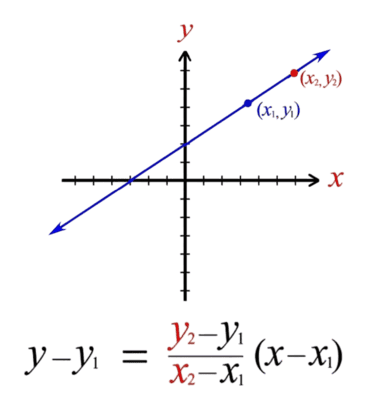
Enter the coordinates of two points: \((x_1, y_1)\) and \((x_2, y_2)\). The calculator applies the slope formula: \[ m = \dfrac{y_2 - y_1}{x_2 - x_1} = \dfrac{\Delta y}{\Delta x} \] The result displays the slope value \(m\); the slope type (positive, negative, zero, or undefined); and the slope-intercept form equation \(y = mx + b\) of the line passing through both points, with the \(y\)-intercept \(b\) calculated as \(b = y_1 - m \times x_1\).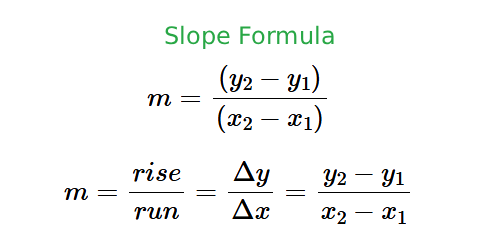
The Four Types of Slope: Positive, Negative, Zero, and Undefined
The slope \(m\) quantifies both the steepness and direction of a line on a Cartesian plane, described as "rise over run" (\(\Delta y / \Delta x\)). The four possible slope outcomes are:
1. Positive slope \((m > 0)\): The line rises from left to right. For every unit increase in \(x\), \(y\) increases by \(m\) units. Example: points (1, 2) and (3, 6) give \(m = \dfrac{6-2}{3-1} = 2\).
2. Negative slope \((m < 0)\): The line falls from left to right. Example: points (−1, 5) and (2, −1) give \(m = \dfrac{-1-5}{2-(-1)} = \dfrac{-6}{3} = -2\).
3. Zero slope \((m = 0)\): The line is perfectly horizontal (\(\Delta y = 0\)). All points share the same \(y\)-value. Example: points (2, 4) and (7, 4) give \(m = \dfrac{4-4}{7-2} = 0\).
4. Undefined slope: The line is perfectly vertical (\(\Delta x = 0\)). Division by zero is mathematically undefined. Example: points (3, 1) and (3, 5) give \(m = \dfrac{5-1}{3-3} = \dfrac{4}{0}\), which is undefined.
Useful Tips 💡
- The order of the two points does not affect the slope value: swapping (x1, y1) and (x2, y2) reverses both the numerator and denominator of the fraction, leaving the ratio unchanged. However, maintaining consistent ordering prevents accidental sign errors in manual checks.
- The slope value is constant for any two points on the same straight line. If your two points are on a line, any other pair of points on that same line will produce the identical slope. This property is the definition of linearity and can be used to verify that three given points are collinear.
📋Steps to Calculate
-
Enter the coordinates of the first point: x1 and y1.
-
Enter the coordinates of the second point: x2 and y2.
-
Click "Calculate" to view the slope value m, its type, and the line equation y = mx + b.
Mistakes to Avoid ⚠️
- Subtracting coordinates in different orders for numerator and denominator. The formula requires the same point subtracted last in both: (y2 - y1) / (x2 - x1). Using (y2 - y1) / (x1 - x2) produces the negative of the correct slope.
- Confusing zero slope with undefined slope. A horizontal line has zero slope (m = 0, because the vertical change is 0); a vertical line has undefined slope (no value exists, because the horizontal change is 0, causing division by zero). Both produce a constant output in one dimension, but they are mathematically distinct.
- Confusing slope with the angle of inclination. Slope m equals the tangent of the angle that the line makes with the positive x-axis. A slope of 1 corresponds to 45°; a slope of 2 corresponds to approximately 63.4°, not twice the angle.
- Assuming a larger slope value always means a steeper visual line. Visual steepness also depends on the scale of the axes. A slope of 10 on axes where each unit on the y-axis is compressed will appear less steep than a slope of 2 on equally-scaled axes.
Practical Applications📊
Construction and civil engineering: roof pitch is expressed as slope (rise over run), e.g., a 4:12 pitch equals \(m \approx 0.333\). Road grades are slopes expressed as percentages: a 6% grade means \(m = 0.06\), or 6 cm of vertical rise per 100 cm of horizontal distance. Minimum drainage slope for pipes is typically 1/4 inch per foot, \(m = 0.0208\).
Physics and data analysis: on a position-time graph, slope equals instantaneous velocity, \(m = \Delta x / \Delta t\). On a velocity-time graph, slope equals acceleration. In linear regression, the slope coefficient quantifies the rate of change of the dependent variable per unit change in the independent variable.
Geometry: knowing the slope of a line immediately determines the slope of any line parallel or perpendicular to it. Parallel lines share identical slopes, \(m_1 = m_2\); perpendicular lines have slopes that are negative reciprocals, \(m_1 \times m_2 = -1\), so \(m_2 = -\dfrac{1}{m_1}\).