Pythagorean Theorem Origins
Babylonians knew the 3-4-5 right triangle relation 1000 years before Pythagoras. The Greek philosopher gets credit for the general proof around 500 BC. Over 350 distinct proofs exist today, including Einstein's version as a child. Visual arrangements of squares on triangle sides demonstrate equality without algebra.
Impossible Greek Problems
Three classical construction challenges using only a compass and a straightedge puzzled mathematicians for millennia. Doubling the cube, trisecting an angle, and squaring the circle all proved impossible in the 19th century. Galois theory explained why certain angles lack constructible roots. These limits revealed boundaries in pure geometric methods.
Platonic Solids Mystery
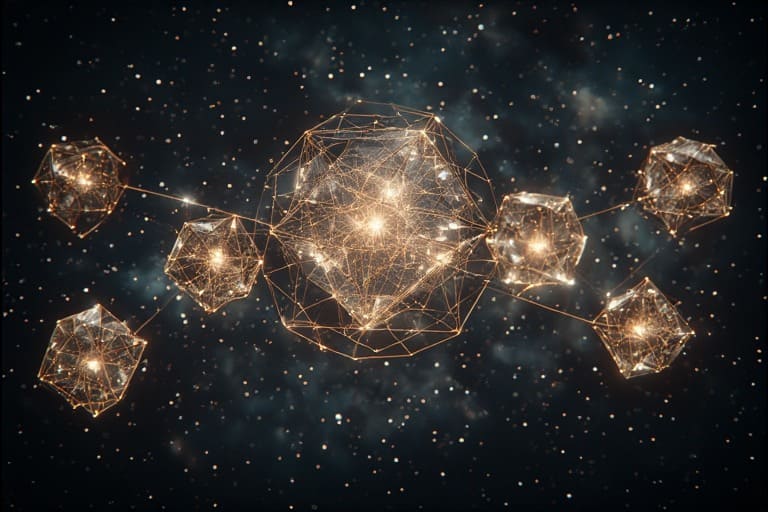
Five regular polyhedra - tetrahedron, cube, octahedron, dodecahedron, icosahedron - possess identical faces and vertices. Plato linked them to elements in Timaeus: fire, earth, air, universe, water. Euclid proved that these exhaust all possibilities in Book XIII of the Elements. Their symmetry appears in crystals and viruses today.
Golden Ratio Appearances
Dividing a line so the longer part by the shorter equals the whole to the longer part yields approximately 1.618. Pentagons and pentagrams display this ratio inherently. Parthenon dimensions incorporate it for visual harmony. Spiral arrangements in plants follow logarithmic growth tied to this proportion.
Triangles form geometry's core building blocks. Explore properties interactively with calculators covering area, angles, and types at our triangle calculator.
Here are six remarkable triangle facts:
- Equilateral triangles tile the plane perfectly without gaps - one of the few regular polygons to do so.
- Any triangle contains an angle sum of exactly 180 degrees, proven by drawing parallel lines in Euclid's proof.
- Reuleaux triangle, formed from equilateral vertices, maintains a constant width like a circle.
- Pascal's theorem states intersections of hexagon lines in conics form collinear points.
- Napoleon proved that equilateral triangles on any triangle's sides create concurrent centroids.
- Morley's theorem reveals that any triangle's interior forms an equilateral triangle from angle trisectors.
Trigonometry Evolution
Sine concepts emerged in Indian astronomy for shadow calculations. Hipparchus compiled the first trigonometric tables around 140 BC for sphere geometry. Modern functions - sine, cosine, tangent - relate triangle sides to angles. Identities like sin²θ + cos²θ = 1 connect circles to waves.
Practical trigonometry solves real problems. Tools for sine, cosine, and angle calculations appear in our trigonometry calculator.
Fractal Geometry Boundaries
Traditional geometry assumes smooth shapes, but coastlines and mountains show self-similarity at scales. Benoit Mandelbrot introduced fractals in the 1960s, with dimensions between integers. Koch snowflake starts as a triangle, adding smaller triangles infinitely, yielding a finite area but an infinite perimeter.
Euler Characteristic Magic
For polyhedra, the number of vertices minus the number of edges plus faces equals 2. This topological invariant holds for spheres but differs for tori. Descartes discovered it in 1639 correspondence. It connects local counts to global shape properties.
These seven geometry milestones reshaped understanding:
- Thales measured pyramid height using shadows around 600 BC.
- Archimedes approximated pi with inscribed polygons.
- Descartes introduced coordinates, merging algebra and geometry.
- Gauss developed curved surface intrinsic geometry.
- Lobachevsky published non-Euclidean hyperbolic geometry in 1829.
- Riemann generalized manifolds for general relativity.
- Poincaré conjectured a topology theorem proved by Perelman in 2003.
Geometry reveals order in chaos and patterns in nature. Theorems stand proven, yet new connections emerge across fields. From surveying land to modeling universes, shapes define reality at every scale.