Wet Bulb Temperature Calculator
Calculate wet-bulb temperature and psychrometric depression from air temperature and relative humidity. Uses the Stull (2011) formula, valid for -20°C to 50°C and 5–99% RH.
Calculation Examples

How to Use the Wet Bulb Temperature Calculator
Enter two inputs: the dry-bulb temperature (standard air temperature from a shaded thermometer) and the relative humidity as a percentage. Select your preferred temperature unit (Celsius or Fahrenheit — the calculator converts internally before applying the formula, which is defined in °C).
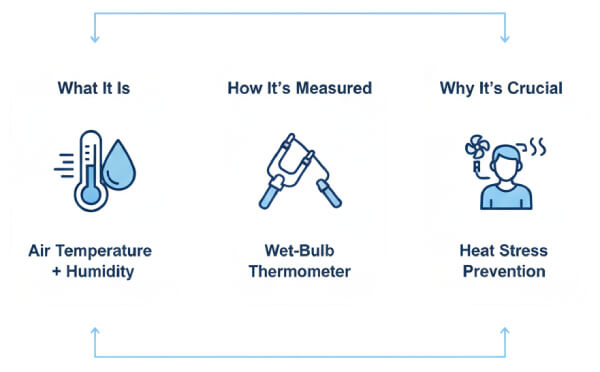
The calculator returns two values: the wet-bulb temperature (\(T_w\)) and the psychrometric depression (\(T_d - T_w\)). The depression is the gap between dry-bulb and wet-bulb temperature and serves as a direct indicator of atmospheric dryness and evaporative cooling potential. A depression of 10°C or more indicates very dry air with high cooling capacity; a depression near zero means the air is nearly saturated and evaporative cooling is ineffective. This is the condition that drives heat stress: at 100% RH, \(T_w = T_d\) and no further cooling through perspiration is possible.
The Wet-Bulb Temperature Formula
The most widely used computational method for wet-bulb temperature without a physical sling psychrometer is the Stull (2011) empirical formula, published by Professor Roland Stull of the University of British Columbia in the Journal of Applied Meteorology and Climatology: \[T_w = T \cdot \arctan(0.151977 \cdot (RH + 8.313659)^{0.5}) + \arctan(T + RH)\] \[- \arctan(RH - 1.676331) + 0.00391838 \cdot RH^{1.5} \cdot \arctan(0.023101 \cdot RH) - 4.686035\] where \(T\) is dry-bulb temperature in °C and \(RH\) is relative humidity in percent (not decimal).
The formula is valid for \(-20°C \leq T \leq 50°C\) and \(5\% \leq RH \leq 99\%\), covering virtually all inhabited terrestrial environments. Within this range, Stull reported a mean absolute error of approximately 0.28°C against direct psychrometric measurements — sufficient precision for heat stress assessment, HVAC design, and meteorological monitoring. Outside this range (for example, at very high altitudes where atmospheric pressure is significantly reduced), the formula loses accuracy because evaporative cooling rates depend on barometric pressure, which the Stull formula does not explicitly include. For those conditions, a full psychrometric calculation incorporating station pressure is recommended.
Useful Tips 💡
- When measuring dry-bulb temperature for input, shield the thermometer from direct sunlight and ensure adequate airflow around the sensor. Unshielded sensors can read 5–10°C above actual air temperature in direct sun.
- If \(RH = 100\%\), the result will equal the dry-bulb temperature exactly (\(T_w = T_d\)). This is the physical saturation point where evaporative cooling stops entirely.
- The Stull formula is calibrated for sea-level to moderate-altitude conditions. At elevations above 2,500 m, reduced barometric pressure increases evaporation rates, making the actual wet-bulb temperature slightly lower than the formula predicts.
📋Steps to Calculate
-
Enter the dry-bulb temperature (standard shaded air temperature) and select Celsius or Fahrenheit.
-
Enter the relative humidity as a whole number percentage (e.g., 65 for 65%). Do not enter a decimal.
-
Click Calculate to get the wet-bulb temperature and the psychrometric depression (\(T_d - T_w\)).
Mistakes to Avoid ⚠️
- Entering relative humidity as a decimal (0.65) instead of a percentage (65). The Stull formula requires RH in percent; entering 0.65 produces a result that is not a wet-bulb temperature.
- Confusing wet-bulb temperature with dew point: both are lower than dry-bulb temperature, but dew point is the temperature at which air becomes saturated (RH reaches 100%), while wet-bulb temperature reflects the evaporative cooling limit, which is always equal to or above the dew point.
- Using the calculator outside its validated range: inputs below -20°C or above 50°C, or RH below 5% or above 99%, produce results with increasing error. For desert conditions below 5% RH, direct psychrometric calculation is more reliable.
- Treating wet-bulb temperature as equivalent to WBGT (Wet-Bulb Globe Temperature): WBGT also incorporates radiant heat (globe temperature) and is used for occupational safety standards, while wet-bulb temperature alone is a purely atmospheric measurement.
Practical Applications of Wet-Bulb Monitoring📊
Occupational health and safety: Assess heat stress risk for outdoor workers, military personnel, and athletes using wet-bulb temperature as the primary input for WBGT calculations (ISO 7933, OSHA heat illness guidelines).
HVAC and evaporative cooling: Determine the maximum cooling achievable by evaporative (swamp) coolers and cooling towers — both are physically limited by the ambient wet-bulb temperature.
Climate risk assessment: Monitor proximity to the 35°C wet-bulb survivability threshold in heat-vulnerable regions, a metric highlighted in IPCC AR6 (2021) as a critical climate tipping point.
Agriculture and horticulture: Predict frost risk for overnight dew point conditions, optimize greenhouse ventilation, and assess snow-making viability at ski resorts.