Tension Calculator
Calculate tension force in ropes and cables for hanging loads and connected object systems.
Calculation Examples

How to Use the Tension Calculator
Start by selecting the physical scenario: Hanging Object or Pulling on a Frictionless Surface. The two modes use different physics models and input sets.
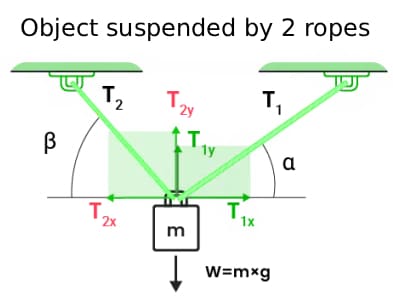
For hanging loads, choose the number of support ropes (up to 3). Enter the object's mass in kilograms and the angle for each rope. In this calculator, hanging angles are measured from the vertical: 0° means the rope hangs straight down, and larger angles represent ropes that slope away from the vertical toward the horizontal. A rope at 45° from the vertical, for instance, makes a 45° angle with a plumb line — not with the ceiling or floor.
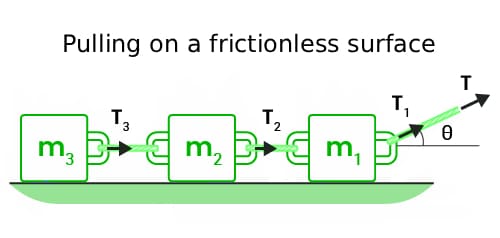
For pulling scenarios, define a chain of up to 5 connected objects. Enter the mass of each segment, the total applied force in Newtons, and the pull angle measured from the horizontal plane. Click Calculate to run the simulation. The tool applies Newton's Second Law and trigonometric decomposition to return the vertical and horizontal force components, the system acceleration, and the individual tension in each segment of the chain.
How Tension Force Is Calculated
Tension calculations rest on Newton's laws applied to systems in static equilibrium or uniform acceleration.
For a single vertical rope, tension equals the object's weight: \(T = mg\). For multiple angled ropes, each tension vector is resolved into vertical and horizontal components. Static equilibrium requires that the sum of all vertical components equals the total weight, and all horizontal components cancel to zero: \[\sum T_i \cdot \cos(\theta_i) = mg, \quad \sum T_i \cdot \sin(\theta_i) = 0\] Solving this system of equations — using substitution or matrix methods for three ropes — yields the individual tension in each support.
For pulling systems, the calculator first finds the system acceleration: \[a = \frac{F \cdot \cos(\theta)}{\sum m_i}\] Only the horizontal component of the applied force \(F \cdot \cos(\theta)\) drives acceleration on a frictionless surface. The tension in each connecting segment is then found by multiplying the cumulative mass of all objects trailing behind that segment by the acceleration: \[T_n = \left(\sum m_{trailing}\right) \cdot a\] Tension is highest at the front (closest to the applied force) and decreases toward the back of the chain.
Useful Tips 💡
- For hanging objects supported by two symmetric ropes (for example, +45° and -45° from the vertical), the horizontal components cancel exactly and each rope carries half the vertical load adjusted for the angle.
- In the pulling scenario, Object 1 is the one directly connected to the force application point — it carries the highest tension in the chain.
- The horizontal component of the pulling force \(F \cdot \cos(\theta)\) drives acceleration; a 30° pull angle reduces effective horizontal force to about 86.6% of the total applied force.
- Gravitational acceleration \(g = 9.81 \, m/s^2\) is built into the weight calculation — enter mass in kg only, not weight in Newtons.
📋Steps to Calculate
-
Choose the Hanging or Pulling scenario from the mode selector.
-
Select the number of ropes (hanging) or the number of objects in the chain (pulling).
-
Enter masses in kg and angles in degrees: from the vertical for hanging loads, from the horizontal for pulling loads.
-
Click Calculate to view total weight, system acceleration, and individual segment tensions.
Mistakes to Avoid ⚠️
- Measuring rope angles from the horizontal for hanging loads: this calculator uses angles from the vertical, so a rope that makes 60° with the ceiling should be entered as 30°.
- Entering a pulling angle of 90° or more, which would direct all force vertically and produce zero horizontal acceleration — the object would lift rather than slide.
- Assuming tension is equal throughout a chain of objects: tension decreases from the front to the back, because each successive link only needs to accelerate the remaining trailing mass.
- Forgetting that the frictionless surface assumption excludes real-world friction: if friction is present, the net horizontal force is reduced and the actual tensions will be lower than calculated.
Practical Applications📊
Verify whether a cable or rope can safely support a suspended mass at a given angle without exceeding its rated tensile strength.
Analyze force distribution in multi-object systems such as connected trailers, cargo sledges, or tow chains.
Design stable overhead suspension rigs for stage lighting, signage, or structural elements using up to three support points.
Solve academic tension problems in physics courses involving Newton's Second Law, free body diagrams, and vector equilibrium.