Velocity Calculator
Calculate average velocity, final velocity under acceleration, or velocity without time using the standard kinematic equations. Built-in unit conversion between m/s, km/h, and mph.
Calculation Examples

How to Use the Velocity Calculator
Start by identifying which variables you know — the calculator supports three modes corresponding to the three main kinematic scenarios:
1. Average velocity: Enter displacement and time elapsed. Use this when an object moves at roughly constant speed.
2. Final velocity with acceleration: Enter initial velocity, acceleration, and time. Use this for uniformly accelerating objects (falling bodies, vehicles braking, etc.).
3. Final velocity without time: Enter initial velocity, acceleration, and displacement. Use this when time is unknown.
One critical input note: velocity is a vector quantity, meaning direction matters. If an object moves in the negative direction (backward, downward against your defined positive axis), enter a negative value for displacement or acceleration. The sign in the result carries physical meaning — a negative velocity means motion in the opposite direction, not an error. Select your preferred output unit (m/s, km/h, or mph) before calculating.
Understanding the Velocity Formula
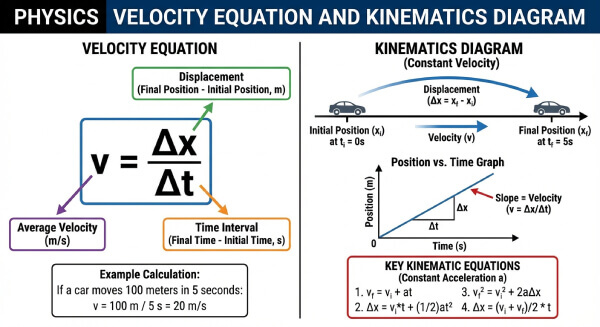
Velocity is formally defined as the rate of change of displacement with respect to time. Unlike speed, which uses total path length (a scalar), velocity uses displacement — the straight-line vector from start to end point. The fundamental velocity equation is: \[v = \frac{\Delta x}{\Delta t}\] where \(v\) is average velocity, \(\Delta x\) is displacement, and \(\Delta t\) is time elapsed. For objects under constant acceleration, classical mechanics provides two additional kinematic equations (derived by Newton and formalized in the IUPAP-endorsed framework of classical mechanics): \[v = u + at\] \[v^2 = u^2 + 2as\] where \(u\) is initial velocity, \(a\) is acceleration, \(t\) is time, and \(s\) is displacement.
A common point of confusion: average velocity is not simply the arithmetic mean of initial and final speeds unless acceleration is constant throughout. For a trip where an object accelerates non-uniformly, \(\bar{v} = \Delta x / \Delta t\) gives the true average, while \((u + v)/2\) is only valid under constant acceleration. The calculator applies the correct formula for each mode automatically.
Useful Tips 💡
- Displacement and distance are not the same. If a runner completes a full lap of a 400 m track and returns to the start, displacement is 0 m and average velocity is 0 m/s — even though speed was nonzero throughout.
- Match your units before calculating: if displacement is in kilometers and time is in hours, the result is in km/h. If you mix meters with hours, you get m/h, which is almost never what you want.
- For free-fall problems, use \(a = 9.81\) m/s² (downward, so negative if upward is your positive axis). At sea level and standard gravity, this is the NIST-recommended value.
📋Steps to Calculate
-
Select the calculation mode: average velocity, final velocity with time, or final velocity without time.
-
Enter the known values. Use negative numbers for motion in the negative direction.
-
Select your preferred output unit (m/s, km/h, or mph).
-
Click Calculate to see the result and the equation applied.
Mistakes to Avoid ⚠️
- Using the basic average velocity formula (displacement divided by time) for a uniformly accelerating object: this gives the correct average velocity but not the final velocity. Use the kinematic equation with initial velocity, acceleration, and time for the final velocity.
- Confusing displacement with distance: a round trip with equal outward and return legs has zero displacement and zero average velocity, regardless of how fast the object moved.
- Mixing unit systems within one calculation: entering displacement in meters and time in minutes gives meters per minute, not meters per second. Convert all inputs to consistent units before calculating.
- Treating average velocity as the mean of two speed values: averaging initial and final speed is only valid under constant acceleration. For variable acceleration, divide total displacement by total time.
Practical Applications of Velocity Calculations📊
Logistics and transport: Calculate average vehicle velocity over a known route distance and travel time for delivery scheduling and fuel cost estimation.
Ballistics and aerospace: Determine the final velocity of a projectile or rocket stage using initial velocity, thrust acceleration, and burn duration.
Physics education: Solve linear motion and kinematics problems from introductory and advanced mechanics courses.
Sports science: Measure an athlete's average velocity over a measured sprint distance to track performance changes across training sessions.